


Use Real Professional-Machine-Learning-Engineer Dumps - Google Correct Answers updated on 2021
Google Certification Professional-Machine-Learning-Engineer Exam Practice Dumps
NEW QUESTION 28
You have deployed multiple versions of an image classification model on Al Platform. You want to monitor the performance of the model versions overtime. How should you perform this comparison?
- A. Compare the mean average precision across the models using the Continuous Evaluation feature
- B. Compare the receiver operating characteristic (ROC) curve for each model using the What-lf Tool
- C. Compare the loss performance for each model on the validation data
- D. Compare the loss performance for each model on a held-out dataset.
Answer: C
NEW QUESTION 29
You work for an advertising company and want to understand the effectiveness of your company's latest advertising campaign. You have streamed 500 MB of campaign data into BigQuery. You want to query the table, and then manipulate the results of that query with a pandas dataframe in an Al Platform notebook. What should you do?
- A. Export your table as a CSV file from BigQuery to Google Drive, and use the Google Drive API to ingest the file into your notebook instance
- B. From a bash cell in your Al Platform notebook, use the bq extract command to export the table as a CSV file to Cloud Storage, and then use gsutii cp to copy the data into the notebook Use pandas. read_csv to ingest the file as a pandas dataframe
- C. Use Al Platform Notebooks' BigQuery cell magic to query the data, and ingest the results as a pandas dataframe
- D. Download your table from BigQuery as a local CSV file, and upload it to your Al Platform notebook instance Use pandas. read_csv to ingest the file as a pandas dataframe
Answer: A
NEW QUESTION 30
You work for a public transportation company and need to build a model to estimate delay times for multiple transportation routes. Predictions are served directly to users in an app in real time. Because different seasons and population increases impact the data relevance, you will retrain the model every month. You want to follow Google-recommended best practices. How should you configure the end-to-end architecture of the predictive model?
- A. Configure Kubeflow Pipelines to schedule your multi-step workflow from training to deploying your model.
- B. Write a Cloud Functions script that launches a training and deploying job on Ai Platform that is triggered by Cloud Scheduler
- C. Use a model trained and deployed on BigQuery ML and trigger retraining with the scheduled query feature in BigQuery
- D. Use Cloud Composer to programmatically schedule a Dataflow job that executes the workflow from training to deploying your model
Answer: C
NEW QUESTION 31
A Machine Learning Specialist is building a model that will perform time series forecasting using Amazon SageMaker. The Specialist has finished training the model and is now planning to perform load testing on the endpoint so they can configure Auto Scaling for the model variant.
Which approach will allow the Specialist to review the latency, memory utilization, and CPU utilization during the load test?
- A. Generate an Amazon CloudWatch dashboard to create a single view for the latency, memory utilization, and CPU utilization metrics that are outputted by Amazon SageMaker.
- B. Build custom Amazon CloudWatch Logs and then leverage Amazon ES and Kibana to query and visualize the log data as it is generated by Amazon SageMaker.
- C. Send Amazon CloudWatch Logs that were generated by Amazon SageMaker to Amazon ES and use Kibana to query and visualize the log data.
- D. Review SageMaker logs that have been written to Amazon S3 by leveraging Amazon Athena and Amazon QuickSight to visualize logs as they are being produced.
Answer: A
Explanation:
Explanation/Reference: https://docs.aws.amazon.com/sagemaker/latest/dg/monitoring-cloudwatch.html
NEW QUESTION 32
A data scientist has developed a machine learning translation model for English to Japanese by using Amazon SageMaker's built-in seq2seq algorithm with 500,000 aligned sentence pairs. While testing with sample sentences, the data scientist finds that the translation quality is reasonable for an example as short as five words. However, the quality becomes unacceptable if the sentence is 100 words long.
Which action will resolve the problem?
- A. Change preprocessing to use n-grams.
- B. Adjust hyperparameters related to the attention mechanism.
- C. Add more nodes to the recurrent neural network (RNN) than the largest sentence's word count.
- D. Choose a different weight initialization type.
Answer: C
NEW QUESTION 33
Your team is working on an NLP research project to predict political affiliation of authors based on articles they have written. You have a large training dataset that is structured like this: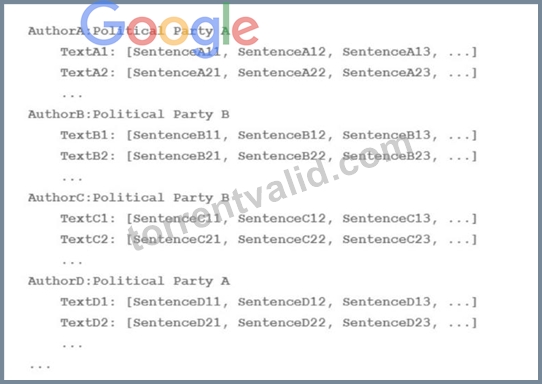
A)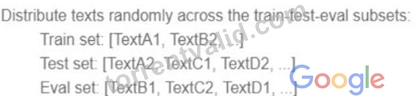
B)
C)
D)
- A. Option A
- B. Option D
- C. Option B
- D. Option C
Answer: B
NEW QUESTION 34
You are responsible for building a unified analytics environment across a variety of on-premises data marts. Your company is experiencing data quality and security challenges when integrating data across the servers, caused by the use of a wide range of disconnected tools and temporary solutions. You need a fully managed, cloud-native data integration service that will lower the total cost of work and reduce repetitive work. Some members on your team prefer a codeless interface for building Extract, Transform, Load (ETL) process. Which service should you use?
- A. Dataprep
- B. Apache Flink
- C. Dataflow
- D. Cloud Data Fusion
Answer: D
NEW QUESTION 35
You have trained a deep neural network model on Google Cloud. The model has low loss on the training data, but is performing worse on the validation dat a. You want the model to be resilient to overfitting. Which strategy should you use when retraining the model?
- A. Run a hyperparameter tuning job on Al Platform to optimize for the L2 regularization and dropout parameters
- B. Apply a dropout parameter of 0 2, and decrease the learning rate by a factor of 10
- C. Run a hyperparameter tuning job on Al Platform to optimize for the learning rate, and increase the number of neurons by a factor of 2.
- D. Apply a 12 regularization parameter of 0.4, and decrease the learning rate by a factor of 10.
Answer: B
NEW QUESTION 36
You are developing ML models with Al Platform for image segmentation on CT scans. You frequently update your model architectures based on the newest available research papers, and have to rerun training on the same dataset to benchmark their performance. You want to minimize computation costs and manual intervention while having version control for your code. What should you do?
- A. Use the gcloud command-line tool to submit training jobs on Al Platform when you update your code
- B. Use Cloud Build linked with Cloud Source Repositories to trigger retraining when new code is pushed to the repository
- C. Use Cloud Functions to identify changes to your code in Cloud Storage and trigger a retraining job
- D. Create an automated workflow in Cloud Composer that runs daily and looks for changes in code in Cloud Storage using a sensor.
Answer: A
NEW QUESTION 37
This graph shows the training and validation loss against the epochs for a neural network.
The network being trained is as follows:
* Two dense layers, one output neuron
* 100 neurons in each layer
* 100 epochs
* Random initialization of weights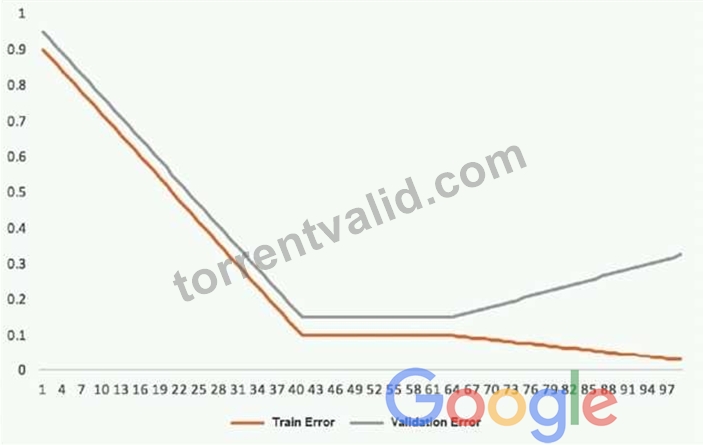
Which technique can be used to improve model performance in terms of accuracy in the validation set?
- A. Increasing the number of epochs
- B. Early stopping
- C. Adding another layer with the 100 neurons
- D. Random initialization of weights with appropriate seed
Answer: A
NEW QUESTION 38
You are building a linear regression model on BigQuery ML to predict a customer's likelihood of purchasing your company's products. Your model uses a city name variable as a key predictive component. In order to train and serve the model, your data must be organized in columns. You want to prepare your data using the least amount of coding while maintaining the predictable variables. What should you do?
- A. Use TensorFlow to create a categorical variable with a vocabulary list Create the vocabulary file, and upload it as part of your model to BigQuery ML.
- B. Use Dataprep to transform the state column using a one-hot encoding method, and make each city a column with binary values.
- C. Use Cloud Data Fusion to assign each city to a region labeled as 1, 2, 3, 4, or 5r and then use that number to represent the city in the model.
- D. Create a new view with BigQuery that does not include a column with city information
Answer: C
NEW QUESTION 39
You work for an online retail company that is creating a visual search engine. You have set up an end-to-end ML pipeline on Google Cloud to classify whether an image contains your company's product. Expecting the release of new products in the near future, you configured a retraining functionality in the pipeline so that new data can be fed into your ML models. You also want to use Al Platform's continuous evaluation service to ensure that the models have high accuracy on your test data set. What should you do?
- A. Update your test dataset with images of the newer products when your evaluation metrics drop below a pre-decided threshold.
- B. Replace your test dataset with images of the newer products when they are introduced to retraining.
- C. Keep the original test dataset unchanged even if newer products are incorporated into retraining
- D. Extend your test dataset with images of the newer products when they are introduced to retraining
Answer: B
NEW QUESTION 40
Your organization's call center has asked you to develop a model that analyzes customer sentiments in each call. The call center receives over one million calls daily, and data is stored in Cloud Storage. The data collected must not leave the region in which the call originated, and no Personally Identifiable Information (Pll) can be stored or analyzed. The data science team has a third-party tool for visualization and access which requires a SQL ANSI-2011 compliant interface. You need to select components for data processing and for analytics. How should the data pipeline be designed?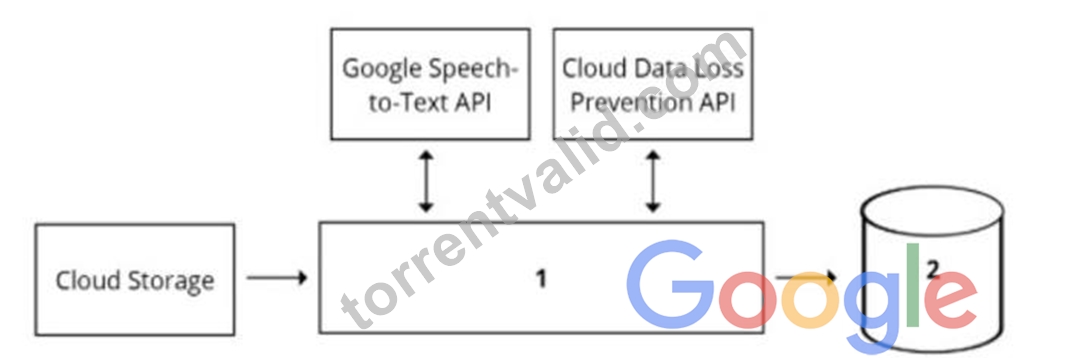
- A. 1 = Cloud Function, 2 = Cloud SQL
- B. 1 = Pub/Sub, 2 = Datastore
- C. 1 = Dataflow, 2 = BigQuery
- D. 1 = Dataflow, 2 = Cloud SQL
Answer: B
NEW QUESTION 41
A Machine Learning Specialist at a company sensitive to security is preparing a dataset for model training. The dataset is stored in Amazon S3 and contains Personally Identifiable Information (PII).
The dataset:
* Must be accessible from a VPC only.
* Must not traverse the public internet.
How can these requirements be satisfied?
- A. Create a VPC endpoint and apply a bucket access policy that restricts access to the given VPC endpoint and the VPC.
- B. Create a VPC endpoint and apply a bucket access policy that allows access from the given VPC endpoint and an Amazon EC2 instance.
- C. Create a VPC endpoint and use security groups to restrict access to the given VPC endpoint and an Amazon EC2 instance
- D. Create a VPC endpoint and use Network Access Control Lists (NACLs) to allow traffic between only the given VPC endpoint and an Amazon EC2 instance.
Answer: A
NEW QUESTION 42
Machine Learning Specialist is building a model to predict future employment rates based on a wide range of economic factors. While exploring the data, the Specialist notices that the magnitude of the input features vary greatly. The Specialist does not want variables with a larger magnitude to dominate the model.
What should the Specialist do to prepare the data for model training?
- A. Apply normalization to ensure each field will have a mean of 0 and a variance of 1 to remove any significant magnitude.
- B. Apply the Cartesian product transformation to create new combinations of fields that are independent of the magnitude.
- C. Apply quantile binning to group the data into categorical bins to keep any relationships in the data by replacing the magnitude with distribution.
- D. Apply the orthogonal sparse bigram (OSB) transformation to apply a fixed-size sliding window to generate new features of a similar magnitude.
Answer: A
Explanation:
Explanation/Reference: https://docs.aws.amazon.com/machine-learning/latest/dg/data-transformations-reference.html
NEW QUESTION 43
You are developing a Kubeflow pipeline on Google Kubernetes Engine. The first step in the pipeline is to issue a query against BigQuery. You plan to use the results of that query as the input to the next step in your pipeline. You want to achieve this in the easiest way possible. What should you do?
- A. Write a Python script that uses the BigQuery API to execute queries against BigQuery Execute this script as the first step in your Kubeflow pipeline
- B. Use the BigQuery console to execute your query and then save the query results Into a new BigQuery table.
- C. Locate the Kubeflow Pipelines repository on GitHub Find the BigQuery Query Component, copy that component's URL, and use it to load the component into your pipeline. Use the component to execute queries against BigQuery
- D. Use the Kubeflow Pipelines domain-specific language to create a custom component that uses the Python BigQuery client library to execute queries
Answer: B
NEW QUESTION 44
A data scientist needs to identify fraudulent user accounts for a company's ecommerce platform. The company wants the ability to determine if a newly created account is associated with a previously known fraudulent user.
The data scientist is using AWS Glue to cleanse the company's application logs during ingestion.
Which strategy will allow the data scientist to identify fraudulent accounts?
- A. Create a FindMatches machine learning transform in AWS Glue.
- B. Execute the built-in FindDuplicates Amazon Athena query.
- C. Create an AWS Glue crawler to infer duplicate accounts in the source data.
- D. Search for duplicate accounts in the AWS Glue Data Catalog.
Answer: A
Explanation:
Explanation/Reference: https://docs.aws.amazon.com/glue/latest/dg/machine-learning.html
NEW QUESTION 45
A Machine Learning Specialist is required to build a supervised image-recognition model to identify a cat. The ML Specialist performs some tests and records the following results for a neural network-based image classifier:
Total number of images available = 1,000
Test set images = 100 (constant test set)
The ML Specialist notices that, in over 75% of the misclassified images, the cats were held upside down by their owners.
Which techniques can be used by the ML Specialist to improve this specific test error?
- A. Increase the training data by adding variation in rotation for training images.
- B. Increase the number of epochs for model training
- C. Increase the dropout rate for the second-to-last layer.
- D. Increase the number of layers for the neural network.
Answer: B
NEW QUESTION 46
......
Get ready to pass the Professional-Machine-Learning-Engineer Exam right now using our Google Certification Exam Package: https://www.torrentvalid.com/Professional-Machine-Learning-Engineer-valid-braindumps-torrent.html
Professional-Machine-Learning-Engineer Premium Files Test pdf - Free Dumps Collection: https://drive.google.com/open?id=1CHxDDyea5y2g7bgQbTlfv_7V5XrkrSeJ