


72 Exam Questions for Professional-Machine-Learning-Engineer Updated Versions With Test Engine
Pass Professional-Machine-Learning-Engineer Exam with Updated Professional-Machine-Learning-Engineer Exam Dumps PDF 2021
How much Professional Machine Learning Engineer - Google Cost
The cost of the Professional Machine Learning Engineer - Google is $200. For more information related to exam price, please visit the official website Google Website as the cost of exams may be subjected to vary county-wise.
NEW QUESTION 33
You trained a text classification model. You have the following SignatureDefs: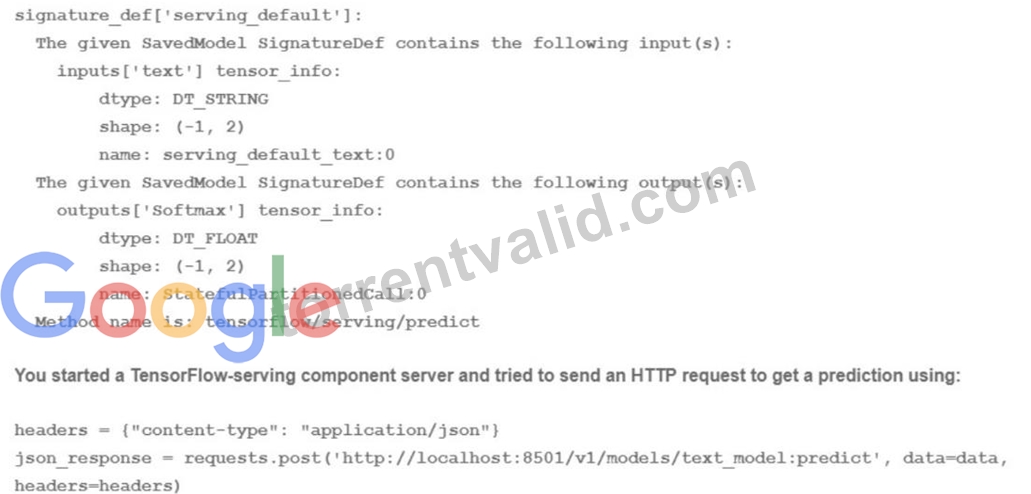
What is the correct way to write the predict request?
- A. data = json.dumps({"signature_name": "serving_default, "instances": [['a', 'b\ 'c'1, [d\ 'e\ T]]})
- B. data = json.dumps({"signature_name": "serving_default'\ "instances": [fab', 'be1, 'cd']]})
- C. data = json dumps({"signature_name": "serving_default"! "instances": [['a', 'b', "c", 'd', 'e', 'f']]})
- D. data = json dumps({"signature_name": f,serving_default", "instances": [['a', 'b'], [c\ 'd'], ['e\ T]]})
Answer: C
NEW QUESTION 34
Your organization's call center has asked you to develop a model that analyzes customer sentiments in each call. The call center receives over one million calls daily, and data is stored in Cloud Storage. The data collected must not leave the region in which the call originated, and no Personally Identifiable Information (Pll) can be stored or analyzed. The data science team has a third-party tool for visualization and access which requires a SQL ANSI-2011 compliant interface. You need to select components for data processing and for analytics. How should the data pipeline be designed?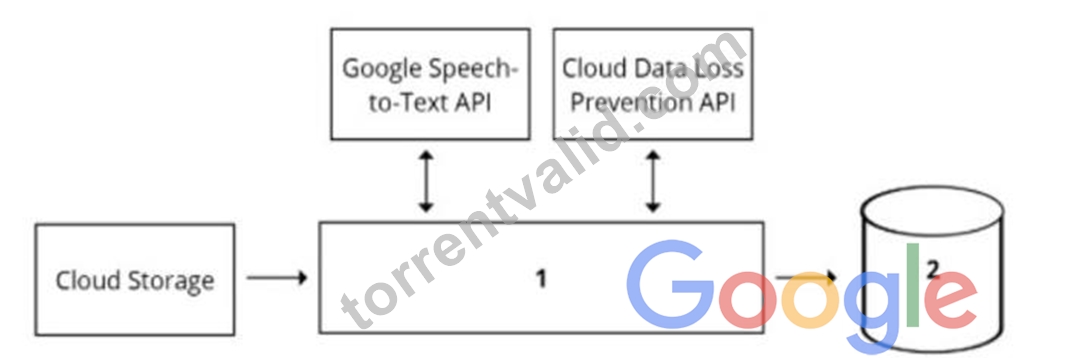
- A. 1 = Dataflow, 2 = BigQuery
- B. 1 = Cloud Function, 2 = Cloud SQL
- C. 1 = Pub/Sub, 2 = Datastore
- D. 1 = Dataflow, 2 = Cloud SQL
Answer: C
NEW QUESTION 35
A Machine Learning Specialist is required to build a supervised image-recognition model to identify a cat. The ML Specialist performs some tests and records the following results for a neural network-based image classifier:
Total number of images available = 1,000
Test set images = 100 (constant test set)
The ML Specialist notices that, in over 75% of the misclassified images, the cats were held upside down by their owners.
Which techniques can be used by the ML Specialist to improve this specific test error?
- A. Increase the dropout rate for the second-to-last layer.
- B. Increase the number of layers for the neural network.
- C. Increase the number of epochs for model training
- D. Increase the training data by adding variation in rotation for training images.
Answer: C
NEW QUESTION 36
You work on a growing team of more than 50 data scientists who all use Al Platform. You are designing a strategy to organize your jobs, models, and versions in a clean and scalable way. Which strategy should you choose?
- A. Separate each data scientist's work into a different project to ensure that the jobs, models, and versions created by each data scientist are accessible only to that user.
- B. Set up restrictive I AM permissions on the Al Platform notebooks so that only a single user or group can access a given instance.
- C. Set up a BigQuery sink for Cloud Logging logs that is appropriately filtered to capture information about Al Platform resource usage In BigQuery create a SQL view that maps users to the resources they are using.
- D. Use labels to organize resources into descriptive categories. Apply a label to each created resource so that users can filter the results by label when viewing or monitoring the resources
Answer: A
NEW QUESTION 37
You are building a linear model with over 100 input features, all with values between -1 and 1. You suspect that many features are non-informative. You want to remove the non-informative features from your model while keeping the informative ones in their original form. Which technique should you use?
- A. After building your model, use Shapley values to determine which features are the most informative.
- B. Use Principal Component Analysis to eliminate the least informative features.
- C. Use an iterative dropout technique to identify which features do not degrade the model when removed.
- D. Use L1 regularization to reduce the coefficients of uninformative features to 0.
Answer: A
NEW QUESTION 38
You work for a large technology company that wants to modernize their contact center. You have been asked to develop a solution to classify incoming calls by product so that requests can be more quickly routed to the correct support team. You have already transcribed the calls using the Speech-to-Text API. You want to minimize data preprocessing and development time. How should you build the model?
- A. Use the Al Platform Training built-in algorithms to create a custom model
- B. Build a custom model to identify the product keywords from the transcribed calls, and then run the keywords through a classification algorithm
- C. Use the Cloud Natural Language API to extract custom entities for classification
- D. Use AutoML Natural Language to extract custom entities for classification
Answer: A
NEW QUESTION 39
Your team trained and tested a DNN regression model with good results. Six months after deployment, the model is performing poorly due to a change in the distribution of the input dat a. How should you address the input differences in production?
- A. Retrain the model, and select an L2 regularization parameter with a hyperparameter tuning service
- B. Perform feature selection on the model, and retrain the model with fewer features
- C. Perform feature selection on the model, and retrain the model on a monthly basis with fewer features
- D. Create alerts to monitor for skew, and retrain the model.
Answer: A
NEW QUESTION 40
You built and manage a production system that is responsible for predicting sales numbers. Model accuracy is crucial, because the production model is required to keep up with market changes. Since being deployed to production, the model hasn't changed; however the accuracy of the model has steadily deteriorated. What issue is most likely causing the steady decline in model accuracy?
- A. Lack of model retraining
- B. Incorrect data split ratio during model training, evaluation, validation, and test
- C. Too few layers in the model for capturing information
- D. Poor data quality
Answer: B
NEW QUESTION 41
Your team has been tasked with creating an ML solution in Google Cloud to classify support requests for one of your platforms. You analyzed the requirements and decided to use TensorFlow to build the classifier so that you have full control of the model's code, serving, and deployment. You will use Kubeflow pipelines for the ML platform. To save time, you want to build on existing resources and use managed services instead of building a completely new model. How should you build the classifier?
- A. Use an established text classification model on Al Platform to perform transfer learning
- B. Use an established text classification model on Al Platform as-is to classify support requests
- C. Use the Natural Language API to classify support requests
- D. Use AutoML Natural Language to build the support requests classifier
Answer: B
NEW QUESTION 42
A company wants to predict the sale prices of houses based on available historical sales data. The target variable in the company's dataset is the sale price. The features include parameters such as the lot size, living area measurements, non-living area measurements, number of bedrooms, number of bathrooms, year built, and postal code. The company wants to use multi-variable linear regression to predict house sale prices.
Which step should a machine learning specialist take to remove features that are irrelevant for the analysis and reduce the model's complexity?
- A. Run a correlation check of all features against the target variable. Remove features with low target variable correlation scores.
- B. Plot a histogram of the features and compute their standard deviation. Remove features with high variance.
- C. Build a heatmap showing the correlation of the dataset against itself. Remove features with low mutual correlation scores.
- D. Plot a histogram of the features and compute their standard deviation. Remove features with low variance.
Answer: A
NEW QUESTION 43
You were asked to investigate failures of a production line component based on sensor readings. After receiving the dataset, you discover that less than 1% of the readings are positive examples representing failure incidents. You have tried to train several classification models, but none of them converge. How should you resolve the class imbalance problem?
- A. Downsample the data with upweighting to create a sample with 10% positive examples
- B. Remove negative examples until the numbers of positive and negative examples are equal
- C. Use the class distribution to generate 10% positive examples
- D. Use a convolutional neural network with max pooling and softmax activation
Answer: D
NEW QUESTION 44
You want to rebuild your ML pipeline for structured data on Google Cloud. You are using PySpark to conduct data transformations at scale, but your pipelines are taking over 12 hours to run. To speed up development and pipeline run time, you want to use a serverless tool and SQL syntax. You have already moved your raw data into Cloud Storage. How should you build the pipeline on Google Cloud while meeting the speed and processing requirements?
- A. Ingest your data into BigQuery using BigQuery Load, convert your PySpark commands into BigQuery SQL queries to transform the data, and then write the transformations to a new table
- B. Ingest your data into Cloud SQL convert your PySpark commands into SQL queries to transform the data, and then use federated queries from BigQuery for machine learning
- C. Convert your PySpark into SparkSQL queries to transform the data and then run your pipeline on Dataproc to write the data into BigQuery.
- D. Use Data Fusion's GUI to build the transformation pipelines, and then write the data into BigQuery
Answer: C
NEW QUESTION 45
A Machine Learning Specialist at a company sensitive to security is preparing a dataset for model training. The dataset is stored in Amazon S3 and contains Personally Identifiable Information (PII).
The dataset:
* Must be accessible from a VPC only.
* Must not traverse the public internet.
How can these requirements be satisfied?
- A. Create a VPC endpoint and apply a bucket access policy that restricts access to the given VPC endpoint and the VPC.
- B. Create a VPC endpoint and use Network Access Control Lists (NACLs) to allow traffic between only the given VPC endpoint and an Amazon EC2 instance.
- C. Create a VPC endpoint and apply a bucket access policy that allows access from the given VPC endpoint and an Amazon EC2 instance.
- D. Create a VPC endpoint and use security groups to restrict access to the given VPC endpoint and an Amazon EC2 instance
Answer: C
Explanation:
Explanation/Reference: https://docs.aws.amazon.com/AmazonS3/latest/dev/example-bucket-policies-vpc-endpoint.html
NEW QUESTION 46
You work for an online retail company that is creating a visual search engine. You have set up an end-to-end ML pipeline on Google Cloud to classify whether an image contains your company's product. Expecting the release of new products in the near future, you configured a retraining functionality in the pipeline so that new data can be fed into your ML models. You also want to use Al Platform's continuous evaluation service to ensure that the models have high accuracy on your test data set. What should you do?
- A. Extend your test dataset with images of the newer products when they are introduced to retraining
- B. Keep the original test dataset unchanged even if newer products are incorporated into retraining
- C. Update your test dataset with images of the newer products when your evaluation metrics drop below a pre-decided threshold.
- D. Replace your test dataset with images of the newer products when they are introduced to retraining.
Answer: D
NEW QUESTION 47
You work for a public transportation company and need to build a model to estimate delay times for multiple transportation routes. Predictions are served directly to users in an app in real time. Because different seasons and population increases impact the data relevance, you will retrain the model every month. You want to follow Google-recommended best practices. How should you configure the end-to-end architecture of the predictive model?
- A. Configure Kubeflow Pipelines to schedule your multi-step workflow from training to deploying your model.
- B. Write a Cloud Functions script that launches a training and deploying job on Ai Platform that is triggered by Cloud Scheduler
- C. Use Cloud Composer to programmatically schedule a Dataflow job that executes the workflow from training to deploying your model
- D. Use a model trained and deployed on BigQuery ML and trigger retraining with the scheduled query feature in BigQuery
Answer: D
NEW QUESTION 48
A Machine Learning Specialist is developing a custom video recommendation model for an application. The dataset used to train this model is very large with millions of data points and is hosted in an Amazon S3 bucket.
The Specialist wants to avoid loading all of this data onto an Amazon SageMaker notebook instance because it would take hours to move and will exceed the attached 5 GB Amazon EBS volume on the notebook instance.
Which approach allows the Specialist to use all the data to train the model?
- A. Launch an Amazon EC2 instance with an AWS Deep Learning AMI and attach the S3 bucket to the instance. Train on a small amount of the data to verify the training code and hyperparameters. Go back to Amazon SageMaker and train using the full dataset
- B. Load a smaller subset of the data into the SageMaker notebook and train locally. Confirm that the training code is executing and the model parameters seem reasonable. Initiate a SageMaker training job using the full dataset from the S3 bucket using Pipe input mode.
- C. Use AWS Glue to train a model using a small subset of the data to confirm that the data will be compatible with Amazon SageMaker. Initiate a SageMaker training job using the full dataset from the S3 bucket using Pipe input mode.
- D. Load a smaller subset of the data into the SageMaker notebook and train locally. Confirm that the training code is executing and the model parameters seem reasonable. Launch an Amazon EC2 instance with an AWS Deep Learning AMI and attach the S3 bucket to train the full dataset.
Answer: B
NEW QUESTION 49
A manufacturing company has a large set of labeled historical sales data. The manufacturer would like to predict how many units of a particular part should be produced each quarter.
Which machine learning approach should be used to solve this problem?
- A. Random Cut Forest (RCF)
- B. Logistic regression
- C. Principal component analysis (PCA)
- D. Linear regression
Answer: A
NEW QUESTION 50
An interactive online dictionary wants to add a widget that displays words used in similar contexts. A Machine Learning Specialist is asked to provide word features for the downstream nearest neighbor model powering the widget.
What should the Specialist do to meet these requirements?
- A. Produce a set of synonyms for every word using Amazon Mechanical Turk.
- B. Create one-hot word encoding vectors.
- C. Create word embedding vectors that store edit distance with every other word.
- D. Download word embeddings pre-trained on a large corpus.
Answer: B
Explanation:
Explanation/Reference: https://aws.amazon.com/blogs/machine-learning/amazon-sagemaker-object2vec-adds-new- features-that-support-automatic-negative-sampling-and-speed-up-training/
NEW QUESTION 51
A company ingests machine learning (ML) data from web advertising clicks into an Amazon S3 data lake. Click data is added to an Amazon Kinesis data stream by using the Kinesis Producer Library (KPL). The data is loaded into the S3 data lake from the data stream by using an Amazon Kinesis Data Firehose delivery stream.
As the data volume increases, an ML specialist notices that the rate of data ingested into Amazon S3 is relatively constant. There also is an increasing backlog of data for Kinesis Data Streams and Kinesis Data Firehose to ingest.
Which next step is MOST likely to improve the data ingestion rate into Amazon S3?
- A. Decrease the retention period for the data stream.
- B. Add more consumers using the Kinesis Client Library (KCL).
- C. Increase the number of shards for the data stream.
- D. Increase the number of S3 prefixes for the delivery stream to write to.
Answer: C
Explanation:
Explanation/Reference:
NEW QUESTION 52
A machine learning (ML) specialist wants to secure calls to the Amazon SageMaker Service API. The specialist has configured Amazon VPC with a VPC interface endpoint for the Amazon SageMaker Service API and is attempting to secure traffic from specific sets of instances and IAM users. The VPC is configured with a single public subnet.
Which combination of steps should the ML specialist take to secure the traffic? (Choose two.)
- A. Add a VPC endpoint policy to allow access to the IAM users.
- B. Modify the security group on the endpoint network interface to restrict access to the instances.
- C. Modify the users' IAM policy to allow access to Amazon SageMaker Service API calls only.
- D. Modify the ACL on the endpoint network interface to restrict access to the instances.
- E. Add a SageMaker Runtime VPC endpoint interface to the VPC.
Answer: A,B
Explanation:
Explanation/Reference: https://aws.amazon.com/blogs/machine-learning/private-package-installation-in-amazon- sagemaker-running-in-internet-free-mode/
NEW QUESTION 53
......
Professional-Machine-Learning-Engineer Exam Dumps - Free Demo & 365 Day Updates: https://www.torrentvalid.com/Professional-Machine-Learning-Engineer-valid-braindumps-torrent.html
Free Sales Ending Soon - Use Real Professional-Machine-Learning-Engineer PDF Questions: https://drive.google.com/open?id=1CHxDDyea5y2g7bgQbTlfv_7V5XrkrSeJ