


[May-2025] Dumps Practice Exam Questions Study Guide for the DP-100 Exam
DP-100 Dumps with Practice Exam Questions Answers
NEW QUESTION # 198
You have a binary classifier that predicts positive cases of diabetes within two separate age groups.
The classifier exhibits a high degree of disparity between the age groups.
You need to modify the output of the classifier to maximize its degree of fairness across the age groups and meet the following requirements:
* Eliminate the need to retrain the model on which the classifier is based.
* Minimize the disparity between true positive rates and false positive rates across age groups.
Which algorithm and panty constraint should you use? To answer, select the appropriate options in the answer are a. NOTE: Each correct selection is worth one point.
Answer:
Explanation:
NEW QUESTION # 199
You are using Azure Machine Learning to train machine learning models. You need a compute target on which to remotely run the training script. You run the following Python code:

Answer:
Explanation:
NEW QUESTION # 200
You run an experiment that uses an AutoMLConfig class to define an automated machine learning task with a maximum of ten model training iterations. The task will attempt to find the best performing model based on a metric named accuracy.
You submit the experiment with the following code:
You need to create Python code that returns the best model that is generated by the automated machine learning task. Which code segment should you use?
A)
B)
C)
D)
- A. Option B
- B. Option A
- C. Option C
- D. Option D
Answer: B
NEW QUESTION # 201
You are creating a machine learning model.
You need to identify outliers data.
Which two visualizations can you use? Each correct answer presents a complete solution.
NOTE: Each correct selection is worth one point.
- A. ROC curve
- B. random forest diagram
- C. box plot
- D. scatter
- E. Venn diagram
Answer: C,D
NEW QUESTION # 202
You need to identify the methods for dividing the data according, to the testing requirements.
Which properties should you select? To answer, select the appropriate option-, m the answer area. NOTE:
Each correct selection is worth one point.
Answer:
Explanation:
NEW QUESTION # 203
Note: This question is part of a series of questions that present the same scenario. Each question in the series contains a unique solution that might meet the stated goals. Some question sets might have more than one correct solution, while others might not have a correct solution.
After you answer a question in this section, you will NOT be able to return to it. As a result, these questions will not appear in the review screen.
You create an Azure Machine Learning service datastore in a workspace. The datastore contains the following files:
* /data/2018/Q1 .csv
* /data/2018/Q2.csv
* /data/2018/Q3.csv
* /data/2018/Q4.csv
* /data/2019/Q1.csv
All files store data in the following format:
id,f1,f2,l
1,1,2,0
2,1,1,1
3.2.1.0
You run the following code:
You need to create a dataset named training_data and load the data from all files into a single data frame by using the following code:
Solution: Run the following code:
Does the solution meet the goal?
- A. Yes
- B. No
Answer: A
Explanation:
Use two file paths.
Use Dataset.Tabular_from_delimeted as the data isn't cleansed.
Note:
A TabularDataset represents data in a tabular format by parsing the provided file or list of files. This provides you with the ability to materialize the data into a pandas or Spark DataFrame so you can work with familiar data preparation and training libraries without having to leave your notebook. You can create a TabularDataset object from .csv, .tsv, .parquet, .jsonl files, and from SQL query results.
Reference:
https://docs.microsoft.com/en-us/azure/machine-learning/how-to-create-register-datasets
NEW QUESTION # 204
Your team is building a data engineering and data science development environment.
The environment must support the following requirements:
support Python and Scala
compose data storage, movement, and processing services into automated data pipelines the same tool should be used for the orchestration of both data engineering and data science support workload isolation and interactive workloads enable scaling across a cluster of machines You need to create the environment.
What should you do?
- A. Build the environment in Azure Databricks and use Azure Data Factory for orchestration.
- B. Build the environment in Apache Hive for HDInsight and use Azure Data Factory for orchestration.
- C. Build the environment in Apache Spark for HDInsight and use Azure Container Instances for orchestration.
- D. Build the environment in Azure Databricks and use Azure Container Instances for orchestration.
Answer: A
Explanation:
Explanation
In Azure Databricks, we can create two different types of clusters.
Standard, these are the default clusters and can be used with Python, R, Scala and SQL High-concurrency Azure Databricks is fully integrated with Azure Data Factory.
Topic 1, Case Study 2
Case study
Overview
You are a data scientist for Fabrikam Residences, a company specializing in quality private and commercial property in the United States. Fabrikam Residences is considering expanding into Europe and has asked you to investigate prices for private residences in major European cities. You use Azure Machine Learning Studio to measure the median value of properties. You produce a regression model to predict property prices by using the Linear Regression and Bayesian Linear Regression modules.
Datasets
There are two datasets in CSV format that contain property details for two cities, London and Paris, with the following columns: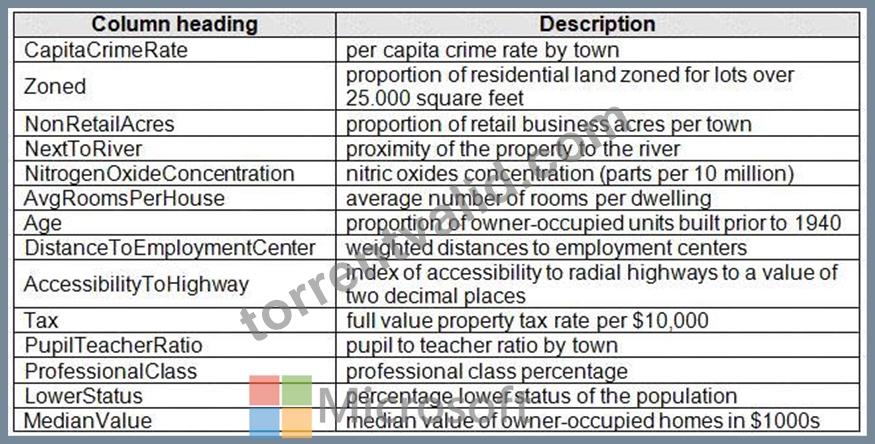
The two datasets have been added to Azure Machine Learning Studio as separate datasets and included as the starting point of the experiment.
Dataset issues
The AccessibilityToHighway column in both datasets contains missing values. The missing data must be replaced with new data so that it is modeled conditionally using the other variables in the data before filling in the missing values.
Columns in each dataset contain missing and null values. The dataset also contains many outliers. The Age column has a high proportion of outliers. You need to remove the rows that have outliers in the Age column.
The MedianValue and AvgRoomsinHouse columns both hold data in numeric format. You need to select a feature selection algorithm to analyze the relationship between the two columns in more detail.
Model fit
The model shows signs of overfitting. You need to produce a more refined regression model that reduces the overfitting.
Experiment requirements
You must set up the experiment to cross-validate the Linear Regression and Bayesian Linear Regression modules to evaluate performance.
In each case, the predictor of the dataset is the column named MedianValue. An initial investigation showed that the datasets are identical in structure apart from the MedianValue column. The smaller Paris dataset contains the MedianValue in text format, whereas the larger London dataset contains the MedianValue in numerical format. You must ensure that the datatype of the MedianValue column of the Paris dataset matches the structure of the London dataset.
You must prioritize the columns of data for predicting the outcome. You must use non-parameters statistics to measure the relationships.
You must use a feature selection algorithm to analyze the relationship between the MedianValue and AvgRoomsinHouse columns.
Model training
Given a trained model and a test dataset, you need to compute the permutation feature importance scores of feature variables. You need to set up the Permutation Feature Importance module to select the correct metric to investigate the model's accuracy and replicate the findings.
You want to configure hyperparameters in the model learning process to speed the learning phase by using hyperparameters. In addition, this configuration should cancel the lowest performing runs at each evaluation interval, thereby directing effort and resources towards models that are more likely to be successful.
You are concerned that the model might not efficiently use compute resources in hyperparameter tuning. You also are concerned that the model might prevent an increase in the overall tuning time. Therefore, you need to implement an early stopping criterion on models that provides savings without terminating promising jobs.
Testing
You must produce multiple partitions of a dataset based on sampling using the Partition and Sample module in Azure Machine Learning Studio. You must create three equal partitions for cross-validation. You must also configure the cross-validation process so that the rows in the test and training datasets are divided evenly by properties that are near each city's main river. The data that identifies that a property is near a river is held in the column named NextToRiver. You want to complete this task before the data goes through the sampling process.
When you train a Linear Regression module using a property dataset that shows data for property prices for a large city, you need to determine the best features to use in a model. You can choose standard metrics provided to measure performance before and after the feature importance process completes. You must ensure that the distribution of the features across multiple training models is consistent.
Data visualization
You need to provide the test results to the Fabrikam Residences team. You create data visualizations to aid in presenting the results.
You must produce a Receiver Operating Characteristic (ROC) curve to conduct a diagnostic test evaluation of the model. You need to select appropriate methods for producing the ROC curve in Azure Machine Learning Studio to compare the Two-Class Decision Forest and the Two-Class Decision Jungle modules with one another.
NEW QUESTION # 205
You create a multi-class image classification deep learning model.
The model must be retrained monthly with the new image data fetched from a public web portal. You create an Azure Machine Learning pipeline to fetch new data, standardize the size of images, and retrain the model.
You need to use the Azure Machine Learning SDK to configure the schedule for the pipeline.
Which four actions should you perform in sequence? To answer, move the appropriate actions from the list of actions to the answer area and arrange them in the correct order.
Answer:
Explanation:
1 - Publish the pipeline.
2 - Retrieve the pipeline ID.
3 - Create a ScheduleRecurrence..
4 - Define an Azure Machine Learning pipeline schedule..
Reference:
https://docs.microsoft.com/en-us/azure/machine-learning/how-to-schedule-pipelines
NEW QUESTION # 206
You are using a decision tree algorithm. You have trained a model that generalizes well at a tree depth equal to 10.
You need to select the bias and variance properties of the model with varying tree depth values.
Which properties should you select for each tree depth? To answer, select the appropriate options in the answer area.
Answer:
Explanation:
Explanation:
In decision trees, the depth of the tree determines the variance. A complicated decision tree (e.g. deep) has low bias and high variance.
Note: In statistics and machine learning, the bias-variance tradeoff is the property of a set of predictive models whereby models with a lower bias in parameter estimation have a higher variance of the parameter estimates across samples, and vice versa. Increasing the bias will decrease the variance. Increasing the variance will decrease the bias.
References:
https://machinelearningmastery.com/gentle-introduction-to-the-bias-variance-trade-off-in-machine-learning/
NEW QUESTION # 207
You create an Azure Machine Learning workspace.
You must implement dedicated compute for model training in the workspace by using Azure Synapse compute resources. The solution must attach the dedicated compute and start an Azure Synapse session.
You need to implement the compute resources.
Which three actions should you perform in sequence? To answer, move the appropriate actions from the list of actions to the answer area and arrange them in the correct order.
Answer:
Explanation:
Explanation:
NEW QUESTION # 208
You are retrieving data from a large datastore by using Azure Machine Learning Studio.
You must create a subset of the data for testing purposes using a random sampling seed based on the system clock.
You add the Partition and Sample module to your experiment.
You need to select the properties for the module.
Which values should you select? To answer, select the appropriate options in the answer area.
NOTE: Each correct selection is worth one point.
Answer:
Explanation:
Reference:
https://docs.microsoft.com/en-us/azure/machine-learning/studio-module-reference/partition-and-sample
NEW QUESTION # 209
You have a multi-class image classification deep learning model that uses a set of labeled photographs. You create the following code to select hyperparameter values when training the model.
For each of the following statements, select Yes if the statement is true. Otherwise, select No.
NOTE: Each correct selection is worth one point.
Answer:
Explanation:
Explanation:
Box 1: Yes
Hyperparameters are adjustable parameters you choose to train a model that govern the training process itself. Azure Machine Learning allows you to automate hyperparameter exploration in an efficient manner, saving you significant time and resources. You specify the range of hyperparameter values and a maximum number of training runs. The system then automatically launches multiple simultaneous runs with different parameter configurations and finds the configuration that results in the best performance, measured by the metric you choose. Poorly performing training runs are automatically early terminated, reducing wastage of compute resources. These resources are instead used to explore other hyperparameter configurations.
Box 2: Yes
uniform(low, high) - Returns a value uniformly distributed between low and high Box 3: No Bayesian sampling does not currently support any early termination policy.
Reference:
https://docs.microsoft.com/en-us/azure/machine-learning/how-to-tune-hyperparameters
NEW QUESTION # 210
You are performing sentiment analysis using a CSV file that includes 12,000 customer reviews written in a short sentence format. You add the CSV file to Azure Machine Learning Studio and configure it as the starting point dataset of an experiment. You add the Extract N-Gram Features from Text module to the experiment to extract key phrases from the customer review column in the dataset.
You must create a new n-gram dictionary from the customer review text and set the maximum n-gram size to trigrams.
What should you select? To answer, select the appropriate options in the answer area.
NOTE: Each correct selection is worth one point.
Answer:
Explanation:
Explanation

Vocabulary mode: Create
For Vocabulary mode, select Create to indicate that you are creating a new list of n-gram features.
N-Grams size: 3
For N-Grams size, type a number that indicates the maximum size of the n-grams to extract and store. For example, if you type 3, unigrams, bigrams, and trigrams will be created.
Weighting function: Leave blank
The option, Weighting function, is required only if you merge or update vocabularies. It specifies how terms in the two vocabularies and their scores should be weighted against each other.
References:
https://docs.microsoft.com/en-us/azure/machine-learning/studio-module-reference/extract-n-gram-features-from-
NEW QUESTION # 211
You need to modify the inputs for the global penalty event model to address the bias and variance issue.
Which three actions should you perform in sequence? To answer, move the appropriate actions from the list of actions to the answer area and arrange them in the correct order.
Answer:
Explanation:
NEW QUESTION # 212
You need to use the Python language to build a sampling strategy for the global penalty detection models.
How should you complete the code segment? To answer, select the appropriate options in the answer area.
NOTE: Each correct selection is worth one point.
Answer:
Explanation:
Reference:
https://github.com/pytorch/pytorch/blob/master/torch/utils/data/distributed.py
NEW QUESTION # 213
You need to implement a scaling strategy for the local penalty detection data.
Which normalization type should you use?
- A. Weight
- B. Cosine
- C. Streaming
- D. Batch
Answer: D
Explanation:
Explanation/Reference:
Explanation:
Post batch normalization statistics (PBN) is the Microsoft Cognitive Toolkit (CNTK) version of how to evaluate the population mean and variance of Batch Normalization which could be used in inference Original Paper.
In CNTK, custom networks are defined using the BrainScriptNetworkBuilder and described in the CNTK network description language "BrainScript." Scenario:
Local penalty detection models must be written by using BrainScript.
References:
https://docs.microsoft.com/en-us/cognitive-toolkit/post-batch-normalization-statistics Testlet 2 Case study Overview You are a data scientist for Fabrikam Residences, a company specializing in quality private and commercial property in the United States. Fabrikam Residences is considering expanding into Europe and has asked you to investigate prices for private residences in major European cities. You use Azure Machine Learning Studio to measure the median value of properties. You produce a regression model to predict property prices by using the Linear Regression and Bayesian Linear Regression modules.
Datasets
There are two datasets in CSV format that contain property details for two cities, London and Paris, with the following columns:
The two datasets have been added to Azure Machine Learning Studio as separate datasets and included as the starting point of the experiment.
Dataset issues
The AccessibilityToHighway column in both datasets contains missing values. The missing data must be replaced with new data so that it is modeled conditionally using the other variables in the data before filling in the missing values.
Columns in each dataset contain missing and null values. The dataset also contains many outliers. The Age column has a high proportion of outliers. You need to remove the rows that have outliers in the Age column. The MedianValue and AvgRoomsinHouse columns both hold data in numeric format. You need to select a feature selection algorithm to analyze the relationship between the two columns in more detail.
Model fit
The model shows signs of overfitting. You need to produce a more refined regression model that reduces the overfitting.
Experiment requirements
You must set up the experiment to cross-validate the Linear Regression and Bayesian Linear Regression modules to evaluate performance.
In each case, the predictor of the dataset is the column named MedianValue. An initial investigation showed that the datasets are identical in structure apart from the MedianValue column. The smaller Paris dataset contains the MedianValue in text format, whereas the larger London dataset contains the MedianValue in numerical format. You must ensure that the datatype of the MedianValue column of the Paris dataset matches the structure of the London dataset.
You must prioritize the columns of data for predicting the outcome. You must use non-parameters statistics to measure the relationships.
You must use a feature selection algorithm to analyze the relationship between the MedianValue and AvgRoomsinHouse columns.
Model training
Given a trained model and a test dataset, you need to compute the permutation feature importance scores of feature variables. You need to set up the Permutation Feature Importance module to select the correct metric to investigate the model's accuracy and replicate the findings.
You want to configure hyperparameters in the model learning process to speed the learning phase by using hyperparameters. In addition, this configuration should cancel the lowest performing runs at each evaluation interval, thereby directing effort and resources towards models that are more likely to be successful.
You are concerned that the model might not efficiently use compute resources in hyperparameter tuning.
You also are concerned that the model might prevent an increase in the overall tuning time. Therefore, you need to implement an early stopping criterion on models that provides savings without terminating promising jobs.
Testing
You must produce multiple partitions of a dataset based on sampling using the Partition and Sample module in Azure Machine Learning Studio. You must create three equal partitions for cross-validation. You must also configure the cross-validation process so that the rows in the test and training datasets are divided evenly by properties that are near each city's main river. The data that identifies that a property is near a river is held in the column named NextToRiver. You want to complete this task before the data goes through the sampling process.
When you train a Linear Regression module using a property dataset that shows data for property prices for a large city, you need to determine the best features to use in a model. You can choose standard metrics provided to measure performance before and after the feature importance process completes. You must ensure that the distribution of the features across multiple training models is consistent.
Data visualization
You need to provide the test results to the Fabrikam Residences team. You create data visualizations to aid in presenting the results.
You must produce a Receiver Operating Characteristic (ROC) curve to conduct a diagnostic test evaluation of the model. You need to select appropriate methods for producing the ROC curve in Azure Machine Learning Studio to compare the Two-Class Decision Forest and the Two-Class Decision Jungle modules with one another.
Question Set 3
NEW QUESTION # 214
You have a multi-class image classification deep learning model that uses a set of labeled photographs. You create the following code to select hyperparameter values when training the model.
For each of the following statements, select Yes if the statement is true. Otherwise, select No.
NOTE: Each correct selection is worth one point.
Answer:
Explanation:
Reference:
https://docs.microsoft.com/en-us/azure/machine-learning/how-to-tune-hyperparameters
NEW QUESTION # 215
You collect data from a nearby weather station. You have a pandas dataframe named weather_df that includes the following data:
The data is collected every 12 hours: noon and midnight.
You plan to use automated machine learning to create a time-series model that predicts temperature over the next seven days. For the initial round of training, you want to train a maximum of 50 different models.
You must use the Azure Machine Learning SDK to run an automated machine learning experiment to train these models.
You need to configure the automated machine learning run.
How should you complete the AutoMLConfig definition? To answer, select the appropriate options in the answer area.
NOTE: Each correct selection is worth one point.

Answer:
Explanation:
Explanation:
Box 1: forcasting
Task: The type of task to run. Values can be 'classification', 'regression', or 'forecasting' depending on the type of automated ML problem to solve.
Box 2: temperature
The training data to be used within the experiment. It should contain both training features and a label column (optionally a sample weights column).
Box 3: observation_time
time_column_name: The name of the time column. This parameter is required when forecasting to specify the datetime column in the input data used for building the time series and inferring its frequency. This setting is being deprecated. Please use forecasting_parameters instead.
Box 4: 7
"predicts temperature over the next seven days"
max_horizon: The desired maximum forecast horizon in units of time-series frequency. The default value is 1.
Units are based on the time interval of your training data, e.g., monthly, weekly that the forecaster should predict out. When task type is forecasting, this parameter is required.
Box 5: 50
"For the initial round of training, you want to train a maximum of 50 different models." Iterations: The total number of different algorithm and parameter combinations to test during an automated ML experiment.
Reference:
https://docs.microsoft.com/en-us/python/api/azureml-train-automl-client/azureml.train.automl.automlconfig.automlconfig
NEW QUESTION # 216 
For each of the following statements, select Yes if the statement is true. Otherwise, select No. NOTE: Each correct selection is worth one point.
Answer:
Explanation:
NEW QUESTION # 217
You plan to use automated machine learning to train a regression model. You have data that has features which have missing values, and categorical features with few distinct values.
You need to configure automated machine learning to automatically impute missing values and encode categorical features as part of the training task.
Which parameter and value pair should you use in the AutoMLConfig class?
- A. featurization = 'auto'
- B. enable_tf = True
- C. enable_voting_ensemble = True
- D. exclude_nan_labels = True
- E. task = 'classification'
Answer: A
Explanation:
Featurization str or FeaturizationConfig
Values: 'auto' / 'off' / FeaturizationConfig
Indicator for whether featurization step should be done automatically or not, or whether customized featurization should be used.
Column type is automatically detected. Based on the detected column type preprocessing/featurization is done as follows:
Categorical: Target encoding, one hot encoding, drop high cardinality categories, impute missing values.
Numeric: Impute missing values, cluster distance, weight of evidence.
DateTime: Several features such as day, seconds, minutes, hours etc.
Text: Bag of words, pre-trained Word embedding, text target encoding.
Reference:
https://docs.microsoft.com/en-us/python/api/azureml-train-automl-client/ azureml.train.automl.automlconfig.automlconfig Develop models Testlet 1 Case study Overview You are a data scientist in a company that provides data science for professional sporting events. Models will use global and local market data to meet the following business goals:
* Understand sentiment of mobile device users at sporting events based on audio from crowd reactions.
* Assess a user's tendency to respond to an advertisement.
* Customize styles of ads served on mobile devices.
* Use video to detect penalty events
Current environment
* Media used for penalty event detection will be provided by consumer devices. Media may include images and videos captured during the sporting event and shared using social media. The images and videos will have varying sizes and formats.
* The data available for model building comprises of seven years of sporting event media. The sporting event media includes; recorded video transcripts or radio commentary, and logs from related social media feeds captured during the sporting events.
* Crowd sentiment will include audio recordings submitted by event attendees in both mono and stereo formats.
Penalty detection and sentiment
* Data scientists must build an intelligent solution by using multiple machine learning models for penalty event detection.
* Data scientists must build notebooks in a local environment using automatic feature engineering and model building in machine learning pipelines.
* Notebooks must be deployed to retrain by using Spark instances with dynamic worker allocation.
* Notebooks must execute with the same code on new Spark instances to recode only the source of the data.
* Global penalty detection models must be trained by using dynamic runtime graph computation during training.
* Local penalty detection models must be written by using BrainScript.
* Experiments for local crowd sentiment models must combine local penalty detection data.
* Crowd sentiment models must identify known sounds such as cheers and known catch phrases. Individual crowd sentiment models will detect similar sounds.
* All shared features for local models are continuous variables.
* Shared features must use double precision. Subsequent layers must have aggregate running mean and standard deviation metrics available.
Advertisements
During the initial weeks in production, the following was observed:
* Ad response rated declined.
* Drops were not consistent across ad styles.
* The distribution of features across training and production data are not consistent Analysis shows that, of the 100 numeric features on user location and behavior, the 47 features that come from location sources are being used as raw features. A suggested experiment to remedy the bias and variance issue is to engineer 10 linearly uncorrelated features.
* Initial data discovery shows a wide range of densities of target states in training data used for crowd sentiment models.
* All penalty detection models show inference phases using a Stochastic Gradient Descent (SGD) are running too slow.
* Audio samples show that the length of a catch phrase varies between 25%-47% depending on region
* The performance of the global penalty detection models shows lower variance but higher bias when comparing training and validation sets. Before implementing any feature changes, you must confirm the bias and variance using all training and validation cases.
* Ad response models must be trained at the beginning of each event and applied during the sporting event.
* Market segmentation models must optimize for similar ad response history.
* Sampling must guarantee mutual and collective exclusively between local and global segmentation models that share the same features.
* Local market segmentation models will be applied before determining a user's propensity to respond to an advertisement.
* Ad response models must support non-linear boundaries of features.
* The ad propensity model uses a cut threshold is 0.45 and retrains occur if weighted Kappa deviated from
0.1 +/- 5%.
* The ad propensity model uses cost factors shown in the following diagram: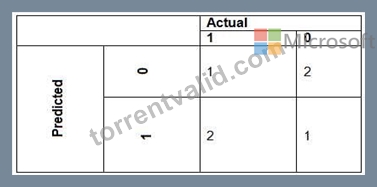
* The ad propensity model uses proposed cost factors shown in the following diagram:
* Performance curves of current and proposed cost factor scenarios are shown in the following diagram:
NEW QUESTION # 218
space and set up a development environment. You plan to train a deep neural network (DNN) by using the Tensorflow framework and by using estimators to submit training scripts.
You must optimize computation speed for training runs.
You need to choose the appropriate estimator to use as well as the appropriate training compute target configuration.
Which values should you use? To answer, select the appropriate options in the answer area.
NOTE: Each correct selection is worth one point.
Answer:
Explanation:
Explanation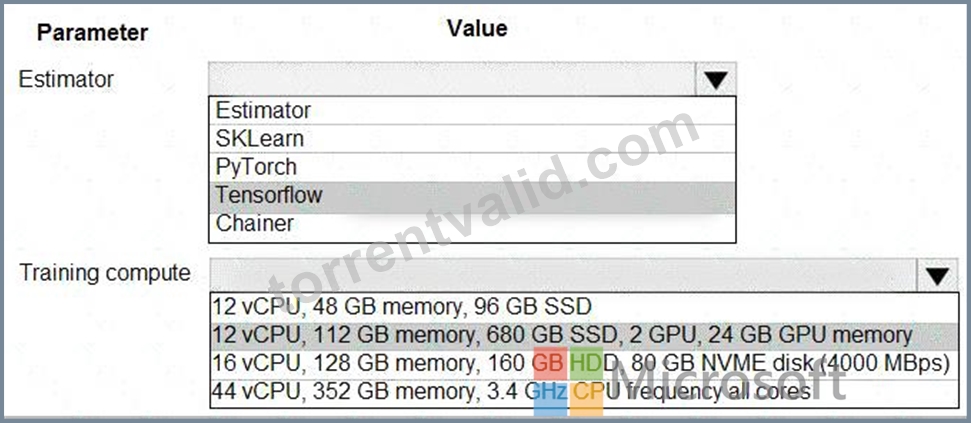
Box 1: Tensorflow
TensorFlow represents an estimator for training in TensorFlow experiments.
Box 2: 12 vCPU, 112 GB memory..,2 GPU,..
Use GPUs for the deep neural network.
Reference:
https://docs.microsoft.com/en-us/python/api/azureml-train-core/azureml.train.dnn
NEW QUESTION # 219
You are using hyperparameter tuning in Azure Machine Learning Python SDK v2 to train a model. You configure the hyperparameter tuning experiment by running the following code:
For each of the following statements select Yes if the statement is true. Otherwise, select No. NOTE: Fach correct selection is worth one paint.
Answer:
Explanation:
NEW QUESTION # 220 
You need to record the row count as a metric named row_count that can be returned using the get_metrics method of the Run object after the experiment run completes. Which code should you use?
- A. run.log_table('row_count', rows)
- B. run.log_row('row_count', rows)
- C. run.log('row_count', rows)
- D. run.tag('row_count', rows)
- E. run.upload_file('row_count', './data.csv')
Answer: C
Explanation:
Explanation
Log a numerical or string value to the run with the given name using log(name, value, description=''). Logging a metric to a run causes that metric to be stored in the run record in the experiment. You can log the same metric multiple times within a run, the result being considered a vector of that metric.
Example: run.log("accuracy", 0.95)
Reference:
https://docs.microsoft.com/en-us/python/api/azureml-core/azureml.core.run
NEW QUESTION # 221
You plan to implement an Azure Machine Learning solution. You have the following requirements:
* Run a Jupyter notebook to interactively tram a machine learning model.
* Deploy assets and workflows for machine learning proof of concept by using scripting rather than custom programming.
You need to select a development technique for each requirement
Which development technique should you use? To answer, select the appropriate options in the answer area.
NOTE: Each correct selection is worth one point.
Answer:
Explanation:
NEW QUESTION # 222
Note: This question is part of a series of questions that present the same scenario. Each question in the series contains a unique solution that might meet the stated goals. Some question sets might have more than one correct solution, while others might not have a correct solution.
After you answer a question in this section, you will NOT be able to return to it. As a result, these questions will not appear in the review screen.
An IT department creates the following Azure resource groups and resources:
The IT department creates an Azure Kubernetes Service (AKS)-based inference compute target named aks-cluster in the Azure Machine Learning workspace. You have a Microsoft Surface Book computer with a GPU. Python 3.6 and Visual Studio Code are installed.
You need to run a script that trains a deep neural network (DNN) model and logs the loss and accuracy metrics.
Solution: Install the Azure ML SDK on the Surface Book. Run Python code to connect to the workspace. Run the training script as an experiment on the aks-cluster compute target.
Does the solution meet the goal?
- A. Yes
- B. No
Answer: B
Explanation:
Explanation
Need to attach the mlvm virtual machine as a compute target in the Azure Machine Learning workspace.
Reference:
https://docs.microsoft.com/en-us/azure/machine-learning/concept-compute-target
NEW QUESTION # 223
......
Free Microsoft Azure DP-100 Exam Question: https://www.torrentvalid.com/DP-100-valid-braindumps-torrent.html
DP-100 by Microsoft Azure Actual Free Exam Practice Test: https://drive.google.com/open?id=1Sdo8XvcoZnBFtA1F488GX8biZ3ZR3LgK