


Free DP-100 Exam Study Guide for the NEW [Nov-2023] Dumps Test Engine
DP-100 PDF Dumps Extremely Quick Way Of Preparation
Microsoft DP-100 certification exam is a valuable credential for data scientists and machine learning engineers who want to demonstrate their proficiency in designing and implementing data science solutions on Azure. DP-100 exam covers a wide range of topics related to data science and machine learning and requires candidates to have a deep understanding of Azure data services. To prepare for the exam, candidates can take advantage of various resources provided by Microsoft, including online training courses, study guides, and practice exams.
Microsoft DP-100 certification exam is an excellent opportunity for data scientists to validate their skills in designing and implementing data science solutions on Azure. Designing and Implementing a Data Science Solution on Azure certification demonstrates your proficiency in Azure tools and services, which are in high demand in the industry. It is a valuable asset to have on your resume and can help you advance your career in the field of data science.
NEW QUESTION # 44
You are authoring a notebook in Azure Machine Learning studio.
You must install packages from the notebook into the currently running kernel. The installation must be limited to the currently running kernel only.
You need to install the packages.
Which magic function should you use?
- A. !pjp
- B. !conda
- C. %pip
- D. %load
Answer: C
NEW QUESTION # 45
You use the Azure Machine Learning service to create a tabular dataset named training.data. You plan to use this dataset in a training script.
You create a variable that references the dataset using the following code:
training_ds = workspace.datasets.get("training_data")
You define an estimator to run the script.
You need to set the correct property of the estimator to ensure that your script can access the training.data dataset Which property should you set?
A)
B)
C)
D)
- A. Option A
- B. Option D
- C. Option B
- D. Option C
Answer: A
Explanation:
Example:
# Get the training dataset
diabetes_ds = ws.datasets.get("Diabetes Dataset")
# Create an estimator that uses the remote compute
hyper_estimator = SKLearn(source_directory=experiment_folder,
inputs=[diabetes_ds.as_named_input('diabetes')], # Pass the dataset as an input compute_target = cpu_cluster, conda_packages=['pandas','ipykernel','matplotlib'], pip_packages=['azureml-sdk','argparse','pyarrow'], entry_script='diabetes_training.py') Reference:
https://notebooks.azure.com/GraemeMalcolm/projects/azureml-primers/html/04%20-%20Optimizing%20Model%20Training.ipynb
NEW QUESTION # 46
You use the Two-Class Neural Network module in Azure Machine Learning Studio to build a binary classification model. You use the Tune Model Hyperparameters module to tune accuracy for the model.
You need to select the hyperparameters that should be tuned using the Tune Model Hyperparameters module.
Which two hyperparameters should you use? Each correct answer presents part of the solution.
NOTE: Each correct selection is worth one point.
- A. Hidden layer specification
- B. Number of hidden nodes
- C. Number of learning iterations
- D. The type of the normalizer
- E. Learning Rate
Answer: A,C
Explanation:
Explanation
D: For Number of learning iterations, specify the maximum number of times the algorithm should process the training cases.
E: For Hidden layer specification, select the type of network architecture to create.
Between the input and output layers you can insert multiple hidden layers. Most predictive tasks can be accomplished easily with only one or a few hidden layers.
References:
https://docs.microsoft.com/en-us/azure/machine-learning/studio-module-reference/two-class-neural-network
NEW QUESTION # 47
You create a multi-class image classification deep learning model.
You train the model by using PyTorch version 1.2.
You need to ensure that the correct version of PyTorch can be identified for the inferencing environment when the model is deployed.
What should you do?
- A. Save the model locally as a.pt file, and deploy the model as a local web service.
- B. Deploy the model on computer that is configured to use the default Azure Machine Learning conda environment.
- C. Register the model with a .pt file extension and the default version property.
- D. Register the model, specifying the model_framework and model_framework_version properties.
Answer: D
Explanation:
Explanation
framework_version: The PyTorch version to be used for executing training code.
Reference:
https://docs.microsoft.com/en-us/python/api/azureml-train-core/azureml.train.dnn.pytorch?view=azure-ml-py
NEW QUESTION # 48
You are using the Azure Machine Learning Service to automate hyper par a meter exploration of your neural network classification model.
You must define the hyper parameter space to automatically tune hyper parameters using random sampling according to following requirements:
* Learning rate must be selected from a normal distribution with a mean value of 10 and a standard deviation of 3.
* Batch size must be 16, 32 and 64.
* Keep probability must be a value selected from a uniform distribution between the range of 0.05 and 0.1.
You need to use the par am .sampling method of the Python API for the Azure Machine Learning Service.
How should you complete the code segment? To answer, select the appropriate Options in the answer area.
NOTE: Each correct selection is worth one point.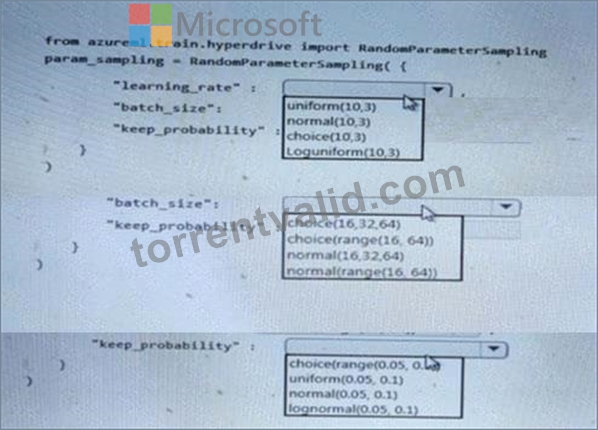
Answer:
Explanation:
NEW QUESTION # 49
You need to identify the methods for dividing the data according to the testing requirements.
Which properties should you select? To answer, select the appropriate options in the answer area.
NOTE: Each correct selection is worth one point.
Answer:
Explanation:
Reference:
https://docs.microsoft.com/en-us/azure/machine-learning/algorithm-module-reference/partition-and-sample
NEW QUESTION # 50
You plan to use Hyperdrive to optimize the hyperparameters selected when training a model. You create the following code to define options for the hyperparameter experiment

For each of the following statements, select Yes if the statement is true. Otherwise, select No. NOTE: Each correct selection is worth one point.
Answer:
Explanation:
Reference:
https://docs.microsoft.com/en-us/python/api/azureml-train-core/azureml.train.hyperdrive.hyperdriveconfig
https://docs.microsoft.com/en-us/azure/machine-learning/how-to-tune-hyperparameters
NEW QUESTION # 51
You use Azure Machine Learning Studio to build a machine learning experiment.
You need to divide data into two distinct datasets.
Which module should you use?
- A. Partition and Sample
- B. Assign Data to Clusters
- C. Test Hypothesis Using t-Test
- D. Group Data into Bins
Answer: A
Explanation:
Partition and Sample with the Stratified split option outputs multiple datasets, partitioned using the rules you specified.
Reference:
https://docs.microsoft.com/en-us/azure/machine-learning/studio-module-reference/partition-and-sample
NEW QUESTION # 52
You are developing a machine learning, experiment by using Azure.
The following images show the input and output of a machine learning experiment:
Use the drop-down menus to select the answer choice that answers each question based on the information presented in the graphic.
NOTE: Each correct selection is worth one point.
Answer:
Explanation:
NEW QUESTION # 53
You are implementing a machine learning model to predict stock prices.
The model uses a PostgreSQL database and requires GPU processing.
You need to create a virtual machine that is pre-configured with the required tools.
What should you do?
- A. Create a Deep Learning Virtual Machine (DLVM) Windows edition.
- B. Create a Deep Learning Virtual Machine (DLVM) Linux edition.
- C. Create a Geo Al Data Science Virtual Machine (Geo-DSVM) Windows edition.
- D. Create a Data Science Virtual Machine (DSVM) Linux edition.
- E. Create a Data Science Virtual Machine (DSVM) Windows edition.
Answer: D
Explanation:
Incorrect Answers:
A, C: PostgreSQL (CentOS) is only available in the Linux Edition.
B: The Azure Geo AI Data Science VM (Geo-DSVM) delivers geospatial analytics capabilities from Microsoft's Data Science VM. Specifically, this VM extends the AI and data science toolkits in the Data Science VM by adding ESRI's market-leading ArcGIS Pro Geographic Information System.
D: DLVM is a template on top of DSVM image. In terms of the packages, GPU drivers etc are all there in the DSVM image. Mostly it is for convenience during creation where we only allow DLVM to be created on GPU VM instances on Azure.
References:
https://docs.microsoft.com/en-us/azure/machine-learning/data-science-virtual-machine/overview
NEW QUESTION # 54
You need to build a feature extraction strategy for the local models.
How should you complete the code segment? To answer, select the appropriate options in the answer area.
NOTE: Each correct selection is worth one point.
Answer:
Explanation:
NEW QUESTION # 55
You are performing clustering by using the K-means algorithm.
You need to define the possible termination conditions.
Which three conditions can you use? Each correct answer presents a complete solution.
NOTE: Each correct selection is worth one point.
- A. The residual sum of squares (RSS) rises above a threshold.
- B. The residual sum of squares (RSS) falls below a threshold.
- C. Centroids do not change between iterations.
- D. The sum of distances between centroids reaches a maximum.
- E. A fixed number of iterations is executed.
Answer: B,C,E
Explanation:
Explanation
References:
https://docs.microsoft.com/en-us/azure/machine-learning/studio-module-reference/k-means-clustering
https://nlp.stanford.edu/IR-book/html/htmledition/k-means-1.html
NEW QUESTION # 56
You plan to explore demographic data for home ownership in various cities. The data is in a CSV file with the following format:
age,city,income,home_owner
21,Chicago,50000,0
35,Seattle,120000,1
23,Seattle,65000,0
45,Seattle,130000,1
18,Chicago,48000,0
You need to run an experiment in your Azure Machine Learning workspace to explore the data and log the results. The experiment must log the following information:
the number of observations in the dataset
a box plot of income by home_owner
a dictionary containing the city names and the average income for each city You need to use the appropriate logging methods of the experiment's run object to log the required information.
How should you complete the code? To answer, drag the appropriate code segments to the correct locations. Each code segment may be used once, more than once, or not at all. You may need to drag the split bar between panes or scroll to view content.
NOTE: Each correct selection is worth one point.
Answer:
Explanation:
NEW QUESTION # 57
You create an Azure Machine Learning compute target named ComputeOne by using the STANDARD_D1 virtual machine image.
You define a Python variable named was that references the Azure Machine Learning workspace. You run the following Python code:
For each of the following statements, select Yes if the statement is true. Otherwise, select No.
NOTE: Each correct selection is worth one point.
Answer:
Explanation:
Reference:
https://docs.microsoft.com/en-us/python/api/azureml-core/azureml.core.compute.computetarget
NEW QUESTION # 58
You create a workspace to include a compute instance by using Azure Machine Learning Studio. You are developing a Python SDK v2 notebook in the workspace. You need to use Intellisense in the notebook. What should you do?
- A. Run a !pip magic function on the compute instance.
- B. Start the compute instance.
- C. Run a %pip magic function on the compute instance.
- D. Stop the compute instance.
Answer: C
NEW QUESTION # 59
You are using C-Support Vector classification to do a multi-class classification with an unbalanced training dataset. The C-Support Vector classification using Python code shown below:
You need to evaluate the C-Support Vector classification code.
Which evaluation statement should you use? To answer, select the appropriate options in the answer area.
NOTE: Each correct selection is worth one point.
Answer:
Explanation: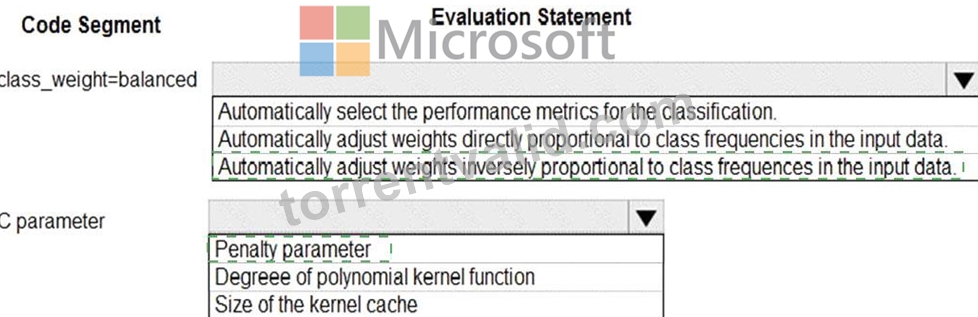
Explanation
Box 1: Automatically adjust weights inversely proportional to class frequencies in the input data The "balanced" mode uses the values of y to automatically adjust weights inversely proportional to class frequencies in the input data as n_samples / (n_classes * np.bincount(y)).
Box 2: Penalty parameter
Parameter: C : float, optional (default=1.0)
Penalty parameter C of the error term.
References:
https://scikit-learn.org/stable/modules/generated/sklearn.svm.SVC.html
NEW QUESTION # 60
You are performing a classification task in Azure Machine learning Studio.
You must prepare balanced testing and training samples based on a provided data set.
Warning samples based on a provided data set.
You need to split the data with a 0.75:0.25.
Which value should you use for each parameter? To answer, select the appropriate options m the answer area.
NOTE: Each correct selection is worth one point.
Answer:
Explanation:
NEW QUESTION # 61
You create a multi-class image classification deep learning model.
The model must be retrained monthly with the new image data fetched from a public web portal. You create an Azure Machine Learning pipeline to fetch new data, standardize the size of images, and retrain the model.
You need to use the Azure Machine Learning SDK to configure the schedule for the pipeline.
Which four actions should you perform in sequence? To answer, move the appropriate actions from the list of actions to the answer area and arrange them in the correct order.
Answer:
Explanation:
1 - Publish the pipeline.
2 - Retrieve the pipeline ID.
3 - Create a ScheduleRecurrence..
4 - Define an Azure Machine Learning pipeline schedule..
Reference:
https://docs.microsoft.com/en-us/azure/machine-learning/how-to-schedule-pipelines
NEW QUESTION # 62
You deploy a model in Azure Container Instance.
You must use the Azure Machine Learning SDK to call the model API.
You need to invoke the deployed model using native SDK classes and methods.
How should you complete the command? To answer, select the appropriate options in the answer areas.
NOTE: Each correct selection is worth one point.
Answer:
Explanation: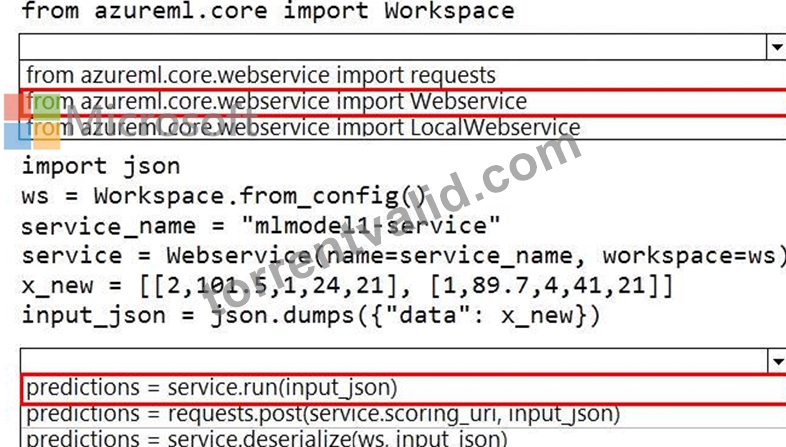
Explanation:
Box 1: from azureml.core.webservice import Webservice
The following code shows how to use the SDK to update the model, environment, and entry script for a web service to Azure Container Instances:
from azureml.core import Environment
from azureml.core.webservice import Webservice
from azureml.core.model import Model, InferenceConfig
Box 2: predictions = service.run(input_json)
Example: The following code demonstrates sending data to the service:
import json
test_sample = json.dumps({'data': [
[1, 2, 3, 4, 5, 6, 7, 8, 9, 10],
[10, 9, 8, 7, 6, 5, 4, 3, 2, 1]
]})
test_sample = bytes(test_sample, encoding='utf8')
prediction = service.run(input_data=test_sample)
print(prediction)
Reference:
https://docs.microsoft.com/bs-latn-ba/azure/machine-learning/how-to-deploy-azure-container-instance
https://docs.microsoft.com/en-us/azure/machine-learning/how-to-troubleshoot-deployment
NEW QUESTION # 63
......
The DP-100 certification exam is an essential tool for professionals who want to demonstrate their expertise in designing and implementing data science solutions on Azure. Designing and Implementing a Data Science Solution on Azure certification exam is ideal for data scientists, software developers, and IT professionals who want to improve their knowledge and skills in Azure data science solutions. DP-100 exam is also suitable for professionals who want to advance their careers in data science.
Enhance your career with DP-100 PDF Dumps - True Microsoft Exam Questions: https://www.torrentvalid.com/DP-100-valid-braindumps-torrent.html
Download DP-100 Dumps (2023) - Free PDF Exam Demo: https://drive.google.com/open?id=1Sdo8XvcoZnBFtA1F488GX8biZ3ZR3LgK