


(PDF) ISO 9001 ISO-9001-Lead-Auditor Exam and Certification Test Engine
Use ISO-9001-Lead-Auditor Exam Dumps (2025 PDF Dumps) To Have Reliable ISO-9001-Lead-Auditor Test Engine
NEW QUESTION # 58
You are the supervisor in Production of a medium size manufacturing organisation. You are qualified as an internal auditor. The Quality Manager asks you to lead the next internal audit of Production and Logistics Dispatch. The audit team includes two other internal auditors.
Answer:
Explanation:
Explanation:
Here is the correct matching of actions to the statements in the context of leading the internal audit:
* If practicablecarry out a formal opening meeting
* You should notaudit production (as you are a supervisor in that area, and this would compromise audit objectivity)
* You need notchange the audit team (unless there is a specific reason, such as conflict of interest)
* You mustraise audit findings if necessary (this is a key responsibility of an auditor when nonconformities are found)
* You must notsend the audit report to the Quality Manager (the audit report must be reviewed first; it is typically part of the internal audit process to go through necessary channels before final submission)
* You shouldsend the audit report to the Quality Manager (after appropriate reviews and approvals) This reflects key principles of conducting an internal audit according to ISO 9001:2015, ensuring objectivity, proper documentation, and clear reporting procedures.
NEW QUESTION # 59
You work for an organisation, 'ABC', which provides packaged food to the public. You are asked to lead a team (you as the leader and two other auditors) to audit an external provider, 'XYZ', which provides packaging materials to your organisation. It is 4 pm, and the audit is dlose to an end; you are having an internal meeting with the team to decide what will be presented to the auditee during the Closing meeting. The Closing meeting was scheduled for 5 pm.
'XYZ' has two manufacturing lines: M1 is a clean room for primary packaging materials (i.e. will be in direct contact with the food), and M2 is for secondary materials (i.e. will not be in direct contact with food).
Auditor 1 audited the two manufacturing lines.
You: "What findings would you report?"
Auditor 1: "I have one issue. Earlier today in the morning I saw some secondary material stocked in the clean room. I would propose raising a nonconformity." You: "How would you write the nonconformity?" Auditor 1: "In the clean room, there was a pallet with secondary materials." What additional information would you add to this text to complete the nonconformity report? Select six.
- A. The signature of the clean room's supervisor accepting the nonconformity
- B. Evidence that the secondary material was approved ready to be used
- C. Batch number of the secondary material
- D. Description of any primary material close to this pallet
- E. Description of the ISO 9001:2015 requirement not being complied with and the clause number
- F. The date on which the evidence was identified
- G. More information in the place within the clean room where secondary material was found
- H. The type of nonconformity (major or minor)
- I. Description of the secondary material
- J. Name of the forklift driver that was moving the pallet
Answer: C,D,E,F,H,I
NEW QUESTION # 60
According to ISO 9000, what is quality?
- A. A set of conditions under which work is performed
- B. The ability of an object to realize an output that will fulfill the requirements for that output
- C. The efficiency with which resources are utilized in achieving objectives
- D. The degree to which a set of inherent characteristics of an object fulfills requirements
Answer: D
Explanation:
Comprehensive and Detailed In-Depth Explanation:
ISO 9000:2015 defines quality as "the degree to which a set of inherent characteristics of an object fulfills requirements."
* Clause 3.6.2 (Quality) confirms this definition.
* Quality is determined by how well an object (product, service, or process) meets defined requirements (customer, regulatory, or internal).
The other options do not align with the official ISO definition:
* Option A refers to performance capability but does not define quality.
* Option C describes work conditions, not quality.
* Option D focuses on efficiency rather than fulfilling requirements.
Reference:
ISO 9000:2015, Clause 3.6.2 - Quality
NEW QUESTION # 61
Scenario 4:
TD Advertising is a print management company based in Chicago. The company offers design services, digital printing, storage, and distribution. As TD expanded, its management recognized that success depended on adopting new technologies and improving quality.
To ensure customer satisfaction and quality improvement, the company decided to pursue ISO 9001 certification.
After implementing the QMS, TD hired a well-known certification body for an audit. Anne Key was appointed as the audit team leader. She received a document listing the audit team members, audit scope, criteria, duration, and audit engagement limits.
Anne reviewed the document and approved the audit mandate. The certification body and TD's top management signed the certification agreement.
Before contacting TD, Anne reviewed the audit scope and noticed that TD made changes to it due to the adoption of new printing equipment. However, Anne disagreed with the changes, stating they would affect the audit timeline. She considered withdrawing from the audit.
Based on scenario 4, conducting which of the activities below is NOT the responsibility of Anne?
- A. Signing the certification agreement.
- B. Assigning responsibilities for the audit team members.
- C. Determining the audit feasibility.
- D. Establishing audit criteria and objectives.
Answer: A
Explanation:
Comprehensive and Detailed In-Depth Explanation:
ISO 9001:2015 requires specific roles and responsibilities for audit leaders and certification bodies.
Clause References:
* ISO 19011:2018, Clause 5.5 - Conducting the Audit: Defines audit team leader responsibilities.
* ISO/IEC 17021-1:2015, Clause 9.1.2 - Audit Planning: Defines certification body responsibilities, including the certification agreement.
Why is the Correct Answer D?
* The certification agreement is signed between the certification body and the auditee (TD Advertising).
* Anne (audit team leader) does NOT have authority to sign the agreement-that is the responsibility of the certification body's management.
Why are the Other Options Incorrect?
* A (Establishing audit criteria and objectives) # Correct responsibility of the audit leader as per ISO 19011.
* B (Determining audit feasibility) # Audit leaders assess feasibility but do not sign agreements.
* C (Assigning responsibilities for the audit team) # This is part of the audit leader's role in planning audits.
NEW QUESTION # 62
Scenario 6: Davis Clinic (DC) is an American medical center focused on integrated health care. Since its establishment DC was committed to providing qualitative services for its clients, which is the reason why the company decided to implement a quality management system (QMS) based on ISO 9001. After a year of having an active QMS in place, DC applied for a certification audit.
A team of five auditors, from a well-known certification body, was selected to conduct the audit. Eva was appointed as the audit team leader. After three days of auditing, the team gathered to review and examine their findings. They also discussed the audit findings with DC's top management and then drafted the audit conclusions.
In the closing meeting, which was held between the audit team and the top management of DC. Eva presented two nonconformities that were detected during the audit. Eva stated that the company did not retain documented information regarding its outsourced services for an analysis laboratory and regarding the conducted management reviews. During the closing meeting, the audit team required from DCs top management to come up with corrective action plans within two weeks. Although the top management did not agree with the audit findings, the audit team insisted that the auditee must submit corrective actions within the given time frame in order for the audit activities to continue.
Once the action plans were evaluated, the audit team began preparing the audit report. Eva required from the team to provide accurate descriptions of the audit findings and the audit conclusions. The report was then distributed to all the interested parties involved in the audit, including the certification body Based on the report, the certification body together with Eva, as the audit team leader, made the certification decision.
Based on the scenario above, answer the following question:
According to Scenario 6, the audit team required DC's top management to submit corrective action plans within two weeks. Is this action acceptable?
- A. No, because the deadline for the client to present a corrective action plan is at least within 7 days
- B. Yes, because a deadline from 10 to 60 days is a best practice for the submission of action plans
- C. No, because the decision for the deadline should have been suggested by the top management
Answer: B
Explanation:
Comprehensive and Detailed In-Depth Explanation:
ISO 17021-1:2015, Clause 9.4.9 (Corrective Actions) states:
* The auditor can set a reasonable deadline for corrective actions.
* 10 to 60 days is a best practice timeframe for the auditee to respond.
* The auditee must propose corrective actions, but the audit team has the authority to set the deadline
.
A 7-day deadline (A) is too short, and the audit team-not the auditee-determines the timeframe (B).
Reference:
ISO 17021-1:2015, Clause 9.4.9 (Corrective Actions)
NEW QUESTION # 63
Select which one of the following statements is true.
- A. Audits leading to auditor qualification are undertaken annually.
- B. An audit team can include non-qualified auditors.
- C. A technical expert can replace a qualified auditor on an audit team.
- D. The team leader shall be an auditor that is qualified in the scheme.
Answer: D
Explanation:
According to the ISO 19011:2018 standard, which provides guidelines for auditing management systems, the team leader of an audit team should be an auditor who has demonstrated the competence to manage an audit of the relevant management system scheme. This means that the team leader should have the appropriate knowledge, skills, and experience to plan, conduct, report, and follow-up an audit of the specific management system, such as ISO 9001 for quality management systems. The other options are false because: B. An audit team can include non-qualified auditors, but only as observers or trainees who do not contribute to the audit findings or conclusions. C. A technical expert can assist a qualified auditor on an audit team, but cannot replace them, as a technical expert does not have the competence to perform audits. D. Audits leading to auditor qualification are not undertaken annually, but rather as part of a certification process that involves meeting certain criteria, such as education, work experience, audit experience, and examination. References:
ISO 19011:2018, PECB Certified ISO 9001 Lead Auditor Exam Preparation Guide, ISO 9001:2015 Quality Management Systems Lead Auditor Training Course
NEW QUESTION # 64
State the correct sequence of events in the certification process for an organisation to obtain third-party accredited certification to ISO 9001.
Answer:
Explanation:
Reference: ISO 9001:2015 Clause 9.2 emphasizes the planning of audits and their scheduling to achieve desired results.
Step 2: Conduct Certification Audit StagesThe certification process includes a two-stage audit.
Stage 1 Audit: Review of documentation to verify readiness and understanding of the Quality Management System (QMS).
Stage 2 Audit: A detailed evaluation of the implementation and effectiveness of the QMS against ISO 9001 requirements.Reference: Clause 8.1 of ISO 9001:2015 discusses operational planning and control, which includes the preparation for audit activities.
Step 3: Award ISO 9001 CertificateAfter successfully completing the certification audits and resolving any identified non-conformities, the certification body awards the ISO 9001 certificate. This certificate demonstrates that the organization's QMS meets the ISO 9001 standard.Reference: Clause 10 of ISO 9001:
2015 focuses on continual improvement and conformity, which leads to the certification issuance.
Step 4: Accredit Certification BodyCertification bodies must be accredited to ensure they meet international standards for certification. Accreditation is conducted by bodies like UKAS (United Kingdom Accreditation Service) or ANAB (ANSI National Accreditation Board), ensuring the credibility and global acceptance of the certification process.Reference: Clause 7.1.5 of ISO 9001 covers resource monitoring, which supports the integrity of the certification process.
By following these steps, organizations can ensure an effective and compliant certification process, achieving ISO 9001 certification.
NEW QUESTION # 65
You work as an external quality consultant for an organisation, 'A', which provides packaged food to the public. You are asked to lead a team (you as the leader and two other auditors) to audit a supplier, 'B', to ISO
9001 which provides packaging materials to your organisation. It is 4 pm and the audit is close to an end; you are having an internal meeting with the team to decide what will be presented to the auditee during the Closing meeting. The Closing meeting was scheduled at 5 pm.
You, as Audit Team Leader, audited top management. You explain to the audit team that you identified two nonconformities:
a. There is no documented information on Top Management Reviews, as required in clause 9.3 of ISO 9001:
2015.
b. There is no evidence of Top Management Commitment as required in clause 5.1 of ISO 9001:2015. (e.g., not ensuring the availability of resources to operate the QMS, not ensuring the establishment of objectives, no promotion of improvement, no promotion of the process approach).
All agreed to present these two nonconformities. They went to meet the Top Management of 'B' and noticed that the General Manager and three other managers (Production, Human Resources, and Sales) were present in the meeting room.
Considering the seriousness of the two nonconformities to Top Management, as audit team leader, from the following select the best option:
- A. Present the nonconformities to the whole group and inform that you will recommend your company to remove them from the approved suppliers list.
- B. Ask the General Manager to have a private conversation in which you present the nonconformities only to him because of their sensitive nature.
- C. Present the nonconformities to the managers, inform them that the report will be sent within 10 days, close the meeting and leave the site.
- D. Present the nonconformities to the whole group and analyse with them how to overcome this situation.
Answer: D
Explanation:
According to the guidance on conducting the audit closing meeting1, the audit team leader should provide a summary of the audit findings and conclusions, invite discussions, and agree on timelines for any corrective actions. The audit team leader should also be respectful, constructive, and objective when presenting the nonconformities, and avoid any personal or emotional comments. The audit team leader should also consider the impact of the disruptive event (such as the Covid-19 pandemic) on the auditee's context, interested parties, and risks2, and acknowledge any good practices or improvements observed during the audit. Therefore, option D is the best option, as it follows the best practices for the closing meeting and allows the auditee to understand the nonconformities and their implications, and to participate in the analysis and resolution of the issues. Option A is not correct, as it is not respectful, constructive, or objective, and it does not invite any discussion or feedback from the auditee. It also assumes that the audit team leader has the authority to recommend the removal of the supplier from the approved list, which may not be the case. Option B is not correct, as it does not provide enough information or explanation to the auditee, and it does not allow any discussion or feedback from the auditee. It also does not follow the best practices for the closing meeting, such as providing a summary of the audit, acknowledging any good practices, and agreeing on timelines for corrective actions. Option C is not correct, as it does not involve the other managers who are responsible for the functions or processes that were audited, and who may have valuable input or information to share. It also does not follow the best practices for the closing meeting, such as providing a summary of the audit, inviting discussions, and agreeing on timelines for corrective actions. References: 1: Conducting the Audit Closing Meeting: Sharing the Results2: Auditing ISO 9001:2015 in the Context of a Disruptive Event.
NEW QUESTION # 66
In the context of a third-party audit, match the activity with the party responsible in relation to the audit process.
Answer:
Explanation: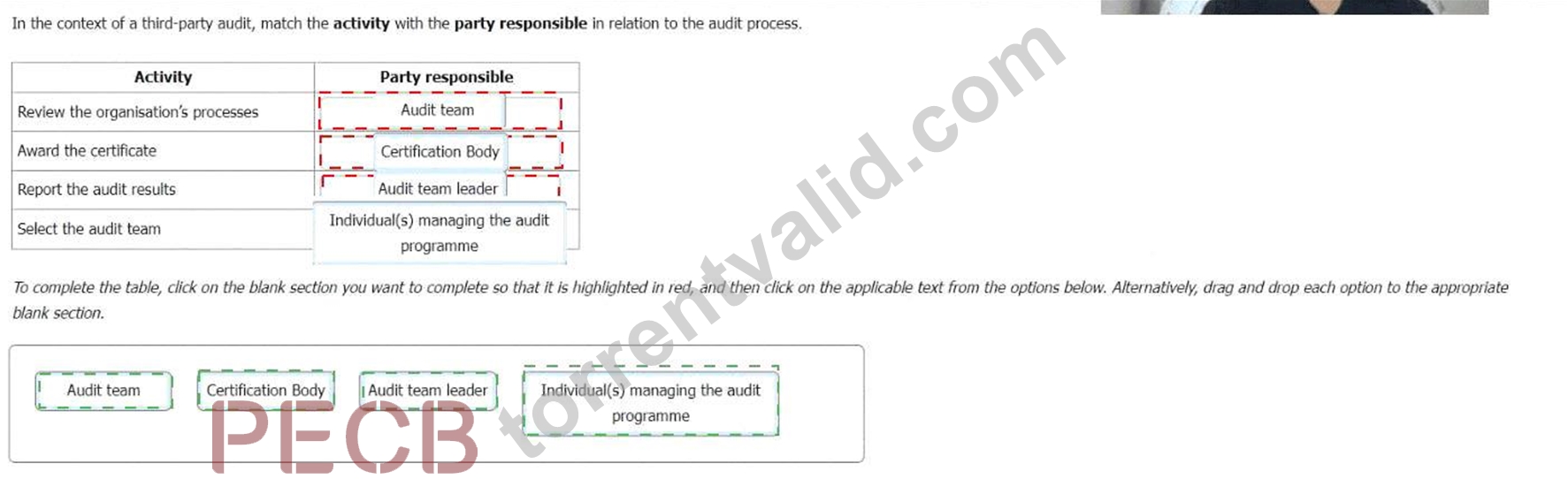
Explanation:
In the context of a third-party audit, the activities and the parties responsible can be matched as follows:
* Review the organization's processes: This is typically the responsibility of the audit team. They examine the processes to ensure they comply with the specified standards1.
* Review the audit results: The audit team leader usually reviews the audit findings to ensure accuracy and completeness before they are finalized1.
* Issue the certificate: The certification body is responsible for issuing the certificate if the audit is successful and the organization meets the required standards1.
* Select the audit team: The individual(s) managing the audit programme are responsible for selecting the audit team. This ensures that the team has the appropriate skills and knowledge for the audit1.
These roles are essential to maintain the integrity and effectiveness of the audit process. The audit team conducts the actual audit, the team leader oversees the audit process, the certification body grants the certification, and the management of the audit program ensures that the right team is in place to conduct the audit1.
Based on the description of the image you've provided, here's how the activities match with the responsible parties in the context of a third-party audit:
* Review the organization's processes: This activity is typically the responsibility of the Audit Team.
They are tasked with examining the processes to ensure they meet the requirements of the standard being audited.
* Review the audit results: The Audit Team Leader is usually responsible for this activity. They oversee the audit process and are in charge of reviewing the findings and ensuring that the audit objectives are met.
* Issue the certificate: The Certification Body is responsible for issuing the certificate if the organization's management system is found to be in compliance with the standard.
* Select the audit team: The Individual(s) managing the audit programme are responsible for selecting the audit team. They ensure that the team has the appropriate competence and resources to effectively conduct the audit.
These roles are defined within the framework of ISO 9001:2015 and are essential for the proper conduct of a third-party audit. The audit team and its leader play a critical role in the operational aspects of the audit, while the certification body and those managing the audit programme have overarching responsibilities for the audit' s governance and integrity.
NEW QUESTION # 67
Scenario 6: Davis Clinic (DC) is an American medical center focused on integrated health care. Since its establishment DC was committed to providing qualitative services for its clients, which is the reason why the company decided to implement a quality management system (QMS) based on ISO 9001. After a year of having an active QMS in place, DC applied for a certification audit.
A team of five auditors, from a well-known certification body, was selected to conduct the audit. Eva was appointed as the audit team leader. After three days of auditing, the team gathered to review and examine their findings. They also discussed the audit findings with DC's top management and then drafted the audit conclusions.
In the closing meeting, which was held between the audit team and the top management of DC. Eva presented two nonconformities that were detected during the audit. Eva stated that the company did not retain documented information regarding its outsourced services for an analysis laboratory and regarding the conducted management reviews. During the closing meeting, the audit team required from DCs top management to come up with corrective action plans within two weeks. Although the top management did not agree with the audit findings, the audit team insisted that the auditee must submit corrective actions within the given time frame in order for the audit activities to continue.
Once the action plans were evaluated, the audit team began preparing the audit report. Eva required from the team to provide accurate descriptions of the audit findings and the audit conclusions. The report was then distributed to all the interested parties involved in the audit, including the certification body Based on the report, the certification body together with Eva, as the audit team leader, made the certification decision.
Based on the scenario above, answer the following question:
Is it acceptable for the certification body and Eva to make the certification decision together?
- A. No, auditors that take part in the audit should never take part in the certification decision
- B. Yes, because the audit team leader must be involved in the certification decision
- C. No, only the audit team leader must make the certification decision
Answer: A
Explanation:
Comprehensive and Detailed In-Depth Explanation:According to ISO 17021-1:2015, Clause 9.5.1 (Certification Decision):
* Auditors who conduct the audit cannot be involved in the certification decision to ensure impartiality.
* The certification body alone is responsible for making the certification decision based on the audit report and findings.
* The audit team leader (Eva) must not take part in the certification decision.
Thus, C is the correct answer.
NEW QUESTION # 68
Which of the following is a responsibility of a guide in an audit?
- A. Witnessing the audit process on behalf of the certification body
- B. Filling any potential gaps in the auditor's knowledge
- C. Maintaining logistics
Answer: C
Explanation:
Comprehensive and Detailed In-Depth Explanation:
A guide is assigned by the auditee to assist the audit team by:
* Managing logistics, such as ensuring that relevant documents are available and arranging interviews.
* Assisting in the coordination of meetings and access to facilities.
* Helping the auditors navigate the organization during the audit.
However, the guide does not fill gaps in the auditor's knowledge or witness the audit for the certification body. Their primary function is logistical support, not providing interpretations or assessments.
Reference:
ISO 19011:2018, Clause 6.4.3 (Roles and Responsibilities of Guides and Observers)
NEW QUESTION # 69
What type of audit evidence are policies and guidelines?
- A. Technical evidence.
- B. Documentary evidence.
- C. Confirmative evidence.
Answer: B
Explanation:
Comprehensive and Detailed In-Depth Explanation:
Policies and guidelines are considered documentary evidence because they are written records that demonstrate how an organization complies with ISO 9001 requirements.
Clause References:
* ISO 19011:2018, Clause 6.4.6 - Audit Evidence:
* Documentary evidence includes manuals, procedures, and policies.
Why is the Correct Answer C?
* Documentary evidence includes written records such as policies, procedures, and documented instructions that support QMS implementation.
* Auditors review policies to verify conformance with ISO 9001.
Why are the Other Options Incorrect?
* A (Confirmative evidence) # Not a recognized category in ISO auditing.
* B (Technical evidence) # Technical evidence refers to measurements, test results, or product data, not policies.
Reference:
ISO 19011:2018, Clause 6.4.6 - Audit Evidence
NEW QUESTION # 70
You are carrying out an audit at a single-site organisation seeking certification to ISO 9001 for the first time.
The
organisation manufactures cosmetics for major retailers and the name of the retailer supplied appears on the product packaging. Sales turnover has increased significantly over the past five years. The organisation uses a software programme called SWIFT, which is used to record sales, plan production, purchase supplies, print despatch notes, track new product development, perform traceability exercises, carry out mass balance checks, raise invoices, create budgets, and support financial control.
You are nearing the end of the audit and you are reviewing your audit notes. You notice a recurring trend concerning the SWIFT database as shown below:
You ask the Quality Manager to explain how the SWIFT database is controlled. You learn that the Operations Director is responsible for determining and progressing SWIFT software updates. You decide to meet the Operations Director (OD).
You: "Good afternoon."
OD: "Good afternoon."
You: "What responsibility do you have concerning the SWIFT database?"
OD: "I maintain it. If anyone wishes to propose an update to the database, they send me an email with details of their proposal. I then either process the database update myself, or I send the request to the consultant who designed the database 20 years ago. The necessary software changes are made, and the amended software is immediately released to users." You: "Would you explain how the software amendments are controlled?" OD: "Of course. I personally update every computer myself." You: "Do you inform the database users of the changes?" OD: "No I don't. They find out for themselves by using the software, or they come to see me if they have any questions." You: "How do you ensure that the database users use the latest version?" OD: "That's easy, I update every computer myself." You: "During the audit, I noted there were several versions of SWIFT in use (you refer to your audit notes)." OD: "I know. That's because some versions work better than others, and depending on user needs and experiences, we allow users to revert to using an earlier version if they find it works better for them." Based on the scenario, which two of the following statements are true? There is evidence of nonconformity with a requirement defined in ...
- A. clause 7.5.1 Documented information - General
- B. clause 7.5.2 Documented information - Creating and updating
- C. clause 7.5.3 Control of documented information
- D. clause 7.1.3 Infrastructure
- E. clause 7.1.4 Environment for the operation of processes
Answer: A,C
Explanation:
Based on the scenario provided, there is evidence of nonconformity with the requirements defined in:
C: Clause 7.5.1 Documented information - General: The scenario indicates that there is no formal process for informing users about updates to the SWIFT database, which suggests a lack of control over documented information. This could lead to users being unaware of important changes and not using the latest version of the software, which is required by the quality management system1.
E: Clause 7.5.3 Control of documented information: The Operations Director's approach to updating the SWIFT database and the lack of communication to users about these updates indicate that the documented information is not adequately controlled. Allowing users to revert to earlier versions of the software at their discretion further suggests that the organization does not have a proper mechanism in place to ensure the integrity and suitability of documented information2.
These clauses are part of the ISO 9001:2015 standard, which requires organizations to have a systematic approach to controlling and managing documented information as part of their quality management system.
The scenario described shows a casual approach to managing critical software updates, which could affect the organization's ability to consistently meet customer and regulatory requirements.
NEW QUESTION # 71
Consultancy ABC, which is a subsidiary of a certification body called ABC-CERT, provided consultancy services regarding the implementation of a QMS based on ISO 9001 to an organization.
Considering this, can ABC-CERT provide certification services to the organization which obtained consultancy services from Consultancy ABC?
- A. Yes, if both parties sign an agreement which states that previous services by Consultancy ABC will not impact the judgment of auditors.
- B. Yes, after a minimum period of two years has passed.
- C. No, ABC-CERT is not allowed to provide certification services to that organization ever, as this would be a conflict of interest.
Answer: C
Explanation:
Comprehensive and Detailed In-Depth Explanation:
Certification bodies must remain independent and impartial. If a certification body (ABC-CERT) provides consulting services to an organization through its subsidiary (Consultancy ABC), it cannot later certify the same organization.
Clause References:
* ISO/IEC 17021-1:2015, Clause 5.2.5 - Impartiality Requirements:
* A certification body must not certify an organization to which it has provided consultancy services.
* ISO/IEC 17021-1:2015, Clause 5.2.6:
* Subsidiaries of certification bodies must not provide consulting services to prevent conflicts of interest.
Why is the Correct Answer C?
* Certifying a client after providing consultancy creates a conflict of interest and violates ISO/IEC
17021-1:2015 impartiality rules.
* The certification body (ABC-CERT) and consultancy firm (Consultancy ABC) are related entities
, making it impossible to remain objective and independent.
Why are the Other Options Incorrect?
* A (Waiting two years) # ISO does not specify a time frame; the issue is impartiality, not just time.
* B (Signing an agreement to ensure objectivity) # Conflicts of interest cannot be resolved through an agreement; independence is required.
NEW QUESTION # 72
You are carrying out an audit at a single-site organisation seeking certification to ISO 9001 for the first time.
The
organisation manufactures cosmetics for major retailers and the name of the retailer supplied appears on the product packaging. Sales turnover has increased significantly over the past five years. The organisation uses a software programme called SWIFT, which is used to record sales, plan production, purchase supplies, print despatch notes, track new product development, perform traceability exercises, carry out mass balance checks, raise invoices, create budgets, and support financial control.
You are nearing the end of the audit and you are reviewing your audit notes. You notice a recurring trend concerning the SWIFT database as shown below:
You ask the Quality Manager to explain how the SWIFT database is controlled. You learn that the Operations Director is responsible for determining and progressing SWIFT software updates. You decide to meet the Operations Director (OD).
You: "Good afternoon."
OD: "Good afternoon."
You: "What responsibility do you have concerning the SWIFT database?"
OD: "I maintain it. If anyone wishes to propose an update to the database, they send me an email with details of their proposal. I then either process the database update myself, or I send the request to the consultant who designed the database 20 years ago. The necessary software changes are made, and the amended software is immediately released to users." You: "Would you explain how the software amendments are controlled?" OD: "Of course. I personally update every computer myself." You: "Do you inform the database users of the changes?" OD: "No I don't. They find out for themselves by using the software, or they come to see me if they have any questions." You: "How do you ensure that the database users use the latest version?" OD: "That's easy, I update every computer myself." You: "During the audit, I noted there were several versions of SWIFT in use (you refer to your audit notes)." OD: "I know. That's because some versions work better than others, and depending on user needs and experiences, we allow users to revert to using an earlier version if they find it works better for them." Based on the scenario, which two of the following statements are true? There is evidence of nonconformity with a requirement defined in ...
- A. ... clause 7.1.4 Environment for the operation of processes
- B. ... clause 7.5.3 Control of documented information
- C. clause 7.5.1 Documented information - General
- D. clause 7.1.3 Infrastructure
- E. ... clause 7.5.2 Documented information - Creating and updating
Answer: B,C
Explanation:
Based on the scenario provided, there is evidence of nonconformity with the requirements defined in:
C: Clause 7.5.1 Documented information - General: The scenario indicates that there is no formal process for informing users about updates to the SWIFT database, which suggests a lack of control over documented information. This could lead to users being unaware of important changes and not using the latest version of the software, which is required by the quality management system1.
E: Clause 7.5.3 Control of documented information: The Operations Director's approach to updating the SWIFT database and the lack of communication to users about these updates indicate that the documented information is not adequately controlled. Allowing users to revert to earlier versions of the software at their discretion further suggests that the organization does not have a proper mechanism in place to ensure the integrity and suitability of documented information2.
These clauses are part of the ISO 9001:2015 standard, which requires organizations to have a systematic approach to controlling and managing documented information as part of their quality management system.
The scenario described shows a casual approach to managing critical software updates, which could affect the organization's ability to consistently meet customer and regulatory requirements.
NEW QUESTION # 73
Match each of the following statements into the table below to show whether they apply to first-party audits, second-party audits or third-party audits:
Answer:
Explanation:
Explanation:
Table
Statement
First-party audits
Second-party audits
Third-party audits
The audit scope is typically determined by the organisation being audited.
Yes
No
No
The outcome of the audit is typically certification to a recognised standard.
No
No
Yes
The audit scope is typically confined to service/product provision capability.
No
Yes
No
Here is a brief explanation of each statement:
The audit scope is typically determined by the organisation being audited: This statement applies to first-party audits, also known as internal audits, where the organisation audits its own processes and activities to ensure conformity and improvement1. The organisation can decide the scope of the audit based on its own needs and objectives2. This statement does not apply to second-party audits, where the customer audits the supplier, or third-party audits, where an independent body audits the organisation. In these cases, the audit scope is determined by the customer or the certification body, respectively34.
The outcome of the audit is typically certification to a recognised standard: This statement applies to third- party audits, where an independent body audits the organisation to verify that it meets the requirements of a specific standard, such as ISO 9001, and issues a certificate of conformity if the audit is successful34. This statement does not apply to first-party audits or second-party audits, where the outcome of the audit is not certification, but rather self-improvement or supplier qualification13.
The audit scope is typically confined to service/product provision capability: This statement applies to second- party audits, where the customer audits the supplier to ensure that they are meeting the requirements specified in the contract, such as service or product quality, delivery, or performance34. The audit scope is usually focused on the specific aspects of the service or product that are of interest to the customer3. This statement does not apply to first-party audits or third-party audits, where the audit scope is broader and covers the entire quality management system or the relevant clauses of the standard14.
NEW QUESTION # 74
The certification body has not been able to verify the implementation of corrective actions for any identified major nonconformity within six months after the last day of the Stage 2 audit. What must the certification body do in this case?
- A. It must conduct all audit activities from the beginning
- B. It must issue an unfavorable recommendation of certification
- C. It must conduct another Stage 2 audit before granting certification
Answer: B
Explanation:
Comprehensive and Detailed In-Depth Explanation:According to ISO 17021-1:2015, Clause 9.4.10 (Corrective Actions for Major Nonconformities):
* If a major nonconformity is not corrected within six months, the certification body must reject the certification request.
* Another Stage 2 audit (C) is not required unless the organization reapplies for certification.
* Restarting all audit activities (B) is unnecessary; instead, certification is denied.
Thus, A is the correct answer.
NEW QUESTION # 75
Even though past audits have highlighted a consistently large number of nonconformities within an organisation's design team, the organisation has not varied the frequency or duration of audits on its audit plan.
The decision for whether this situation is acceptable or not should be governed by which of the following?
- A. The availability of competent internal auditors
- B. A risk-based approach to the audit programme
- C. The authority of the audit team leader
- D. The organisation's reasoning behind the lack of change to the audit plan
Answer: B
NEW QUESTION # 76
......
ISO-9001-Lead-Auditor Dumps Full Questions with Free PDF Questions to Pass: https://www.torrentvalid.com/ISO-9001-Lead-Auditor-valid-braindumps-torrent.html
ISO-9001-Lead-Auditor PDF Recently Updated Questions Dumps to Improve Exam Score: https://drive.google.com/open?id=1sCXGL79M5_iHdEk_aPnooWtUOqOH8lY3