


[Dec 08, 2024] DP-203 Exam Dumps 100% Same Q&A In Your Real Exam
DP-203 Test Engine Dumps Training With 335 Questions
To qualify for the DP-203 certification exam, candidates should have a solid understanding of data engineering concepts and be proficient in using Azure technologies. They should also have experience in designing and implementing data solutions on the Azure platform. DP-203 exam consists of multiple-choice questions and is designed to test the candidate's knowledge of Azure data services, data storage options, data processing technologies, and data analysis tools. DP-203 exam is challenging and requires a good understanding of the topics covered. However, passing the exam demonstrates that the candidate has the skills and knowledge required to work on complex data engineering projects using Azure technologies.
Microsoft DP-203 Exam Syllabus Topics:
| Topic | Details |
|---|---|
| Topic 1 |
|
| Topic 2 |
|
| Topic 3 |
|
NEW QUESTION # 15
You have an Azure Data Lake Storage Gen 2 account named storage1.
You need to recommend a solution for accessing the content in storage1. The solution must meet the following requirements:
List and read permissions must be granted at the storage account level.
Additional permissions can be applied to individual objects in storage1.
Security principals from Microsoft Azure Active Directory (Azure AD), part of Microsoft Entra, must be used for authentication.
What should you use? To answer, drag the appropriate components to the correct requirements. Each component may be used once, more than once, or not at all. You may need to drag the split bar between panes or scroll to view content.
NOTE: Each correct selection is worth one point.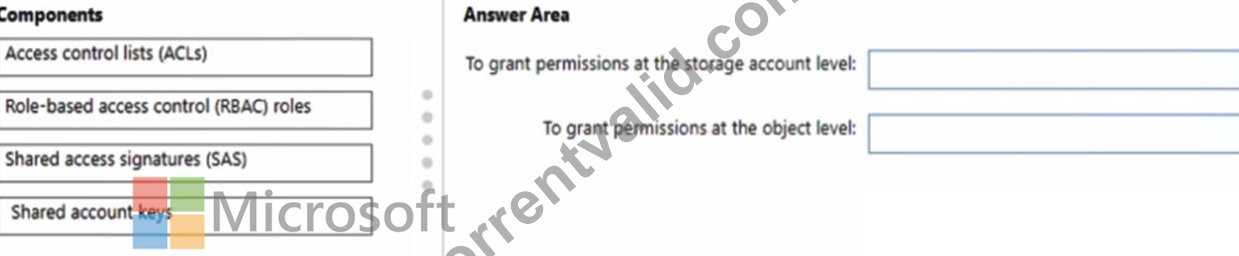
Answer:
Explanation: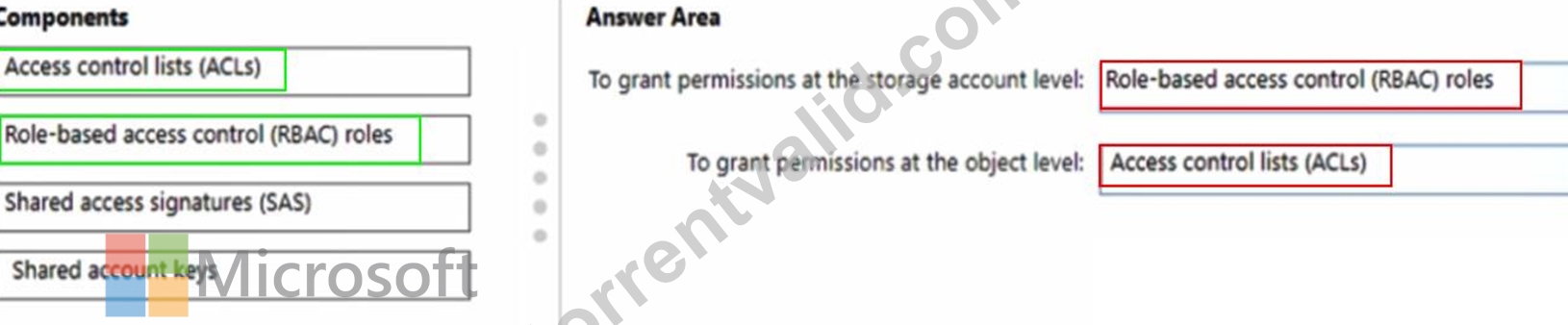
NEW QUESTION # 16
You have an Azure Synapse Analytics workspace named WS1.
You have an Azure Data Lake Storage Gen2 container that contains JSON-formatted files in the following format.
You need to use the serverless SQL pool in WS1 to read the files.
How should you complete the Transact-SQL statement? To answer, drag the appropriate values to the correct targets. Each value may be used once, more than once, or not at all. You may need to drag the split bar between panes or scroll to view content.
NOTE: Each correct selection is worth one point.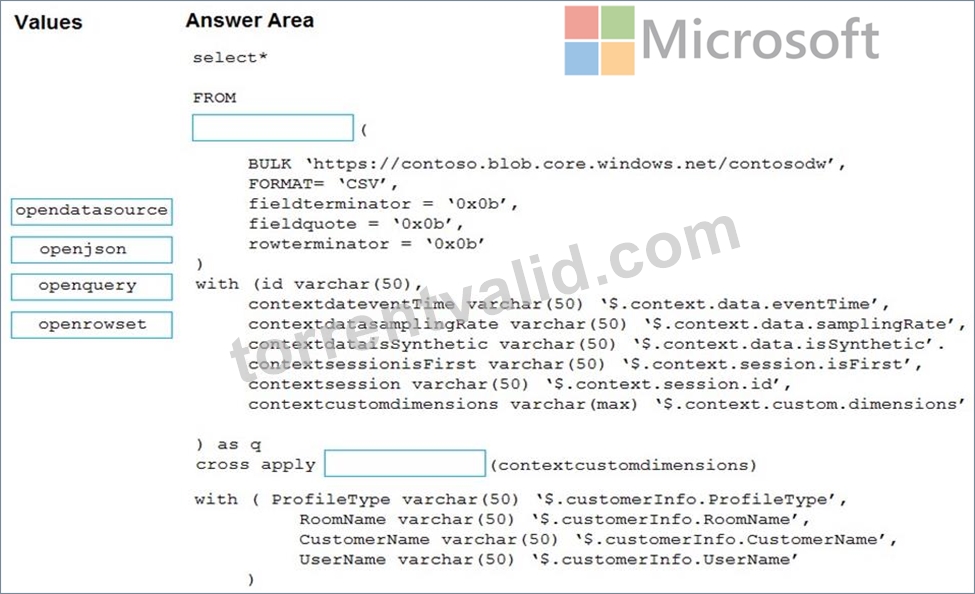
Answer:
Explanation: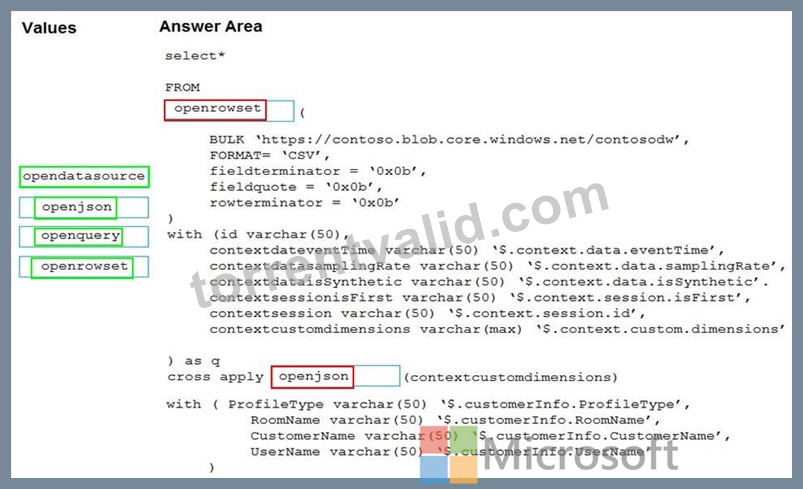
Reference:
https://docs.microsoft.com/en-us/azure/synapse-analytics/sql/query-single-csv-file
https://docs.microsoft.com/en-us/sql/relational-databases/json/import-json-documents-into-sql-server
NEW QUESTION # 17
You have an Azure Active Directory (Azure AD) tenant that contains a security group named Group1. You have an Azure Synapse Analytics dedicated SQL pool named dw1 that contains a schema named schema1.
You need to grant Group1 read-only permissions to all the tables and views in schema1. The solution must use the principle of least privilege.
Which three actions should you perform in sequence? To answer, move the appropriate actions from the list of actions to the answer area and arrange them in the correct order.
NOTE: More than one order of answer choices is correct. You will receive credit for any of the correct orders you select.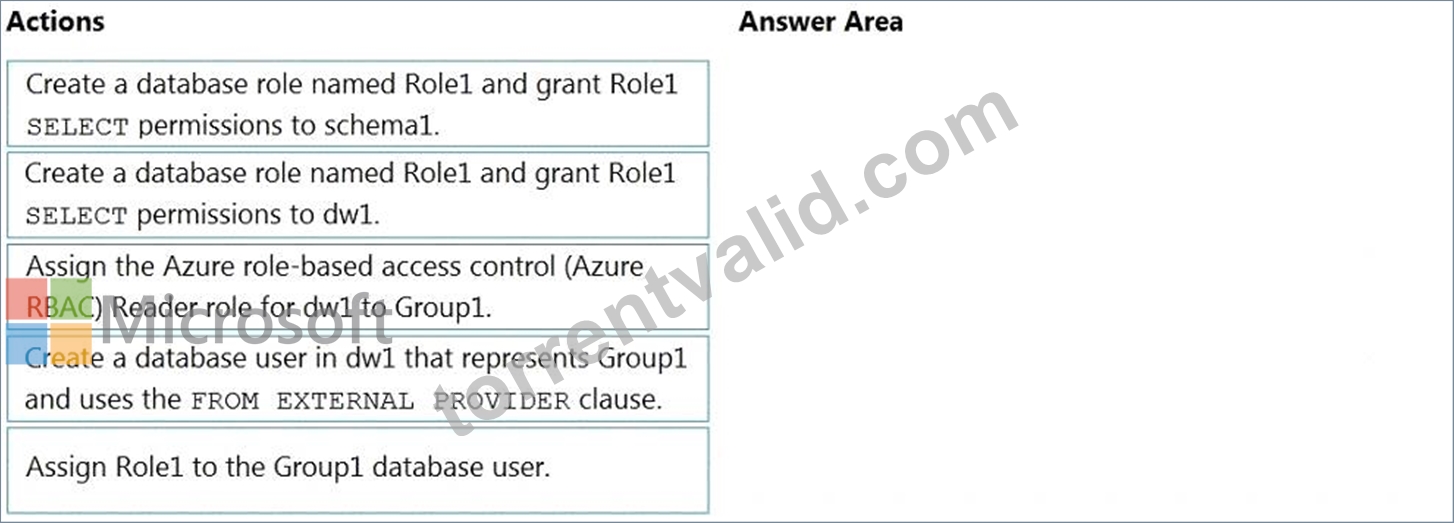
Answer:
Explanation: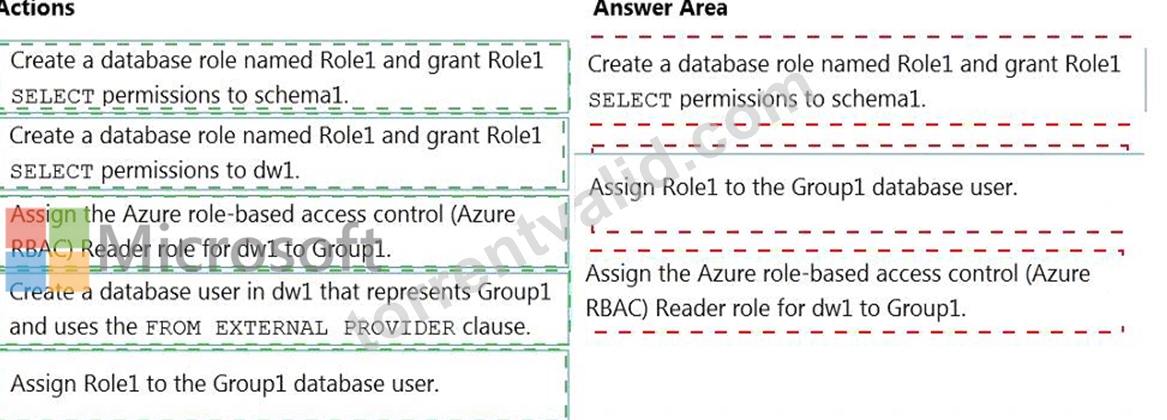
Explanation: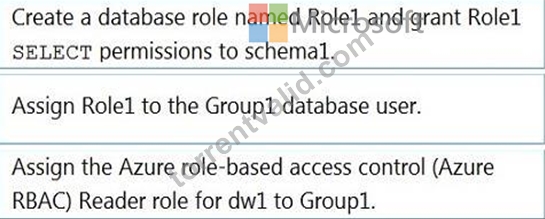
Step 1: Create a database role named Role1 and grant Role1 SELECT permissions to schema You need to grant Group1 read-only permissions to all the tables and views in schema1.
Place one or more database users into a database role and then assign permissions to the database role.
Step 2: Assign Rol1 to the Group database user
Step 3: Assign the Azure role-based access control (Azure RBAC) Reader role for dw1 to Group1 Reference:
https://docs.microsoft.com/en-us/azure/data-share/how-to-share-from-sql
NEW QUESTION # 18
You have a self-hosted integration runtime in Azure Data Factory.
The current status of the integration runtime has the following configurations:
Status: Running
Type: Self-Hosted
Version: 4.4.7292.1
Running / Registered Node(s): 1/1
High Availability Enabled: False
Linked Count: 0
Queue Length: 0
Average Queue Duration. 0.00s
The integration runtime has the following node details:
Name: X-M
Status: Running
Version: 4.4.7292.1
Available Memory: 7697MB
CPU Utilization: 6%
Network (In/Out): 1.21KBps/0.83KBps
Concurrent Jobs (Running/Limit): 2/14
Role: Dispatcher/Worker
Credential Status: In Sync
Use the drop-down menus to select the answer choice that completes each statement based on the information presented.
NOTE: Each correct selection is worth one point.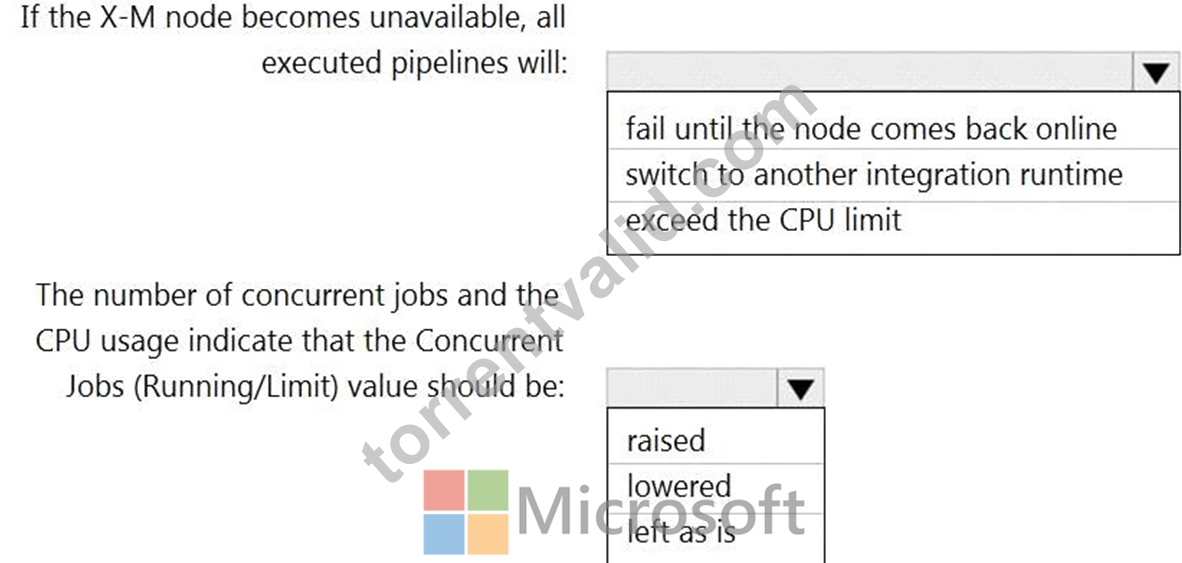
Answer:
Explanation: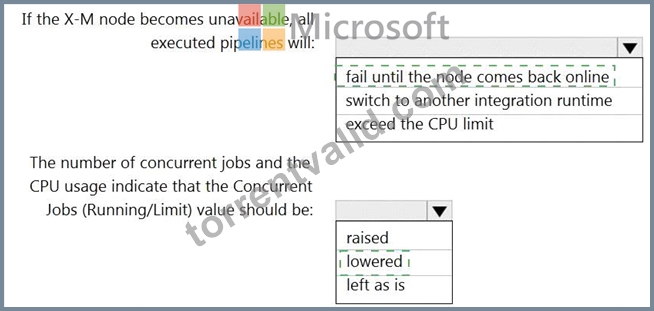
Explanation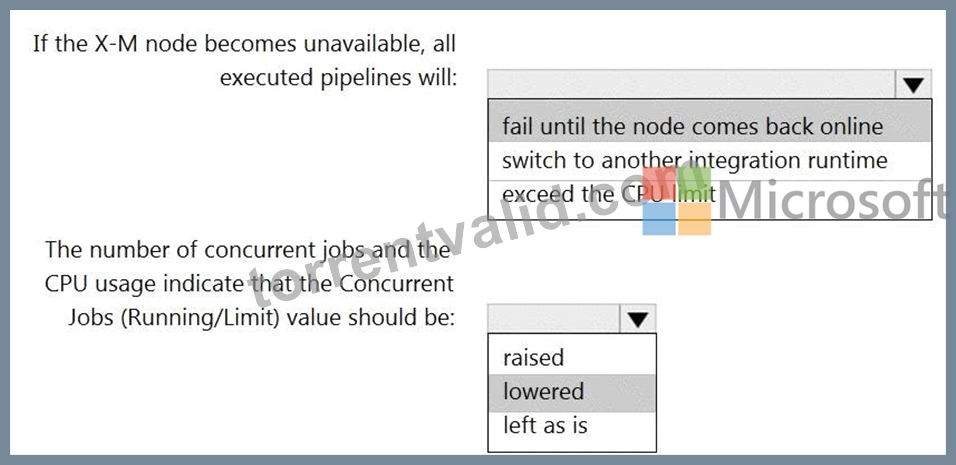
Box 1: fail until the node comes back online
We see: High Availability Enabled: False
Note: Higher availability of the self-hosted integration runtime so that it's no longer the single point of failure in your big data solution or cloud data integration with Data Factory.
Box 2: lowered
We see:
Concurrent Jobs (Running/Limit): 2/14
CPU Utilization: 6%
Note: When the processor and available RAM aren't well utilized, but the execution of concurrent jobs reaches a node's limits, scale up by increasing the number of concurrent jobs that a node can run Reference:
https://docs.microsoft.com/en-us/azure/data-factory/create-self-hosted-integration-runtime
NEW QUESTION # 19
You have the following table named Employees.
You need to calculate the employee_type value based on the hire_date value.
How should you complete the Transact-SQL statement? To answer, drag the appropriate values to the correct targets. Each value may be used once, more than once, or not at all. You may need to drag the split bar between panes or scroll to view content.
NOTE: Each correct selection is worth one point.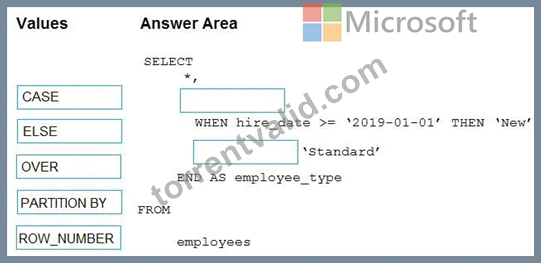
Answer:
Explanation: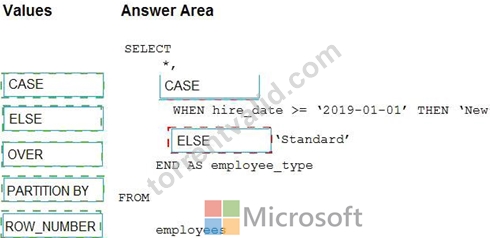
Explanation
Graphical user interface, text, application Description automatically generated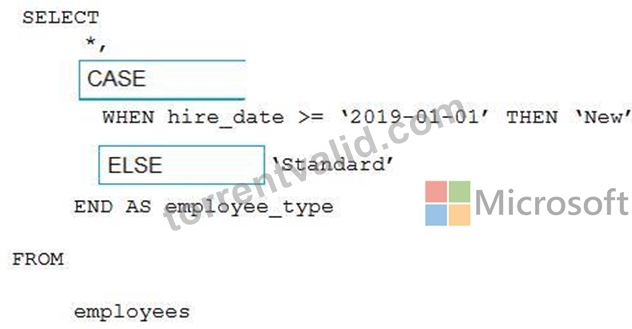
Box 1: CASE
CASE evaluates a list of conditions and returns one of multiple possible result expressions.
CASE can be used in any statement or clause that allows a valid expression. For example, you can use CASE in statements such as SELECT, UPDATE, DELETE and SET, and in clauses such as select_list, IN, WHERE, ORDER BY, and HAVING.
Syntax: Simple CASE expression:
CASE input_expression
WHEN when_expression THEN result_expression [ ...n ]
[ ELSE else_result_expression ]
END
Box 2: ELSE
Reference:
https://docs.microsoft.com/en-us/sql/t-sql/language-elements/case-transact-sql
NEW QUESTION # 20
You have an Azure subscription that contains the following resources:
An Azure Active Directory (Azure AD) tenant that contains a security group named Group1 An Azure Synapse Analytics SQL pool named Pool1 You need to control the access of Group1 to specific columns and rows in a table in Pool1.
Which Transact-SQL commands should you use? To answer, select the appropriate options in the answer area.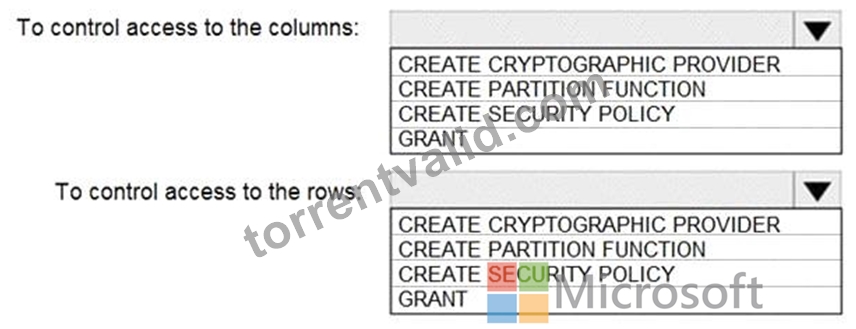
Answer:
Explanation: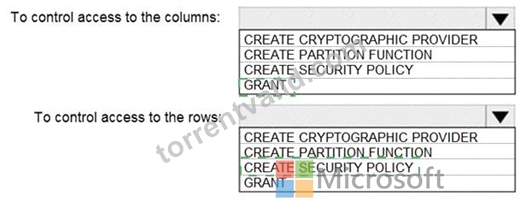
Explanation
Text Description automatically generated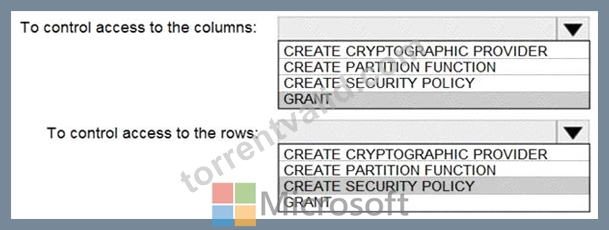
Box 1: GRANT
You can implement column-level security with the GRANT T-SQL statement.
Box 2: CREATE SECURITY POLICY
Implement Row Level Security by using the CREATE SECURITY POLICY Transact-SQL statement Reference:
https://docs.microsoft.com/en-us/azure/synapse-analytics/sql-data-warehouse/column-level-security
NEW QUESTION # 21
You have an Azure Synapse Analytics dedicated SQL Pool1. Pool1 contains a partitioned fact table named dbo.Sales and a staging table named stg.Sales that has the matching table and partition definitions.
You need to overwrite the content of the first partition in dbo.Sales with the content of the same partition in stg.Sales. The solution must minimize load times.
What should you do?
- A. Switch the first partition from dbo.Sales to stg.Sales.
- B. Switch the first partition from stg.Sales to dbo. Sales.
- C. Update dbo.Sales from stg.Sales.
- D. Insert the data from stg.Sales into dbo.Sales.
Answer: D
NEW QUESTION # 22
In Azure Data Factory, you have a schedule trigger that is scheduled in Pacific Time.
Pacific Time observes daylight saving time.
The trigger has the following JSON file.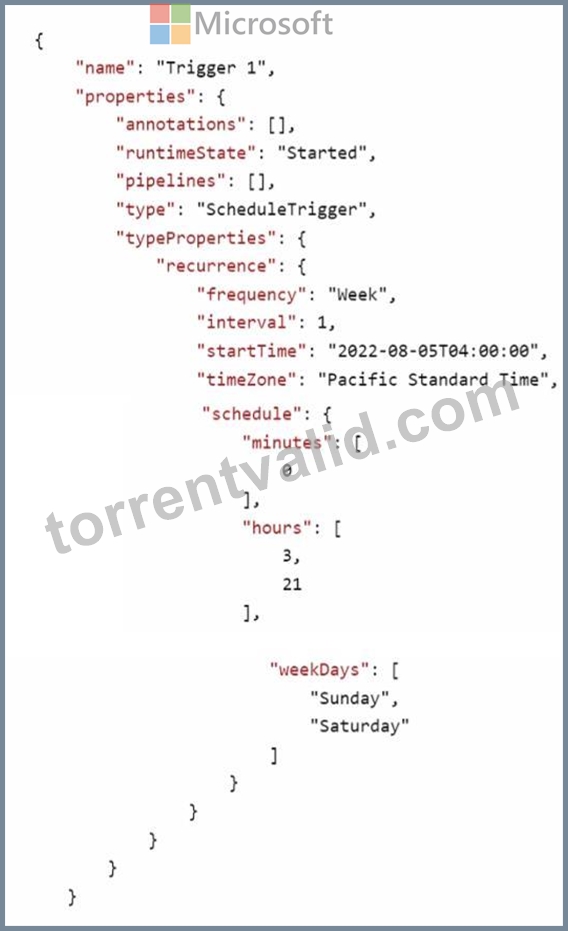
Use the drop-down menus to select the answer choice that completes each statement based on the information presented.
NOTE: Each correct selection is worth one point.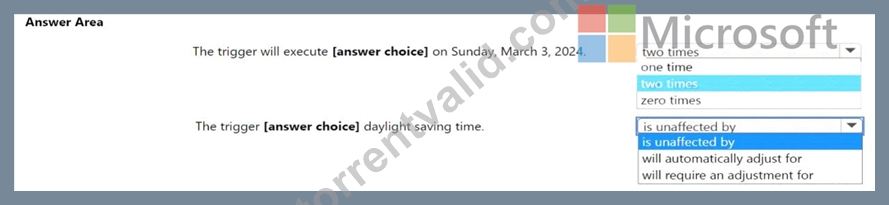
Answer:
Explanation: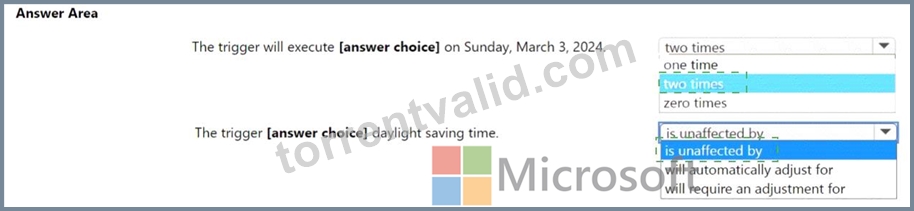
Explanation:
NEW QUESTION # 23
You plan to ingest streaming social media data by using Azure Stream Analytics. The data will be stored in files in Azure Data Lake Storage, and then consumed by using Azure Datiabricks and PolyBase in Azure Synapse Analytics.
You need to recommend a Stream Analytics data output format to ensure that the queries from Databricks and PolyBase against the files encounter the fewest possible errors. The solution must ensure that the tiles can be queried quickly and that the data type information is retained.
What should you recommend?
- A. Avro
- B. JSON
- C. CSV
- D. Parquet
Answer: A
Explanation:
The Avro format is great for data and message preservation. Avro schema with its support for evolution is essential for making the data robust for streaming architectures like Kafka, and with the metadata that schema provides, you can reason on the data. Having a schema provides robustness in providing meta-data about the data stored in Avro records which are self- documenting the data. References: http://cloudurable.com/blog/avro/index.html
NEW QUESTION # 24
You have an Azure Data Lake Storage Gen2 account that contains a JSON file for customers. The file contains two attributes named FirstName and LastName.
You need to copy the data from the JSON file to an Azure Synapse Analytics table by using Azure Databricks.
A new column must be created that concatenates the FirstName and LastName values.
You create the following components:
* A destination table in Azure Synapse
* An Azure Blob storage container
* A service principal
Which five actions should you perform in sequence next in is Databricks notebook? To answer, move the appropriate actions from the list of actions to the answer area and arrange them in the correct order.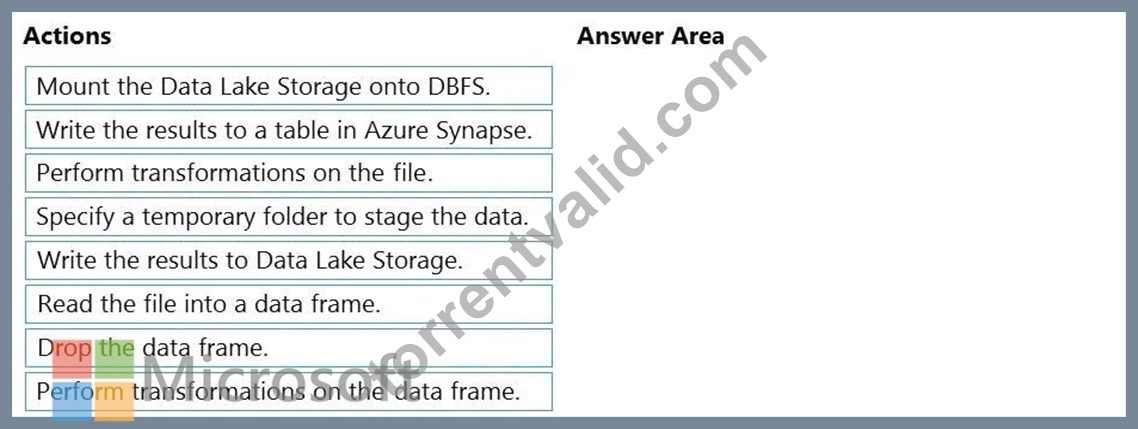
Answer:
Explanation: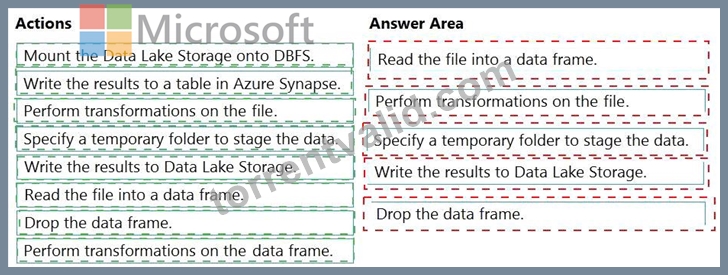
Explanation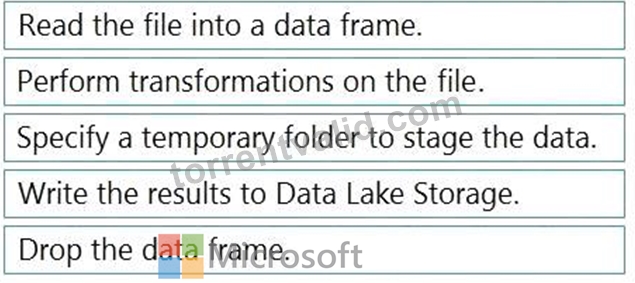
Step 1: Read the file into a data frame.
You can load the json files as a data frame in Azure Databricks.
Step 2: Perform transformations on the data frame.
Step 3:Specify a temporary folder to stage the data
Specify a temporary folder to use while moving data between Azure Databricks and Azure Synapse.
Step 4: Write the results to a table in Azure Synapse.
You upload the transformed data frame into Azure Synapse. You use the Azure Synapse connector for Azure Databricks to directly upload a dataframe as a table in a Azure Synapse.
Step 5: Drop the data frame
Clean up resources. You can terminate the cluster. From the Azure Databricks workspace, select Clusters on the left. For the cluster to terminate, under Actions, point to the ellipsis (...) and select the Terminate icon.
Reference:
https://docs.microsoft.com/en-us/azure/azure-databricks/databricks-extract-load-sql-data-warehouse
NEW QUESTION # 25
You need to ensure that the Twitter feed data can be analyzed in the dedicated SQL pool. The solution must meet the customer sentiment analytics requirements.
Which three Transaction-SQL DDL commands should you run in sequence? To answer, move the appropriate commands from the list of commands to the answer area and arrange them in the correct order.
NOTE: More than one order of answer choices is correct. You will receive credit for any of the correct orders you select.
Answer:
Explanation: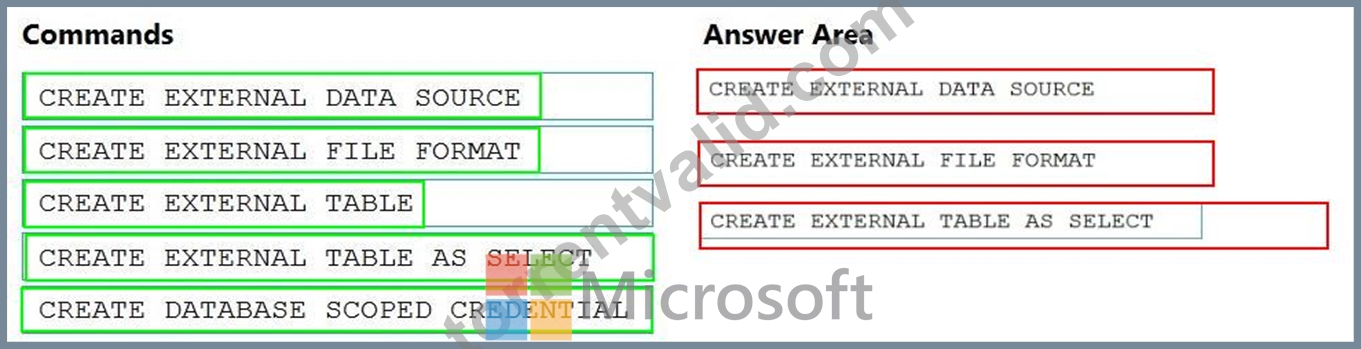
Reference:
https://docs.microsoft.com/en-us/azure/synapse-analytics/sql/develop-tables-external-tables
NEW QUESTION # 26
You have the following table named Employees.
You need to calculate the employee_type value based on the hire_date value.
How should you complete the Transact-SQL statement? To answer, drag the appropriate values to the correct targets. Each value may be used once, more than once, or not at all. You may need to drag the split bar between panes or scroll to view content.
NOTE: Each correct selection is worth one point.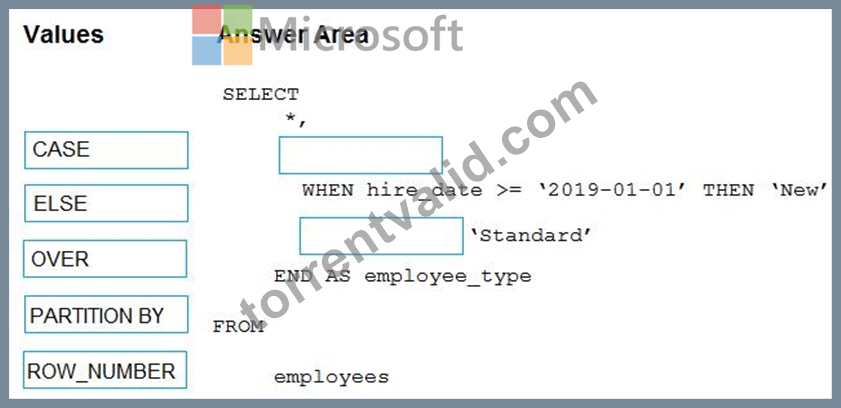
Answer:
Explanation: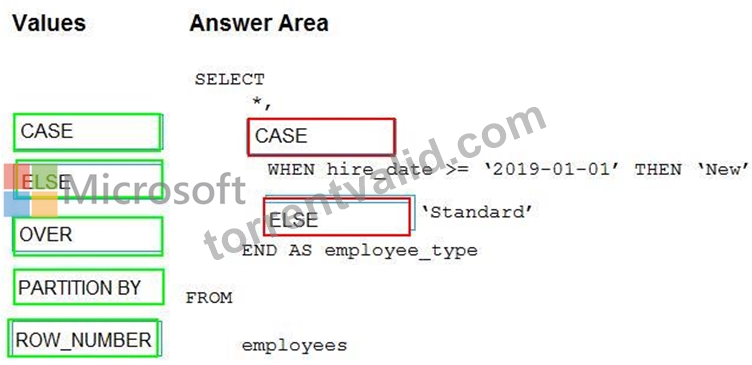
Reference:
https://docs.microsoft.com/en-us/sql/t-sql/language-elements/case-transact-sql
NEW QUESTION # 27
You have an Azure Data Factory pipeline that has the activities shown in the following exhibit.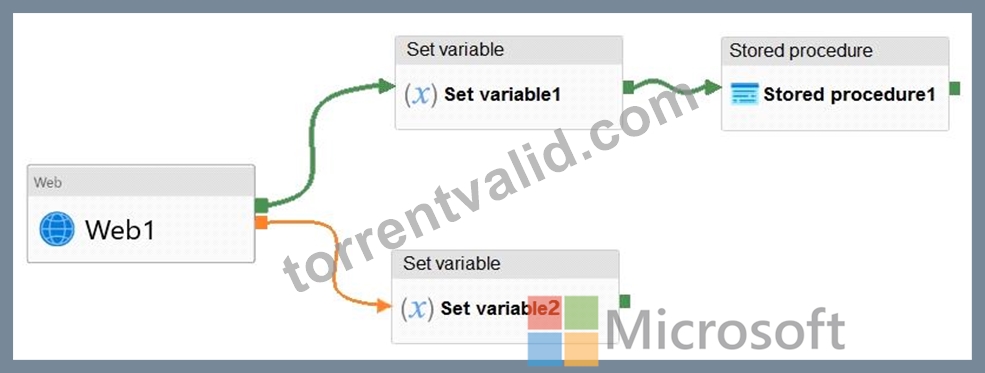
Use the drop-down menus to select the answer choice that completes each statement based on the information presented in the graphic.
NOTE: Each correct selection is worth one point.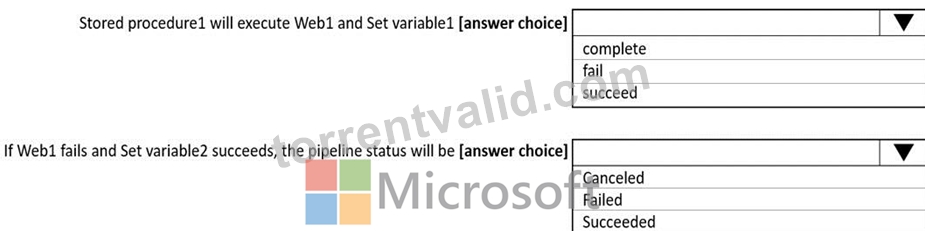
Answer:
Explanation: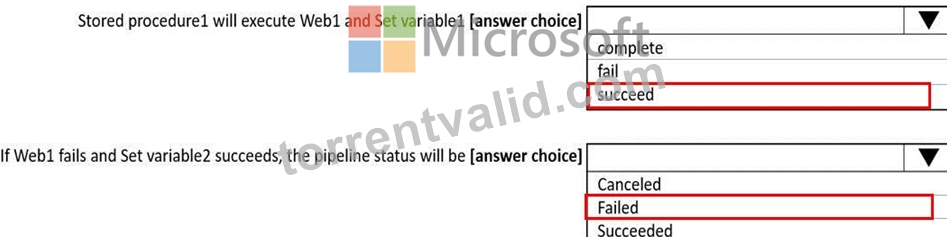
Reference:
https://datasavvy.me/2021/02/18/azure-data-factory-activity-failures-and-pipeline-outcomes/
NEW QUESTION # 28
You have an Azure Data Lake Storage Gen2 account that contains two folders named Folder and Folder2.
You use Azure Data Factory to copy multiple files from Folder1 to Folder2.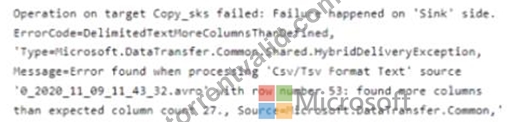
You receive the following error.
What should you do to resolve the error.
- A. Lower the degree of copy parallelism
- B. Change the Copy activity setting to Binary Copy
- C. Add an explicit mapping.
- D. Enable fault tolerance to skip incompatible rows.
Answer: C
Explanation:
Reference:
https://knowledge.informatica.com/s/article/Microsoft-Azure-Data-Lake-Store-Gen2-target-file-names-not-gener
NEW QUESTION # 29
You are building an Azure Stream Analytics job to retrieve game data.
You need to ensure that the job returns the highest scoring record for each five-minute time interval of each game.
How should you complete the Stream Analytics query? To answer, select the appropriate options in the answer area.
NOTE: Each correct selection is worth one point.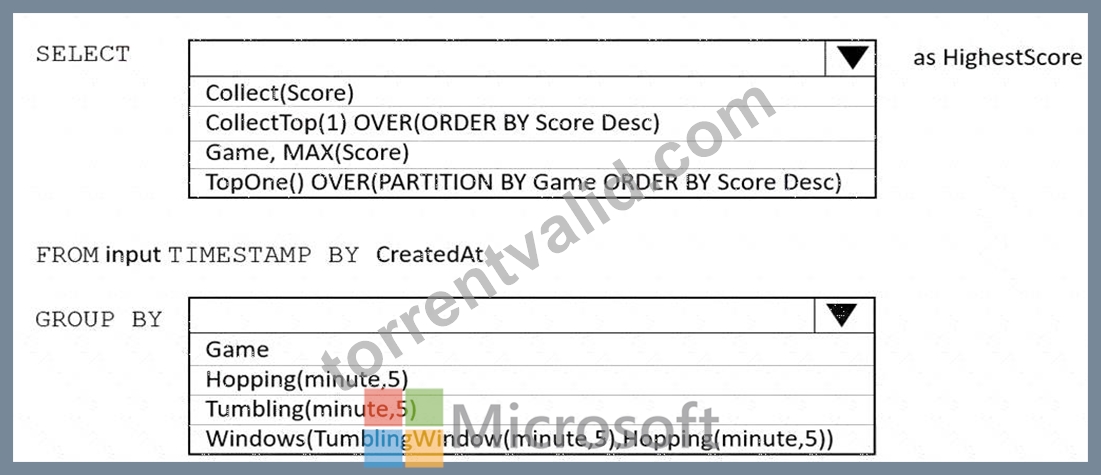
Answer:
Explanation: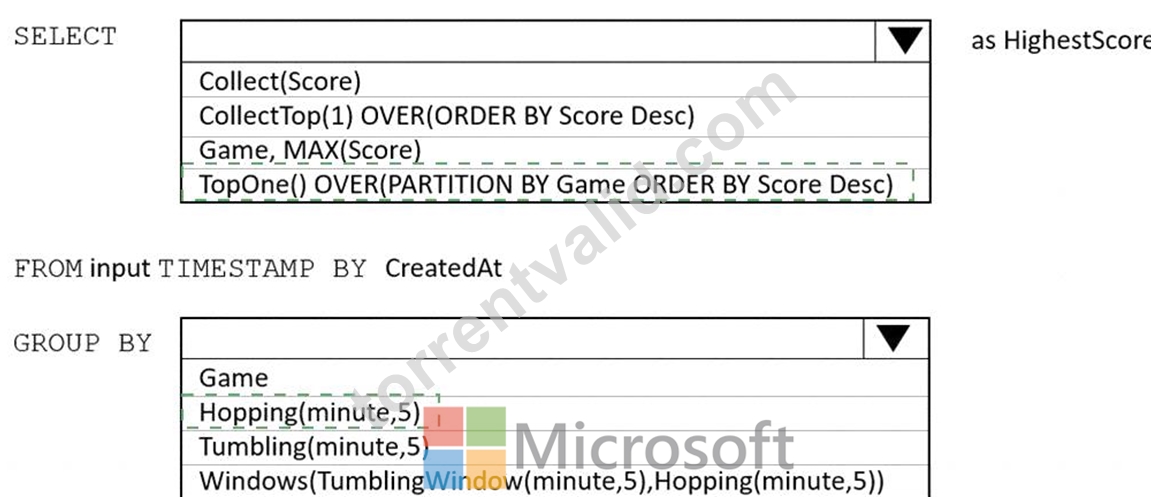
Explanation:
Box 1: TopOne OVER(PARTITION BY Game ORDER BY Score Desc)
TopOne returns the top-rank record, where rank defines the ranking position of the event in the window according to the specified ordering. Ordering/ranking is based on event columns and can be specified in ORDER BY clause.
Box 2: Hopping(minute,5)
Hopping window functions hop forward in time by a fixed period. It may be easy to think of them as Tumbling windows that can overlap and be emitted more often than the window size. Events can belong to more than one Hopping window result set. To make a Hopping window the same as a Tumbling window, specify the hop size to be the same as the window size.
A picture containing timeline Description automatically generated
Reference:
https://docs.microsoft.com/en-us/stream-analytics-query/topone-azure-stream-analytics
https://docs.microsoft.com/en-us/azure/stream-analytics/stream-analytics-window-functions
NEW QUESTION # 30
You need to implement versioned changes to the integration pipelines. The solution must meet the data integration requirements.
In which order should you perform the actions? To answer, move all actions from the list of actions to the answer area and arrange them in the correct order.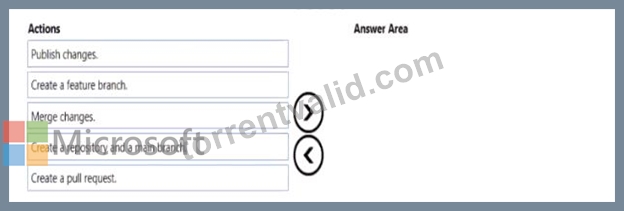
Answer:
Explanation: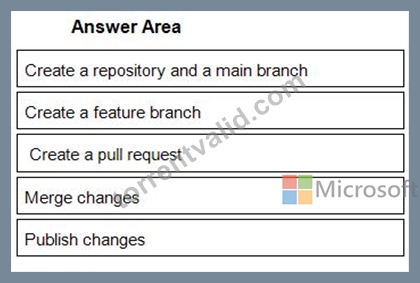
1 - Create a repository and a main branch
2 - Create a feature branch
3 - Create a pull request
4 - Merge changes
5 - Publish changes
Reference:
https://docs.microsoft.com/en-us/azure/devops/pipelines/repos/pipeline-options-for-git
NEW QUESTION # 31
......
DP-203 Practice Test Pdf Exam Material: https://www.torrentvalid.com/DP-203-valid-braindumps-torrent.html
DP-203 Questions Pass on Your First Attempt Dumps for Microsoft Certified: Azure Data Engineer Associate Certified: https://drive.google.com/open?id=1x40X5oxH6El6X0LV48C0WVEdyqBU701d