


265 Q&As in UPDATED CORe Exam Questions Certification Test Engine to PDF
Get The Important Preparation Guide With CORe Dumps
At the end of the HBX CORe program, students are required to take the HBX CORe Final Examination, which is an online assessment that tests their understanding of the program's core concepts. CORe exam is designed to be challenging, and it requires students to apply the knowledge they have gained throughout the program to real-world business scenarios. The HBX CORe Final Examination is a crucial component of the program, as it serves as a measure of students' readiness to pursue advanced studies or to enter the workforce.
NEW QUESTION # 19
Mobile telephone providers often require customers to enter two-year contracts, with the stipulation that these customers pay a termination fee if they would like to end their contracts early. A new mobile telephone provider offers to pay customers' early termination fees if they are currently in a contract but would like to change providers. If the goal of the company is to gain as many new customers as possible, it might be offering this promotion in order to:
- A. overcome the barriers to entry induced by high customer switching costs.
- B. compete for a customer segment that is interested in different mobile phone models.
- C. differentiate its brand by requiring shorter contracts.
- D. compete with existing carriers by offering the lowest costs plans.
Answer: A
NEW QUESTION # 20
Company A has a Weighted Average Cost of Capital (WACC) of 12 percent. They are evaluating four different projects/investments with financial flows as described below. Available funds are limited, so they can only pursue one of the investment alternatives. Each project/investment involves an initial outflow of $1,000,000 and has an eight year life.
Which project should they select?
- A. Project 4
- B. Project 2
- C. Project 3
- D. Project 1
Answer: A
NEW QUESTION # 21
The owner of a chain of convenience stores is concerned that store-level marketing expenditures are not increasing its stores' sales. In addition, the owner believes that an especially cold winter has caused sales to drop. The owner collects data in Dec. 2013 for a random sampling of 50 stores in the Midwestern region of the United States; a portion of this spreadsheet is given below.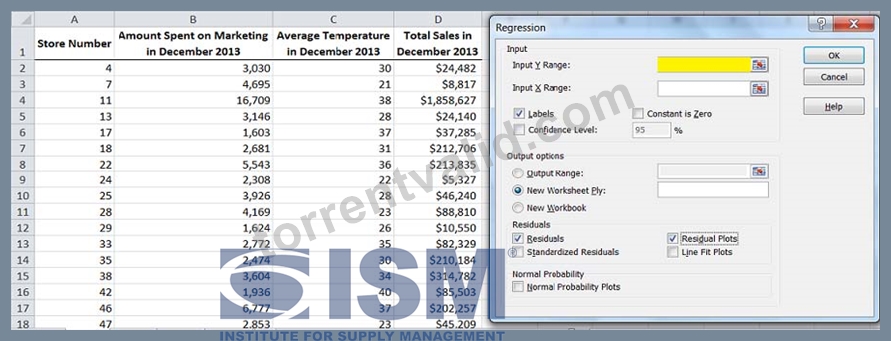
In the regression specified above, which cell range belongs in the highlighted region?
- A. B1:C51
- B. D1:D51
- C. C1:D51
- D. B1:B51
Answer: B
NEW QUESTION # 22
Which of the following items would be considered a relevant cash flow for capital budgeting purposes?
- A. Fixed operating expenses that will be incurred no matter which alternative is chosen
- B. Intangible and qualitative factors
- C. Research expenses incurred during the previous three years
- D. Incremental investment in working capital as the sales revenue increases
Answer: D
NEW QUESTION # 23
A college has recently finished building a new dining hall on campus. School administrators wish to survey students regarding their thoughts on the new dining hall. Which of the options below represents a correct sampling method?
- A. The school posts a survey on their Facebook page and collects responses from current students.
- B. An administrator surveys the first 50 students that enter the new dining hall that evening.
- C. The administrators randomly select students from each class who are then surveyed via phone.
- D. An administrator surveys the first 50 students that arrive to hear a guest speaker.
Answer: C
NEW QUESTION # 24
Which of the following figures does an analyst need to calculate from the income statement in order to calculate free cash flows?
- A. Earnings before interest and taxes
- B. Net revenue
- C. Capital expenditures
- D. Gross profit
Answer: A
NEW QUESTION # 25
In an automobile manufacturing factory, selected cars are subjected to a crash test to ensure they meet baseline safety requirements. The null hypothesis of the crash test is that all cars are safe. The manufacturer aims to guarantee that all cars it sells meet the safety requirements. Which type of error is MORE serious for the automobile manufacturer?
- A. Type I error
- B. Type II error
- C. Type I and Type II are equally serious.
- D. Neither Type I nor Type II is serious.
Answer: B
Explanation:
NEW QUESTION # 26
Why are ratios important when comparing different companies within the same industry?
- A. They eliminate the effect of size differences among the different companies.
- B. They reflect macroeconomic factors.
- C. They are useful for assessing the stage of the industry.
- D. Accounting policies might be different between companies.
Answer: A
NEW QUESTION # 27
Which of the following transactions represents an owner's equity transaction for a company?
- A. The purchase of shares in a company that's also a supplier
- B. An in-kind payment for services received
- C. A repurchase of a company's own stock
- D. A purchase of a building paid in cash
Answer: C
NEW QUESTION # 28
A restaurant that sells hamburgers is considering lowering prices to gain market share. The restaurant pays $3,000 a month for the building it occupies, and ingredients and labor cost $2.50 per hamburger. If the restaurant expects to sell 2,000 hamburgers a month, what is the minimum price it could charge?
- A. $3.50
- B. $4.00
- C. $2.50
- D. $3.00
Answer: B
NEW QUESTION # 29
A company's Balance Sheet for the year ended Dec. 31, 2013 is as follows:
(In millions)
The company is MOST likely in which of the following industries?
- A. Civil aviation
- B. Retailing
- C. Commercial banking
- D. Pharmaceutical
Answer: C
NEW QUESTION # 30
Accounting standards establish that companies should depreciate a long-lived physical asset, because:
- A. It is an explicit transaction beyond the current period.
- B. Not all assets are paid in cash at the time they are purchased.
- C. Costs should be matched with the benefits that are realized over multiple periods.
- D. Assets lose value in the long term.
Answer: C
NEW QUESTION # 31
In Dec. of 2013, a company signed a promissory note and recorded a note payable of $150,000. This note is payable in three equal annual installments beginning from Dec. of 2014. How should the company report the note payable on its Dec. 31, 2013 balance sheet?
- A. $150,000 in current liability
- B. $50,000 in noncurrent liability and $100,000 in current liability
- C. $50,000 in current liability and $100,000 in noncurrent liability
- D. $150,000 in noncurrent liability
Answer: C
NEW QUESTION # 32
Which of the following graphs shows a negative relationship between the two variables?
A)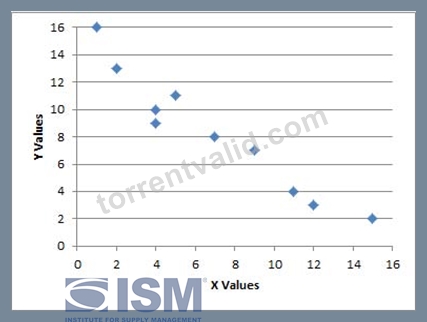
B)
C)
D)
- A. Option D
- B. Option B
- C. Option C
- D. Option A
Answer: D
NEW QUESTION # 33
A researcher wants to know the impact that obesity and universal health care have on the amount a country spends on healthcare as measured by the percentage of gross domestic product (GDP). The researcher collects data from 30 countries on the percentage of the population considered to be obese and whether that country offers universal health care to their citizens. A dummy variable is constructed to measure the latter: the variable is set to equal 1 for countries that offer universal health care and 0 for those that do not. The researcher wishes to set up a regression analysis to measure the effects these two variables have on health care spending. A partial view of the data is shown below.
Based on the available data, what ranges should be entered into the Excel regression dialog box for the dependent and independent variables?
- A. Dependent Variable. B1:C31; Independent Variable. D1:D31
- B. Dependent Variable. B1:B31; Independent Variable. C1:D31
- C. Dependent Variable. C1:D31; Independent Variable. B1:B31
- D. Dependent Variable. A1:A31; Independent Variable. B1:C31
Answer: B
NEW QUESTION # 34
A new smartphone is being released at a price of $100. A customer with a willingness to pay (WTP) of $105 walks to the store, sees that there is a long line, and decides to leave. Another customer with a WTP of $113 arrives at the store at the same time and decides to wait in the line. What can an observer deduce from this observation?
- A. The first customer has a higher opportunity cost of time than the second.
- B. The second customer has a higher opportunity cost of time than the first.
- C. The second customer considers the cost of waiting in line to be $13.
- D. The first customer considers the cost of waiting in line to be more than $5.
Answer: D
NEW QUESTION # 35
Which of the following options represent implicit transactions? (Select all that apply.)
- A. Interest expense accrued at the end of the fiscal year
- B. The recognition of revenue over time related to payment received in advance for a multiyear contract
- C. Recording a loss on the sale of a piece of plant equipment
- D. An inter-company sale of goods under a short term agreement
- E. The repurchase of shares of the company's stock
Answer: A,B
NEW QUESTION # 36
......
To prepare for the HBX CORe Final Examination, participants can access a range of resources provided by Harvard Business School. These resources include practice questions, video lectures, and interactive exercises. Participants are also encouraged to interact with other program participants through online discussion forums to share knowledge and insights. Harvard Business School also provides support through a team of dedicated program coaches who are available to answer questions and provide guidance.
Prepare With Top Rated High-quality CORe Dumps For Success in Exam: https://www.torrentvalid.com/CORe-valid-braindumps-torrent.html
Get Totally Free Updates on CORe Dumps PDF Questions: https://drive.google.com/open?id=1ttIL5iSyTxLnOTxIHQtmxLnlQSpo2vg9