


100% Free Real Updated 1z1-071 Questions & Answers Pass Your Exam Easily
Easily To Pass New 1z1-071 Verified & Correct Answers
NEW QUESTION # 144
View the Exhibit and examine PRODUCTS and ORDER_ITEMS tables.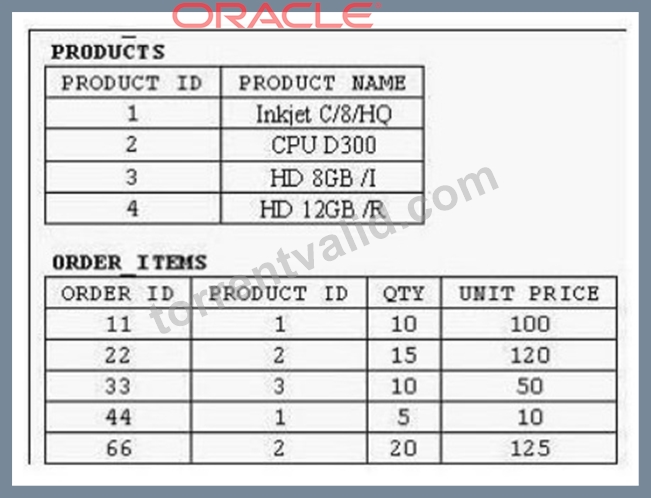
You executed the following query to display PRODUCT_NAME and the number of times the product has been ordered:
SQL>SELECT p.product_name, i.item_cnt
FROM (SELECT product_id, COUNT (*) item_cnt
FROM order_items
GROUP BY product_id) i RIGHT OUTER JOIN products p
ON i.product_id = p.product_id;
What would happen when the above statement is executed?
- A. The statement would not execute because the GROUP BY clause cannot be used in the inline.
- B. The statement would not execute because the ITEM_CNT alias cannot be displayed in the outer query.
- C. The statement would execute successfully to produce the required output.
- D. The statement would not execute because inline views and outer joins cannot be used together.
Answer: C
NEW QUESTION # 145
Which three actions can you perform by using the ALTER TABLE command?
- A. Lock a set of rows in a table CE Rename a table.
- B. Drop pseudo columns from a table.
- C. Drop all columns simultaneously from a table.
- D. Enable or disable constraints on a table.
- E. Restrict all DML statements on a table.
- F. Rename a table
Answer: A,D,F
NEW QUESTION # 146
Evaluate the following two queries: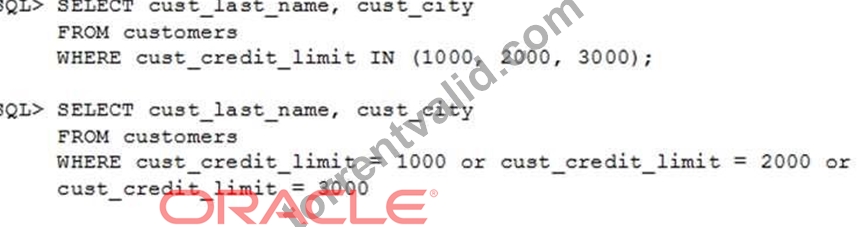
Which statement is true regarding the above two queries?
- A. Performance would improve in query 2 only if there are null values in the CUST_CREDIT_LIMIT column.
- B. There would be no change in performance.
- C. Performance would improve in query 2.
- D. Performance would degrade in query 2.
Answer: B
Explanation:
Explanation
NEW QUESTION # 147
Examine this description of the PRODUCTS table: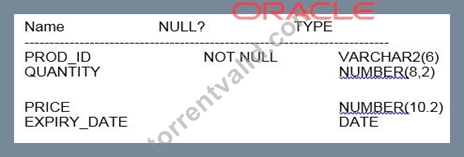
Rows exist in this table with data in all the columns. You put the PRODUCTS table in read-only mode. Which three commands execute successfully on PRODUCTS?
- A. ALTER TABLE products SET UNUSED(expiry_date);
- B. ALTER TAELE products DROP COLUMN expiry_date;
- C. DROP TABLE products
- D. TRUNCATE TABLE products;
- E. ALTER TABLE products DROP UNUSED COLUMNS
- F. CREATE INDEX price_idx on products (price);
Answer: C,E,F
NEW QUESTION # 148
You are designing the structure of a table in which two columns have the specifications:
COMPONENT_ID- must be able to contain a maximum of 12 alphanumeric characters and uniquely identify the row
EXECUTION_DATETIME- contains Century, Year, Month, Day, Hour, Minute, Second to the maximum precision and is used for calculations and comparisons between components.
Which two options define the data types that satisfy these requirements most efficiently?
- A. The EXECUTION_DATETIME must be of TIMESTAMP data type.
- B. The COMPONENT_IDmust be of VARCHAR2 data type.
- C. The COMPONENT_IDmust be of ROWID data type.
- D. The EXECUTION_DATETIME must be of INTERVAL DAY TO SECOND data type.
- E. The COMPONENT_IDcolumn must be of CHAR data type.
- F. The EXECUTION_DATETIME must be of DATE data type.
Answer: E,F
NEW QUESTION # 149
The PRODUCT_INFORMATION table has a UNIT_PRICE column of data type NUMBER (8, 2).
Evaluate this SQL statement:
SELECT TO_CHAR(unit_price, '$9,999') FROM product_information;
Which two statements are true about the output?
- A. A row whose UNIT_PRICE column contains the value 10235.99 will be displayed as $1,0236.
- B. A row whose UNIT_PRICE column contains the value 10235.99 will be displayed as #######.
- C. A row whose UNIT_PRICE column contains the value 1023.99 will be displayed as $1,023.
- D. A row whose UNIT_PRICE column contains the value 1023.99 will be displayed as $1,024.
- E. A row whose UNIT_PRICE column contains the value 10235.99 will be displayed as $1,023.
Answer: B,C
NEW QUESTION # 150
View the Exhibit and examine the structure of the EMP table which is not partitioned and not an index-organized table. (Choose two.)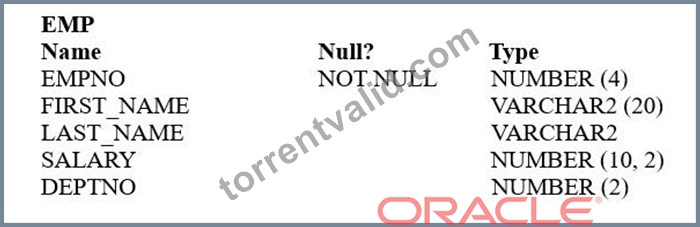
Evaluate this SQL statement:
ALTER TABLE emp
DROP COLUMN first_name;
Which two statements are true?
- A. The FIRST_NAME column can be dropped even if it is part of a composite PRIMARY KEY provided the CASCADE option is added to the SQL statement.
- B. The FIRST_NAME column would be dropped provided at least one column remains in the table.
- C. The FIRST_NAME column would be dropped provided it does not contain any data.
- D. The drop of the FIRST_NAME column can be rolled back provided the SET UNUSED option is added to the SQL statement.
Answer: B
NEW QUESTION # 151
View the Exhibit and examine the structure of the EMPtable which is not partitioned and not an index-organized table. (Choose two.)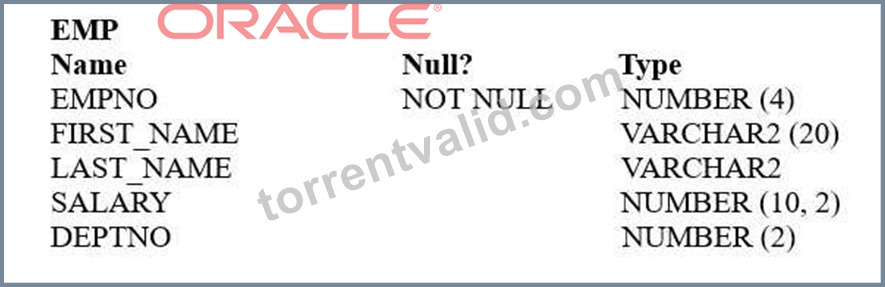
Evaluate this SQL statement:
ALTER TABLE emp
DROP COLUMN first_name;
Which two statements are true?
- A. The FIRST_NAMEcolumn can be dropped even if it is part of a composite PRIMARY KEYprovided the CASCADEoption is added to the SQL statement.
- B. The drop of the FIRST_NAMEcolumn can be rolled back provided the SET UNUSEDoption is added to the SQL statement.
- C. The FIRST_NAMEcolumn would be dropped provided at least one column remains in the table.
- D. The FIRST_NAMEcolumn would be dropped provided it does not contain any data.
Answer: C
Explanation:
Explanation
NEW QUESTION # 152
Which two statements are true about Oracle synonyms? (Choose two.)
- A. A synonym can be created on an object in a package.
- B. A synonym has an object number.
- C. Any user can create a PUBLICsynonym.
- D. All private synonym names must be unique in the database.
- E. A synonym can have a synonym.
Answer: A,D
Explanation:
Explanation/Reference: https://docs.oracle.com/cd/B19306_01/server.102/b14200/statements_7001.htm
NEW QUESTION # 153
Which three actions can you perform on an existing table containing date?
- A. Change the default value of a column.
- B. Define a default value that is automatically inserted into a column containing nulls.
- C. Change a DATE Column containing data to a NUMBER data type.
- D. Increase the width of a numeric column.
- E. Add a new NOT NULL Column with a DEFAULT value.
- F. Add a new column as the table's first column.
Answer: A,D,E
Explanation:
C: True. You can add a new NOT NULL column to an existing table, provided you specify a DEFAULT value for the column. This ensures that existing rows in the table can be updated with a default value, thus maintaining the NOT NULL constraint integrity.
E: True. It is permissible to increase the width of a numeric column, provided the change does not truncate existing data. This change is generally safe as it allows for greater values or more precision without affecting existing data.
F: True. The default value of a column can be changed. This action affects subsequent insert operations but does not alter the values of existing rows. Changing the default is useful for adapting tables to evolving business rules without impacting existing data.
NEW QUESTION # 154
Examine the business rule:
Each student can take up multiple projects and each project can have multiple students.
You need to design an Entity Relationship Model (ERD) for optimal data storage and allow for generating reports in this format:
STUDENT_ID FIRST_NAME LAST_NAME PROJECT_ID PROJECT_NAME PROJECT_TASK
Which two statements are true in this scenario?
- A. The ERD must have a M:M relationship between the STUDENTSand PROJECTSentities that must be resolved into 1:M relationships.
- B. The ERD must have a 1:M relationship between the STUDENTSand PROJECTSentities.
- C. STUDENT_IDmust be the primary key in the STUDENTSentity and foreign key in the PROJECTSentity.
- D. PROJECT_IDmust be the primary key in the PROJECTSentity and foreign key in the STUDENTSentity.
- E. An associative table must be created with a composite key of STUDENT_ID and PROJECT_ID, which is the foreign key linked to the STUDENTS and PROJECTS entities.
Answer: A,E
Explanation:
Explanation/Reference:
References:
http://www.oracle.com/technetwork/issue-archive/2011/11-nov/o61sql-512018.html
NEW QUESTION # 155
SCOTTis a user in the database.
Evaluate the commands issued by the DBA: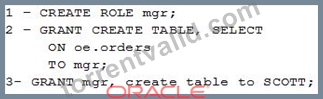
Which statement is true regarding the execution of the above commands?
- A. Statement 1 would not execute because the WITH GRANToption is missing.
- B. Statement 2 would not execute because system privileges and object privileges cannot be granted together in a single GRANTcommand.
- C. Statement 1 would not execute because the IDENTIFIED BY <password>clause is missing.
- D. Statement 3 would not execute because role and system privileges cannot be granted together in a single GRANTstatement.
Answer: B
NEW QUESTION # 156
View the Exhibits and examine the structure of the costs and promotions tables.
You want to display prod_ids whose promotion cost is less than the highest cost PR0D_ID in a promotion time interval.
Examine this SQL statement: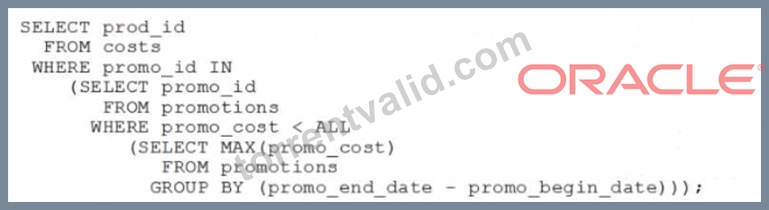
What will be the result?
- A. It gives an error because the all keyword is not valid.
- B. It gives an error because the ROUP BY clause is not valid.
- C. It executes successfully but does not give the required result.
- D. It executes successfully and gives the required result.
Answer: D
NEW QUESTION # 157
Examine the structure of the MEMBERStable:
Name Null? Type
------------------ --------------- ------------------------------
MEMBER_ID NOT NULL VARCHAR2 (6)
FIRST_NAME VARCHAR2 (50)
LAST_NAME NOT NULL VARCHAR2 (50)
ADDRESS VARCHAR2 (50)
You execute the SQL statement:
SQL > SELECT member_id, ' ' , first_name, ' ' , last_name "ID FIRSTNAME LASTNAME " FROM members; What is the outcome?
- A. It fails because the alias name specified after the column names is invalid.
- B. It executes successfully and displays the column details in three separate columns and replaces only the last column heading with the alias.
- C. It executes successfully and displays the column details in a single column with only the alias column heading.
- D. It fails because the space specified in single quotation marks after the first two column names is invalid.
Answer: B
NEW QUESTION # 158
Examine these statements executed in a single Oracle session:
CREATE TABLE product (pcode NUMBER(2),pname VARCHAR2(20));
INSERT INTO product VALUES(1,'pen');
INSERT INTO product VALUES (2,'pencil');
INSERT INTO product VALUES(3,'fountain pen');
SAVEPOINT a;
UPDATE product SET pcode=10 WHERE pcode =1;
COMMIT;
DELETE FROM product WHERE pcode =2;
SAVEPOINT b;
UPDATE product SET pcode=30 WHERE pcode =3;
SAVEPOINT c;
DELETE FROM product WHERE pcode =10;
ROLLBACK TO SAVEPOINT b;
COMMIT;
Which three statements are true
- A. There is no row containing pen
- B. There is no row containing pencil.
- C. The code for pen is 10.
- D. The code for pen is 1.
- E. There is no row containing fountain pen.
- F. The code for fountain pen is 3
Answer: A,B,C
Explanation:
* After creation and initial inserts, the pcode for 'pen' is updated to 10, and then committed.
* The 'pencil' row is deleted and not yet committed.
* A savepoint b is set after the deletion of the 'pencil' row.
* The 'fountain pen' pcode is updated to 30, followed by setting savepoint c.
* The 'pen' row (now with pcode 10) is deleted.
* A rollback to savepoint b reverts the deletion of 'pen' and the update to 'fountain pen', but not the deletion of 'pencil', which was committed earlier due to the scope of the savepoint.
* Therefore, after the final commit:
* A: The code for 'pen' is 10, since the update was committed and the subsequent delete was rolled back.
* C: There is no row containing 'pencil' because its deletion was committed.
* F: There is a row containing 'pen' because the deletion was rolled back to savepoint b which was set after the deletion of 'pencil'.
NEW QUESTION # 159
Examine the description of the EMPLOYEES table: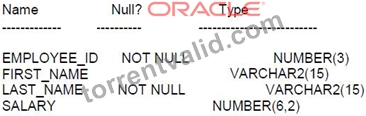
Which two statements will run successfully?
- A. SELECT 'The first_name is '''||first_name ||'''' FROM employees ;
- B. SELECT 'The first_name is '|| first_name|| '' FROM employees;
- C. SELECT 'The first_name is ''' ||first_name||''' FROM employees ;
- D. SELECT 'The first_name is \'' || first_name || '\'' FROM employees;
- E. SELECT 'The first_name is '' || first_name || '' FROM employees ;
Answer: A,C
Explanation:
In Oracle SQL, to include single quotes in a string literal, you need to use two single-quote characters.
A). This statement will not run successfully because the single quotes are not properly escaped. After the text The first_name is , there should be two single quotes to start the string literal for the first name.
B). This statement will run successfully. It properly escapes the single quotes by using two single quotes around first_name. This will result in the output like The first_name is 'John'.
C). This statement will run successfully as well. The two single quotes after The first_name is and before FROM employees are correctly used to delimit the first name.
D). This statement will not run successfully. There is a missing single quote before the double pipe (||) operator, and at the end of the statement, only one single quote is used instead of two for escaping.
E). This statement will not run successfully because the backslash is not used to escape single quotes in Oracle SQL. The proper method is to use two single quotes without a backslash.
References:
* Oracle Database SQL Language Reference, 12c Release 1 (12.1): "Text Literals"
* Oracle Database SQL Language Reference, 12c Release 1 (12.1): "String Concatenation Operator"
NEW QUESTION # 160
You executed the following CREATE TABLE statement that resulted in an error:
SQL> CREATE TABLE employees(emp_id NUMBER(10) PRIMARY KEY, ename VARCHAR2(20), email NUMBER(3) UNIQUE, address VARCHAR2(500), phone VARCHAR2(20), resume LONG, hire_date DATE, remarks LONG, dept_id NUMBER(3) CONSTRAINT emp_dept_id_fk REFERENCES departments (dept_id), CONSTRAINT ename_nn NOY NULL(ename));
Identify two reasons for the error.
- A. The FOREIGN KEY keyword is missing in the constraint definition
- B. The NOT NULL constraint on the ENAME column must be defined as the column level
- C. Only one LONG column can be used per table
- D. The PRIMARY KEY constraint in the EMP_ID column must have a name and must be defined at the table level only
- E. FOREIGN KEY defined on the DEPT_ID column must be at the table level only
Answer: B,C
NEW QUESTION # 161
View the Exhibit and examine the structure of the ORDERS table.
Which UPDATE statement is valid?
- A. UPDATE ordersSET order_date = '12-mar-2007',order_total = NULLWHERE order_id
2455; - B. UPDATE ordersSET order_date = '12-mar-2007',order_total IS NULLWHERE order_id
= 2455; - C. UPDATE ordersSET order_date = '12-mar-2007',AND order_total
TO_NUMBER(NULL)WHERE order_id = 2455; - D. UPDATE ordersSET order_date = TO_DATE('12-mar-2007','dd-mon-yyyy'),SET order_total = TO_NUMBER (NULL)WHERE order_id = 2455;
Answer: A
NEW QUESTION # 162
View the Exhibit and examine the data in the PROMOTIONS table.
PROMO_BEGIN_DATE is stored in the default date format, dd-mon-rr.
You need to produce a report that provides the name, cost, and start date of all promos in the POST category that were launched before January 1, 2000.
Which SQL statement would you use?
- A. SELECT promo_name, promo_cost, promo_begin_dateFROM promotionsWHERE promo_category = 'post' AND promo_begin_date < '01-01-00';
- B. SELECT promo_name, promo_cost, promo_begin_dateFROM promotionsWHERE promo_category LIKE '%post%' AND promo_begin_date < '1-JAN-00';
- C. SELECT promo_name, promo_cost, promo_begin_dateFROM promotionsWHERE promo_cost LIKE 'post%' AND promo_begin_date < '01-01-2000';
- D. SELECT promo_name, promo_cost, promo_begin_dateFROM promotionsWHERE promo_category LIKE 'P%' AND promo_begin_date < '1-JANUARY-00';
Answer: B
NEW QUESTION # 163
Examine the structure of the PROGRAMS table:
Which two SQL statements would execute successfully?
- A. SELECT NVL (MONTHS_BETWEEN (start_date, end_date), 'Ongoing') FROM
programs; - B. SELECT NVL (TO_CHAR (MONTHS_BETWEEN (start-date, end_date)), 'Ongoing') FROM programs
- C. SELECT TO_DATE (NVL (SYSDATE-END_DATE, SYSDATE)) FROM programs;
- D. SELECT NVL (ADD_MONTHS (END_DATE,1) SYSDATE) FROM programs;
Answer: B,D
NEW QUESTION # 164
Examine this list of requirements for a sequence:
1. Name:EMP_SEQ
2. First value returned:1
3. Duplicates are never permitted.
4. Provide values to be inserted into the EMPLOYEES.EMPLOYEE_ID COLUMN.
5. Reduce the chances of gaps in the values.
Which two statements will satisfy these requirements?
- A. CREATE SEQUENCE emp_seq;
- B. CREATE SEQUENCE emp_seq NOCACHE;
- C. CREATE SEQUENCE emp_seq START WITH 1 INCREMENT BY 1 CACHE;
- D. CREATE SEQUENCE emp_seq START WITH 1 CACHE;
- E. CREATE SEQUENCE emp_seq START WITH 1 INCRENENT BY 1 NOCACHE;
- F. CREATE SEQUENCE emp_seq START WITH 1 INCREMENT BY 1 CYCLE;
Answer: B,E
NEW QUESTION # 165
Examine this description of the PRODUCTS table:
You successfully execute this command:
CREATE TALE new_prices(prod_id NUBER(2),price NUMBER(8,2));
Which two statements execute without errors?
- A. MERGE INTO new_prices n
USING(SELECT*FROM products)p
WHEN MATECHED THEN
UPDATE SET n.price=p.cost*.01
WHEN NOT MATCHED THEN
INSERT(n.prod_id,n.price)VALUES (p.prod_id,cost*01)
WHERE(p.cost<200); - B. MERGE INTO new_prices n
USING products p
WHEN NOT NATCHED THEN
INSERT (n.prod_id, n.price)VALUES (p.prod_id,cost*.01)
WHERE (p.cost <200); - C. MERGE INTO new_prices n
USING(SELECT*FROM product WHERE cost>150) p
ON (n.prod_id=p.prod_id)
WHEN NATCHED THEN
DELETE WHERE(p.cost<200)
WHEN NOT MATCHED THEN
INSERT (n.prod_id,n.price)VALUES (p.prod_id,p.cost*.01); - D. MERGE INTO new_prices n
USING (SELECT * FROM products WHERE cost>150) p
ON (n.prod_id=p.prod_id)
WHEN NATCHED THEN
UPDATE SET n.price=p.cost*.01
DELETE WHERE (p.cost<200);
Answer: B,C
Explanation:
In the context of the MERGE statement, certain syntax rules and logical sequences must be observed:
* Option B:
* Correct use of the MERGE statement includes specifying the source and target correctly, and handling cases for matched and unmatched rows. This option properly structures the MERGE command with correct conditions for both matching (on prod_id) and actions (insert for unmatched, and delete under certain conditions for matched rows).
* Option D:
* While this option has a typographical error with "WHEN NOT NATCHED", assuming it's intended as "WHEN NOT MATCHED", it correctly describes the action for inserting into new_prices when no match is found in the target table based on the condition specified (product cost less than 200).
Options A and C contain syntax errors and logical contradictions (such as attempting to both update and delete in the same matched clause without proper separation or conditions), which are not allowed in a single WHEN MATCHED clause in Oracle SQL.
NEW QUESTION # 166
The SALES table has columns PROD_IDand QUANTITY_SOLDof data type NUMBER.
Which two queries execute successfully? (Choose two.)
- A. BY COUNT(*) >10;
SELECT COUNT(prod_id) FROM sales GROUP BY prod_id WHERE quantity_sold > 55000; - B. prod_id;
SELECT prod_id FROM sales WHERE quantity_sold > 55000 AND COUNT(*) > 10 GROUP - C. SELECT prod_id FROM sales WHERE quantity_sold > 55000 GROUP BY prod_id HAVING
- D. COUNT(*) >10;
SELECT prod_id FROM sales WHERE quantity_sold > 55000 AND COUNT(*) > 10 GROUP - E. BY prod_id HAVING COUNT(*) >10;
SELECT COUNT (prod_id) FROM sales WHERE quantity_sold > 55000 GROUP BY
Answer: C,E
NEW QUESTION # 167
Examine the structure of the PROMOTIONS table: (Choose the best answer.)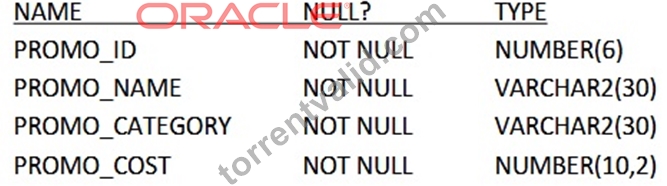
Management requires a report of unique promotion costs in each promotion category.
Which query would satisfy this requirement?
- A. SELECT DISTINCT promo_cost, DISTINCT promo_category FROM promotions;
- B. SELECT DISTINCT promo_cost, promo_category FROM promotions
- C. SELECT promo_category, DISTINCT promo_cost FROM promotions
- D. SELECT DISTINCT promo_category, promo_cost FROM promotions ORDER BY 1
Answer: D
NEW QUESTION # 168
Which two statements are true about dropping views? (Choose two.)
- A. CASCADE CONSTRAINTSmust be specified when referential integrity constraints on other objects refer to primary or unique keys in the view to be dropped.
- B. The creator of a view to be dropped must have the DROP ANY VIEWprivilege.
- C. Data selected by a view's defining query is deleted from its underlying tables when the view is dropped.
- D. Views referencing a dropped view become invalid.
- E. Read only views cannot be dropped.
Answer: A,B
Explanation:
The view must be in your own schema or you must have the DROP ANY VIEW system privilege.
Specify CASCADE CONSTRAINTS to drop all referential integrity constraints that refer to primary and unique keys in the view to be dropped.
Reference: https://docs.oracle.com/cd/B12037_01/server.101/b10759/statements_9009.htm
NEW QUESTION # 169
......
Free 1z1-071 Exam Files Downloaded Instantly: https://www.torrentvalid.com/1z1-071-valid-braindumps-torrent.html
Verified & Latest 1z1-071 Dump Q&As with Correct Answers: https://drive.google.com/open?id=1nqVH06kb-ZcogbgAXHwao3nntI-uPPiM