


[Sep-2026] Study resources for the Valid HPE7-A06 Braindumps!
Updated HPE7-A06 Tests Engine pdf - All Free Dumps Guaranteed!
NEW QUESTION # 55
Refer to the exhibit which illustrates the current configuration of Router-1.
Clients of VLAN 10 require access to services hosted in the 10.1.100.0/24subnet. This 'equites one 01 more routes to be added to Rculer-1 that do not currently exist.
Which script would install a route from 10.2.10.0/24 to 10.1.100.0/24 on Router-1? A return path is not required as part of this answer.
- A. there is no solution as Core-1 is not part of VRF service
- B. ip route 0.0.0.0/0 10.255.101.11 vrf service
ip route 10.255.101.0/24 1/1/1 vrf IoT-Medical
ip route 10.1.100.0/24 10.255.101.11 vrf IoT-Medical - C. ip route 0.0.0.0/0 10.255.101.11 vrf service
ip route 10.1.100.0/24 1/1/1:10.255.101.11 vrf IoT-Medical - D. ip route 0.0.0.0/0 10.255.101.11 vrf service
ip route 10.1.100.0/24 1/1/1 vrf IoT-Medical
Answer: B
Explanation:
The goal is to add a static route on Router-1 to allow clients in VLAN 10 (subnet 10.2.10.0/24, presumably in VRF 'IoT-Medical' based on options) to reach services in the 10.1.100.0/24 subnet. The exhibit indicates interface 1/1/1 (IP 10.255.101.10/24) is in VRF 'service', and the likely next hop towards the destination is Core-1 at 10.255.101.11 (also implied to be reachable via VRF 'service'). This requires adding a route in the source VRF ('IoT-Medical') pointing towards the destination via the next hop in the 'service' VRF.
* Static Route Syntax (with VRF):ip route <destination_prefix> <next-hop-ip> [vrf <source-vrf>]
* Analysis of Options:
* A: Claims Core-1 isn't in VRF 'service', contradicting the likely setup.
* B: Uses unusual interface:ip syntax (1/1/1:10.255.101.11). Defines the route in VRF 'IoT- Medical'.
* C: Uses interface 1/1/1 as the next hop. This is less specific than using the IP address and relies on the interface being point-to-point or having proxy ARP enabled. Defines the route in VRF
'IoT-Medical'.
* D: ip route 10.1.100.0/24 10.255.101.11 vrf IoT-Medical. This uses the standard syntax to define a static route for the destination 10.1.100.0/24 via the next-hop IP 10.255.101.11 within the context of the IoT-Medical VRF. The successful function of this route depends on inter-VRF routing (route leaking) being configured between 'IoT-Medical' and 'service' VRFs, but the command itself correctly defines the desired static route.
* Conclusion:Option D provides the correct and standard command syntax to configure the required static route within the specified source VRF ('IoT-Medical').
References:AOS-CX IP Routing Guide (Static Routes), AOS-CX VRF Configuration Guide (Inter-VRF Routing). This relates to the "Routing" (16%) and "Connectivity" (9%) objectives.
NEW QUESTION # 56
A Python developer could not modify the VLAN database on an AOS-CX switch through the REST API.
Which settings should the developer check first? (Select two.)
- A. HTTPS settings
- B. local-user settings
- C. SSH settings
- D. REST API settings
- E. SNMP settings
Answer: A,B
Explanation:
A Python developer using the REST API cannot modify the VLAN database on an AOS-CX switch. We need to identify the first settings to check.
* REST API Requirements for Modification:
* HTTPS Server:The REST API operates over HTTPS, so the HTTPS server must be enabled on the switch (show https-server status).
* REST Interface:The REST API interface itself must be enabled (it usually is by default, check with show rest-interface).
* Authentication:The API client must provide valid credentials (username/password or token) for a user account configured on the switch.
* Authorization:The authenticated user account must have sufficient privileges to modify the configuration (e.g., belong to the built-in administrators group or a custom role with appropriate permissions). Check user details (show user <name>) and role permissions (show user roles).
* Analysis of Options:
* A. HTTPS settings: Essential for API communication. Check if enabled.
* B. SSH settings: Irrelevant to REST API.
* C. SNMP settings: Irrelevant to REST API.
* D. REST API settings: Check if enabled (show rest-interface), but it's usually enabled by default.
Less likely than A or E to be the initial problem.
* E. local-user settings: Crucial for both authentication (correct credentials used?) and authorization (does the user have modification privileges?).
* Conclusion:When a REST API modification fails, the most critical initial checks involve ensuring the API endpoint is accessible (HTTPS Server enabled - A) and that the user account being used for the API call has the necessary permissions (local-user settings, specifically privileges/roles - E).
References:AOS-CX REST API Guide, AOS-CX Security Guide (User Accounts, Roles, HTTPS Server configuration). This relates to "Security" (10%) and "Authentication/Authorization" (9%).
NEW QUESTION # 57
Refer to the exhibit.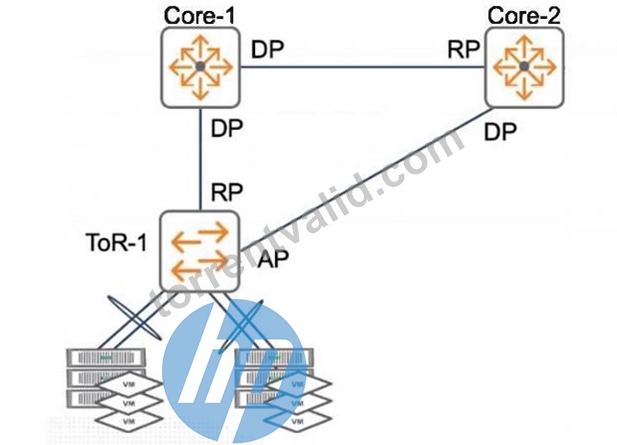
Acme Corp has VM workload running downstream of ToR-1 and has noticed performance degradation. They suspect ToR-1 uplinks are periodically overutilized. A partner has suggested you migrate your legacy 1U Core-1 and Core-2 to the CX 6400 series.
Which aspects of this platform would solve the customer's problem, while focusing on implementing HPE Aruba Networking best practices? (Choose two.)
- A. The port density of the CX 6400 series chassis permits the direct connection of the VM hypervisors to the core.
- B. MC-LAG permits Core-1 and Core-2 to present the edge 802.3ad device as a common "system ID".
- C. The proposed new core's VSF capability allows multiple active forwarding pathways from ToR-1 based while eliminating the need for STP.
- D. The CX 6400 series supports multiple active forwarding pathways from ToR-1 based on multi- region design.
- E. The proposed solutions backplane stacking permits the directly connected ESXI hosts to load balance using active LACP.
Answer: B,C
Explanation:
Moving to CX 6400 with VSX/MC-LAG lets Core-1 and Core-2 appear as a single LACP partner (common system ID) to ToR-1. This enables active-active uplinks and balances traffic across both cores, reducing uplink overutilization.
Using a multi-chassis/stacked core eliminates blocked STP links so ToR-1 has multiple active forwarding paths, further improving utilization and resiliency.
NEW QUESTION # 58
Refer to the exhibit.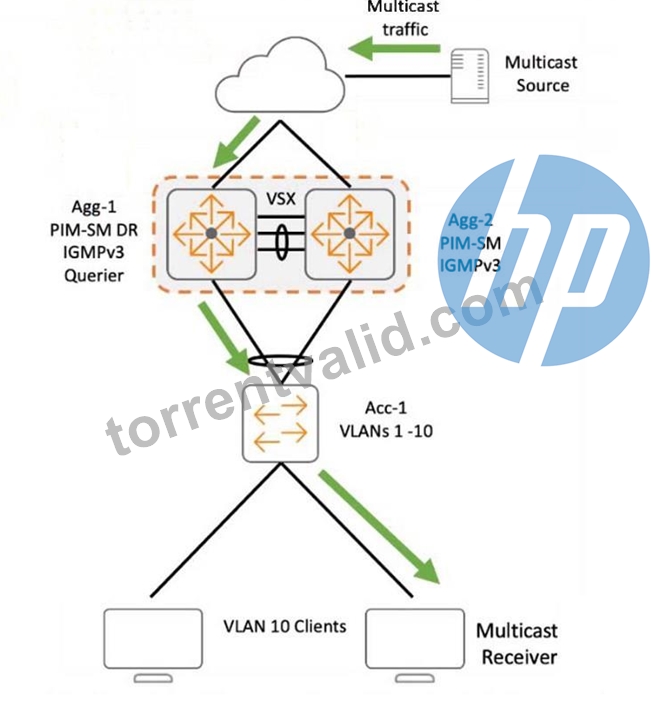
During the update of the aggregation switches, Acc-1 clients were not able to receive multicast traffic for a few seconds. How can you improve the downtime for multicast traffic to a minimum time?
- A. Configure VSX active forwarding on Agg-1 and Agg-2 switches.
- B. Enable config-sync multicast at the VSX command context.
- C. Enable PIM active-active feature on both Agg-1 and Agg-2.
- D. Change multicast routing protocol from PIM-SM to PIM-DM.
Answer: C
Explanation:
In a VSX environment, only one aggregation switch (Agg-1) is the PIM-SM Designated Router (DR) and IGMP querier. During an upgrade, when Agg-1 is unavailable, multicast traffic forwarding fails until Agg-2 takes over. By enabling the PIM active-active feature on both Agg-1 and Agg-2, multicast forwarding becomes synchronized and seamless across both devices, reducing downtime to the minimum.
NEW QUESTION # 59
A customer is experiencing problems with BGP on their AOS-CX network. The users cannot access specific resources on the network, even though they have been assigned the appropriate roles and permissions.
What is the most likely cause of the problem?
- A. The GBP database is corrupted.
- B. The HPE Aruba Networking ClearPass configuration is incorrect.
- C. The GBP tags are not being applied correctly to the user's traffic.
- D. The users are not being assigned the correct GBP classes.
Answer: C
Explanation:
In AOS-CX, Group-Based Policy (GBP) relies on correct tagging of user traffic. If GBP tags are not applied properly, even users with the correct roles and permissions will not be able to access the intended network resources. This makes incorrect tag application the most likely cause of the BGP-related issue described.
NEW QUESTION # 60
A senior engineer from the network operations team has reported an intermittent problem where some PoE-powered devices are randomly losing power. During your investigation, you find that port 1 of the Acc-1 switch is currently presenting the behavior shown in the CLI output for the Acc-1.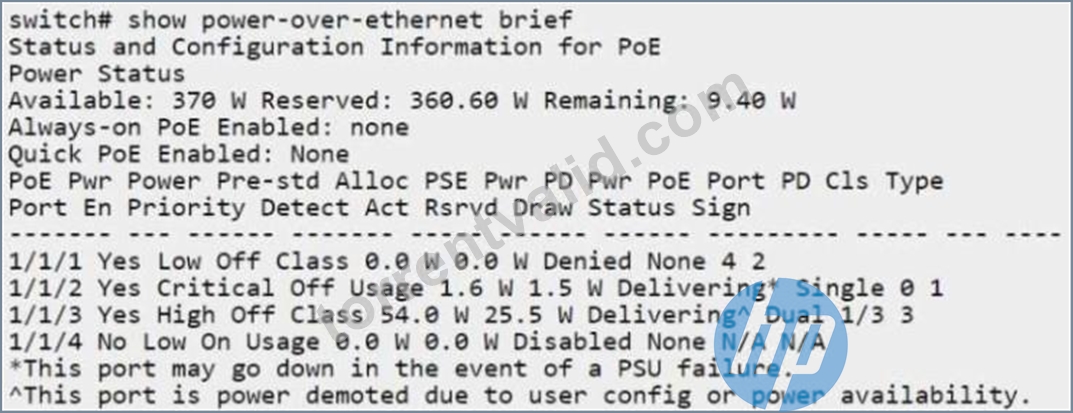
What is a probable cause for poor 1/1/1 is denying PoE?
- A. This switch does not support PoE class 4.
- B. switch PoE power budget exceeded
- C. PoE was manually disabled for port 1/1/1
- D. PoE port priority set to low
Answer: B
Explanation:
The output shows: Available: 370 W, Reserved: 360.60 W, Remaining: 9.40 W.
Port 1/1/1 has status "Denied" for PoE power delivery and is set to "Low" priority.
This means the PoE power budget is nearly exhausted and the switch cannot allocate more PoE power to additional ports, especially those with low priority.
NEW QUESTION # 61
An HPE Aruba NetworkingCX switch administrator wants to monitor all inter-switch connections and change their descriptions dynamically with Python scriptand NAE engine. The administratorhas written the script template and uploaded it to the switch GUI. After the upload, not all data is stored as planned.
Which things should be checked first? (Select three.]
- A. processor usage
- B. monitor usage
- C. flash memory usage
- D. scriptusage
- E. memory usage
- F. Agent usage
Answer: B,D,F
Explanation:
An NAE (Network Analytics Engine) Python script designed to monitor links and update descriptions isn't storing data as planned. We need the first things to check (select three).
* NAE Components & Troubleshooting:NAE involves Agents running Scripts, often triggered by Monitors observing system state (like interface status or LLDP changes). Failures can occur in any component or due to resource issues.
* Initial Checks:
* Script (script usage - C):Check the script itself for syntax errors, logic flaws, status, and logs (show nae script <name> [status|log]). Ensure it's uploaded correctly and enabled.
* Agent (Agent usage - B):Check the agent configured to run the script. Is it running? Are its parameters correct? Are there errors associated with the agent? (show nae agent [status|detail]).
Check agent resource limits.
* Monitor (monitor usage - E):If the script relies on a monitor to trigger or gather data, check the monitor's status, configuration, and associated conditions (show nae monitor [status|detail]). Is the monitor detecting the intended events?
* Resources (Processor/Memory/Flash - D, F, A):General switch health is important. High CPU (D) or memory (F) usage could prevent the script/agent from running correctly. If the script is supposed to store datapersistently (e.g., write to a file or NAE database), check flash memory usage (A) or NAE database limits.
* Conclusion:When troubleshooting NAE, the core components to check first are the Script itself (C), the Agent running it (B), and any Monitors it depends on (E). These cover the specific NAE elements involved. General system resources (D, F, A) are secondary checks if the core components appear configured correctly but still fail.
References:AOS-CX NAE Guide (Scripting, Agents, Monitors, Troubleshooting). This relates to
"Troubleshooting" (10%) and potentially "Performance Optimization" (6%).
NEW QUESTION # 62
Security administrators are complaining about the number if HPE Aruba Networking ClearPass Access Tracker events from the user 'radius-test'. Given the configuration below, hao can the number of events be reduced?
- A. Increase the tracking interval.
- B. Decrease the tracking retries.
- C. Configure 'dead-only' tracking mode.
- D. Configure 'any' tracking mode.
Answer: C
Explanation:
The configuration shown enables RADIUS server tracking using the test user radius-test. By default, this generates continuous Access Tracker events because every probe attempt is logged.
To reduce the number of events, the tracking mode should be changed to dead-only, which limits authentication probes to when the RADIUS server is marked as unreachable. This way, ClearPass only sees test authentications when a failure condition occurs, significantly reducing unnecessary log entries.
NEW QUESTION # 63
A customer is trialing the below colorless port configuration on a single switch and has noticed that users roaming to access points connected to the test switch are unable to receive an IP address on the corporate Wi- R network, which is operating in bridged mode All other SSIDs are working as expected and the AP is Online in HPE Aruba Networking Central.
The security team reports that there have been no failed authentications m HPE Aruba Networking ClearPass Access Tracker and that the last entry for the wiredport is returning the KADIUS Aruba-User-Hold attribute
'Access_Point.
Which configuration change is required to resolve the issue?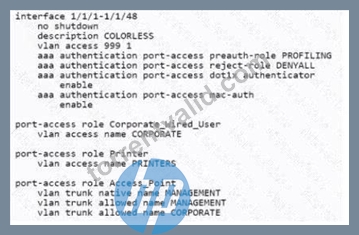
- A. port-access client-move enable
- B. port access role Access_point auth-mode device-mode
- C. interface 1/1/1/1-1/48
port-access onboarding-method concurrent enable - D. interface 1/1/1-1/1/48
aaa authentication port-access client-limited 0
Answer: D
Explanation:
The issue involves users roaming to APs connected to a test switch failing to receive an IP address on the corporate Wi-Fi network (bridged mode), with ClearPass reporting a RADIUS Aruba-User-Role attribute of Access_Point. The goal is to identify the configuration change needed to resolve this issue.
* Analysis of Options:
* Option A (port-access client-move enable):Enables client movement between ports but does not address the AP authentication issue.
* Option B (aaa authentication port-access client-limit 0):Correct. Setting the client limit to 0 on the switch ports (1/1/1-1/1/48) disables MAC authentication for APs, allowing them to be treated as trusted devices and preventing the application of an incorrect role.
* Option C (port-access onboarding-method concurrent enable):Enables concurrent onboarding but is unrelated to the AP role issue.
* Option D (port-access role Access_point auth-mode device-mode):Configures a device mode role but does not resolve the IP assignment issue caused by incorrect authentication.
* Why Option B is Correct:The issue arises because the switch is applying 802.1X or MAC authentication to the AP ports, resulting in ClearPass assigning the Access_Point role, which restricts client connectivity. By setting aaa authentication port-access client-limit 0 on the AP-connected ports (1
/1/1-1/1/48), the switch disables port-access authentication for these ports, treating the APs as trusted devices. This allows clients to authenticate properly via the AP and receive IP addresses in bridged mode, resolving the issue.
* Relevance to Certification Objectives:
* WLAN (9%):Involves troubleshooting wireless functions and Layer 2 issues related to AP connectivity.
* Authentication/Authorization (9%):Includes troubleshooting ClearPass integration and 802.1X configurations.
* Security (10%):Covers troubleshooting wired 802.1X implementations.
References:
HPE Aruba Networking AOS-CX Configuration Guide: Port Access Authentication, detailing client-limit configuration.
HPE7-A06Study Guide: Covers ClearPass integration and AP authentication troubleshooting.
HPE Aruba Networking Technical Documentation: Dynamic Segmentation and Port Access Security.
NEW QUESTION # 64
Ever since a recent firewall change at your WAN/lnternet edge, the 8GP state in your VSX pair has not returned to Established. What should you check to restore BGP functionality at the site?
- A. Confirm that appropriate TCP ports are still allowed.
- B. Confirm that BGP Peer AS has not changed.
- C. Restart the routing service so thatBGP auto-discovers its neighbors.
- D. Restart NAT service for the BGP interface.
Answer: A
Explanation:
The BGP state on a VSX pair is stuck (not 'Established') after a recent firewall change at the WAN/Internet edge, where the BGP peering likely occurs.
* BGP and Firewalls:BGP establishes sessions usingTCP port 179. Firewalls located between BGP peers must explicitly permit TCP port 179 traffic bidirectionally for the peering to establish and maintain. Firewall changes are a frequent cause of broken BGP sessions.
* Troubleshooting Steps After Firewall Change:The most logical first step is to verify that the firewall change did not inadvertently block TCP port 179 between the configured BGP neighbor IP addresses.
* Analysis of Options:
* A: Restarting routing service is disruptive and not the first step.
* B: Confirming that appropriate TCP ports (specifically 179) are still allowed through the firewall directly addresses the most probable cause related to the firewall change event.
* C: Restarting NAT service is likely irrelevant unless NAT is incorrectly configured for BGP peers.
* D: Confirming the peer AS is a basic configuration check but less likely related to thefirewall changeevent than port blocking.
* Conclusion:Given the problem occurred immediately following a firewall change, verifying that the firewall still permits TCP port 179 between the BGP peers is the most direct and likely troubleshooting step.
References:BGP protocol specifications (RFC 4271), Firewall management principles, Network troubleshooting methodology. This relates to "Routing" (16%), "Security" (10%), and "Troubleshooting" (10%) objectives.
NEW QUESTION # 65
In an HPE network, which scenarios can indicate a configuration issue with Link Aggregation (LACP)?
- A. Spanning tree topology changes
- B. Increased latency on traffic paths
- C. Port flapping
- D. Unstable link state
Answer: B,C,D
NEW QUESTION # 66
Refer to the exhibit.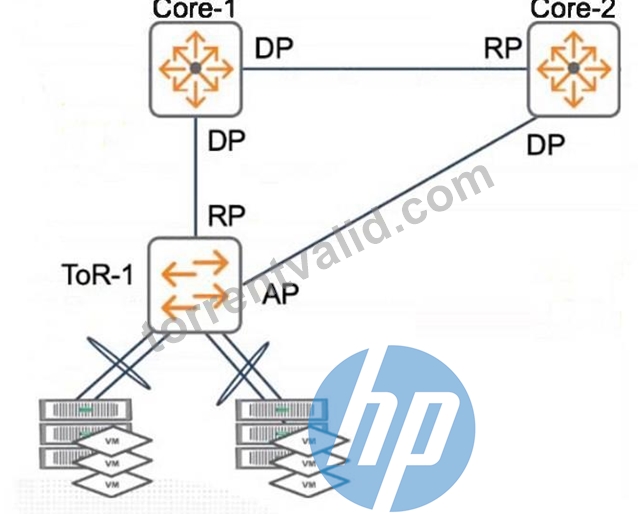
Acme Corp has VM workload running from ToR-1, and has noticed performance degradation.
They suspect ToR-1 uplinks are periodically overutilized.
List valid reasons why ToR-1 uplinks are being overutilized based on the diagram. (Choose two.)
- A. Core-1 and Core-2 are not running the same firmware.
- B. Core-2 has been incorrectly configured as the root bridge.
- C. The customer has used the default MSTP region configuration.
- D. ToR-1 uplinks and downlinks are both running spanning-tree port-type admin-network.
- E. The VLAN to instance mapping is not the same on all switches.
Answer: C,E
Explanation:
With default MSTP region settings, devices form different regions, so only the CIST participates across them. This removes per-instance load-sharing and pushes all VLANs over a single active uplink, overutilizing it.
If VLAN-to-instance mappings differ between switches, MSTP instances don't align end-to-end, so VLANs cannot split paths per instance and converge onto one uplink, causing periodic overutilization.
NEW QUESTION # 67
Refer to the exhibit.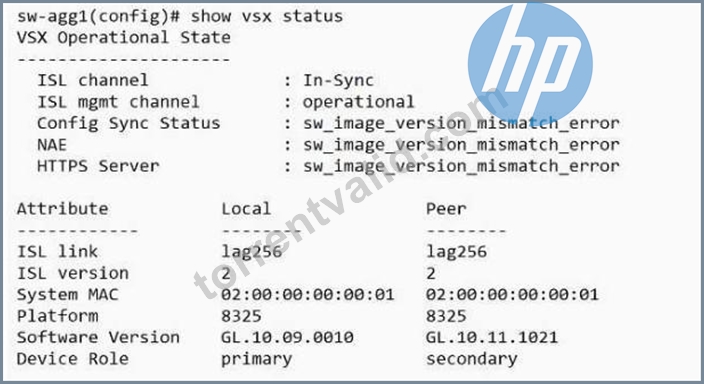
Based on the screenshot, what is required to bring the secondary switch MCLAG interfaces online?
- A. Use the same CX OS version as on the primary.
- B. Use vsx-software-upgrade on the secondary.
- C. Use the same ServiceOS version as on the primary.
- D. Update the NAE agents on the secondary.
Answer: A
Explanation:
The error messages (sw_image_version_mismatch_error) in the VSX status output indicate that the primary (GL.10.09.0010) and secondary (GL.10.11.1021) switches are running different AOS- CX software versions. For VSX peers to synchronize and bring MCLAG interfaces online, both devices must run the same AOS-CX software version.
NEW QUESTION # 68
A customer has configured 802.1X authentication with MAC authentication fallback and is complaining that printers are not accessible with the new configuration below.
You can see a successful entry in HPE Aruba Networking ClearPass Access Tracker assigning the correct user role and you have confirmed that the printer MAC address is being learned in the correct VLAN. However, the printer network settings show an IP address starting with 169.254.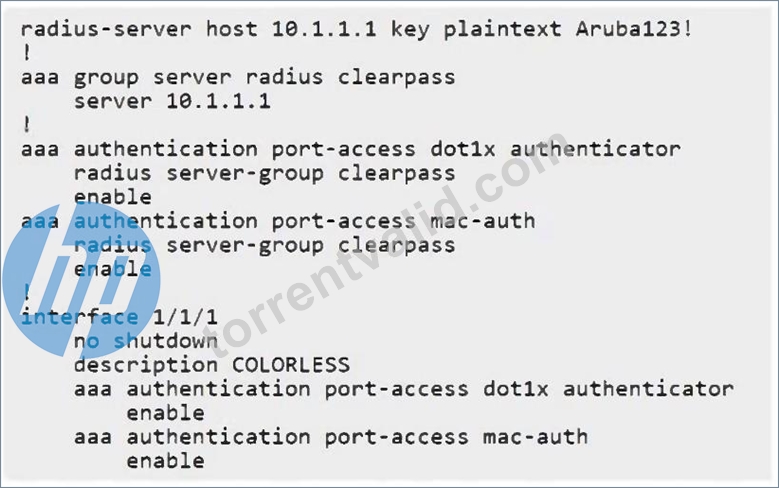
Which configuration change would you recommend to resolve the issue?
interface 1/1/1
- A. aaa authentication port-access auth-priority dot1x mac-auth
- B. interface 1/1/1
- C. aaa authentication port-access auth-precedence mac-auth dot1x
aaa authentication allow-fail-through - D. port-access onboarding-method concurrent enable
interface 1/1/1
Answer: C
Explanation:
Printers don't do 802.1X. With the default order, the switch waits for 802.1X to fail before trying MAC authentication, causing DHCP to time out and the printer to self-assign a 169.254 address.
Set the authentication order so MAC auth is tried first:
interface 1/1/1
aaa authentication port-access auth-precedence mac-auth dot1x
This lets the printer authenticate immediately via MAC and obtain a DHCP address in the correct VLAN.
NEW QUESTION # 69
You are troubleshooting a network issue on a VSX cluster. The network was functioning properly yesterday but today the network operations center is receiving alerts. On one of the two VSX members, a 'show interface brief' indicated that all VSX LAGs are "down by feature".
What could be the cause of this condition?
- A. LAGs were disabled because a split-brain condition was detected.
- B. Both VSX members are configurated as Primary.
- C. VSX has detected a firmware version mismatch.
- D. VSX-sync is not enabled on the cluster.
Answer: A
Explanation:
In VSX, if the keepalive link goes down and the system detects a possible split-brain condition (both peers thinking they are primary), the secondary switch will bring down all VSX LAGs and report them as "down by feature" to prevent loops. This matches the described condition.
NEW QUESTION # 70
Refer to the exhibit and code sample.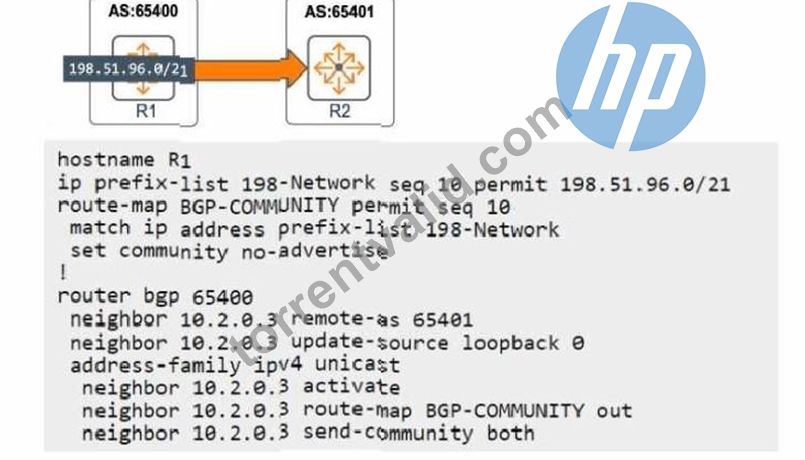
What is the effect when you add the statement "neighbor 10.2.0.3 send-community both" to the ipv4 address family? (Choose two.)
- A. It causes R1 to allow the exchange of communities with NLRI records in both inbound and outbound direction.
- B. It will cause existing BGP peering between R1 and R2 to flap.
- C. It causes R1 to negotiate the ability to send and receive standard and extended communities with R2.
- D. The feature will be enabled without consequence to the R1 established session with R2.
- E. It causes R1 to negotiate for the ability to import and export all type-1 and type-2 communities with R2.
Answer: A,C
Explanation:
The send-community both command ensures that both standard and extended BGP communities are sent to the neighbor, and this capability is negotiated during session setup.
The send-community both command enables the router to attach community attributes to BGP NLRI updates in both directions, not just outbound.
NEW QUESTION # 71
A customer is trialing the below colorless port configuration on a single switch and has noticed that users roaming to access points connected to the test switch are unable to receive an IP address on the corporate Wi-Fi network, which is operating in bridged mode. All other SSIDs are working as expected and the AP is Online in HPE Aruba Networking Central.
The security team reports that there have been no failed authentications in HPE Aruba Networking ClearPass Access Tracker and that the last entry for the wired port is returning the REDIUS Aruba-User-Role attribute 'Access_Point'.
Which configuration change is required to resolve the issue?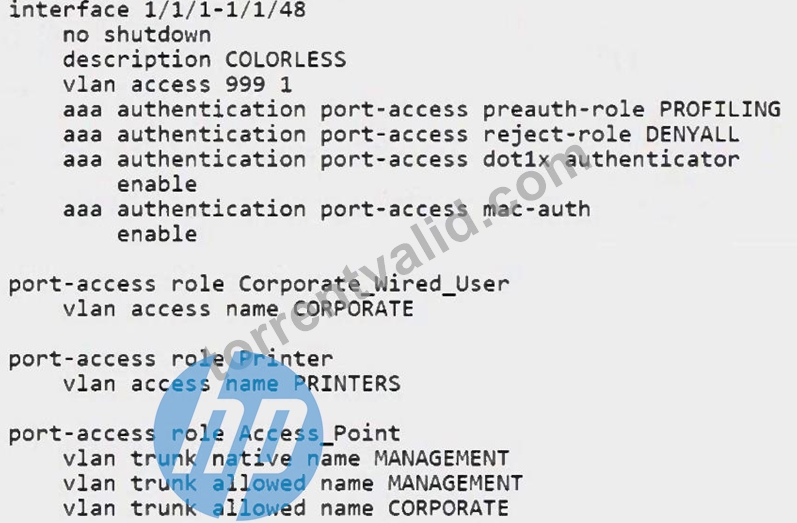
port-access client-move enable
- A. auth-mode device-mode
interface 1/1/1-1/1/48 - B. port-access role Access_Point
- C. port-access onboarding-method concurrent enable
interface 1/1/1-1/1/48 - D. aaa authentication port-access client-limit 0
Answer: A
Explanation:
For AP uplinks carrying bridged SSIDs, the switchport must authenticate only the AP and then treat all client MACs as part of the same trusted device. Enabling auth-mode device-mode under the Access_Point port-access role ensures the AP is authenticated (MAC-auth), the trunk is applied, and the switch does not attempt to re-authenticate wireless client MACs - allowing clients on the corporate SSID to obtain IP addresses.
NEW QUESTION # 72
Exhibit.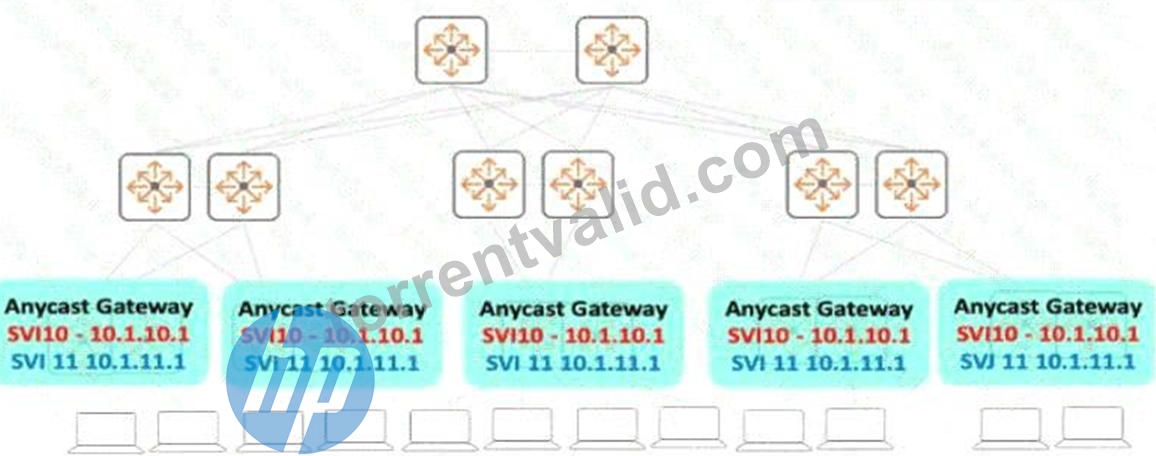
After Implementing a distributed overlay with distributed anycast gateways, you noticed that toomany ARP packets are being replicated to every access (leaf) switch Which command can you use to optimize the network?
- A. vlan 10 arp-suppression vlan 11 arp-suppression
- B. interface vlan 10 ip proxy-arp interface vlan 11 ip proxy-arp
- C. evpn arp-suppression
- D. evpn ip proxy-arp
Answer: C
Explanation:
In an EVPN VXLAN distributed overlay network, excessive ARP packet replication (flooding) to all leaf switches is observed. We need the command to optimize this.
* EVPN ARP Optimization:EVPN uses its control plane (BGP) to distribute MAC and IP address reachability information. Leaf switches (VTEPs) learn these mappings. To reduce ARP flooding across the VXLAN fabric:
* ARP Suppression:VTEPs intercept ARP requests. If the VTEP already knows the MAC address for the requested IP (learned via EVPN), it can suppress the ARP request, preventing it from being flooded over VXLAN.
* Proxy ARP:VTEPs intercept ARP requests. If the VTEP knows the MAC for the requested IP, it can generate an ARP replyon behalfof the remote host.
* AOS-CX Commands:These features are configured within the EVPN context.
* evpn arp-suppression (B): Enables the ARP suppression feature for EVPN.
* evpn ip proxy-arp (C): Enables the proxy ARP feature for EVPN.
* Options A and D use standard interface/VLAN level arp-suppression or proxy-arp commands, which are not specific to optimizing flooding within the EVPN VXLAN fabric itself.
* Conclusion:To optimize by reducing the replication/flooding of ARP packets across the EVPN VXLAN overlay, enabling evpn arp-suppression (Option B) is the direct command. This leverages the EVPN control plane knowledge to stop unnecessary ARP flooding.
References:AOS-CX EVPN Configuration Guide (ARP Suppression, Proxy ARP features). This relates to
"Switching" (19%) and "Routing" (16%) objectives in the context of overlays.
NEW QUESTION # 73
Hotspot Question
Following HPE Aruba Networking best practice, click where you implement loop protection.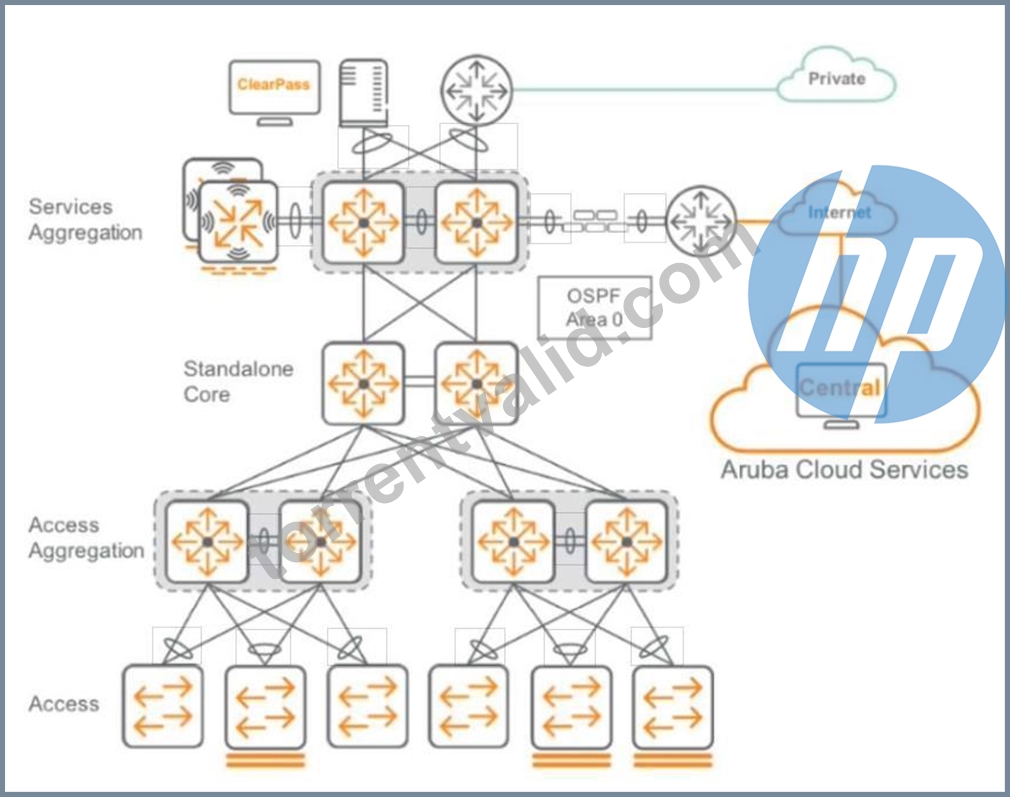
Answer:
Explanation: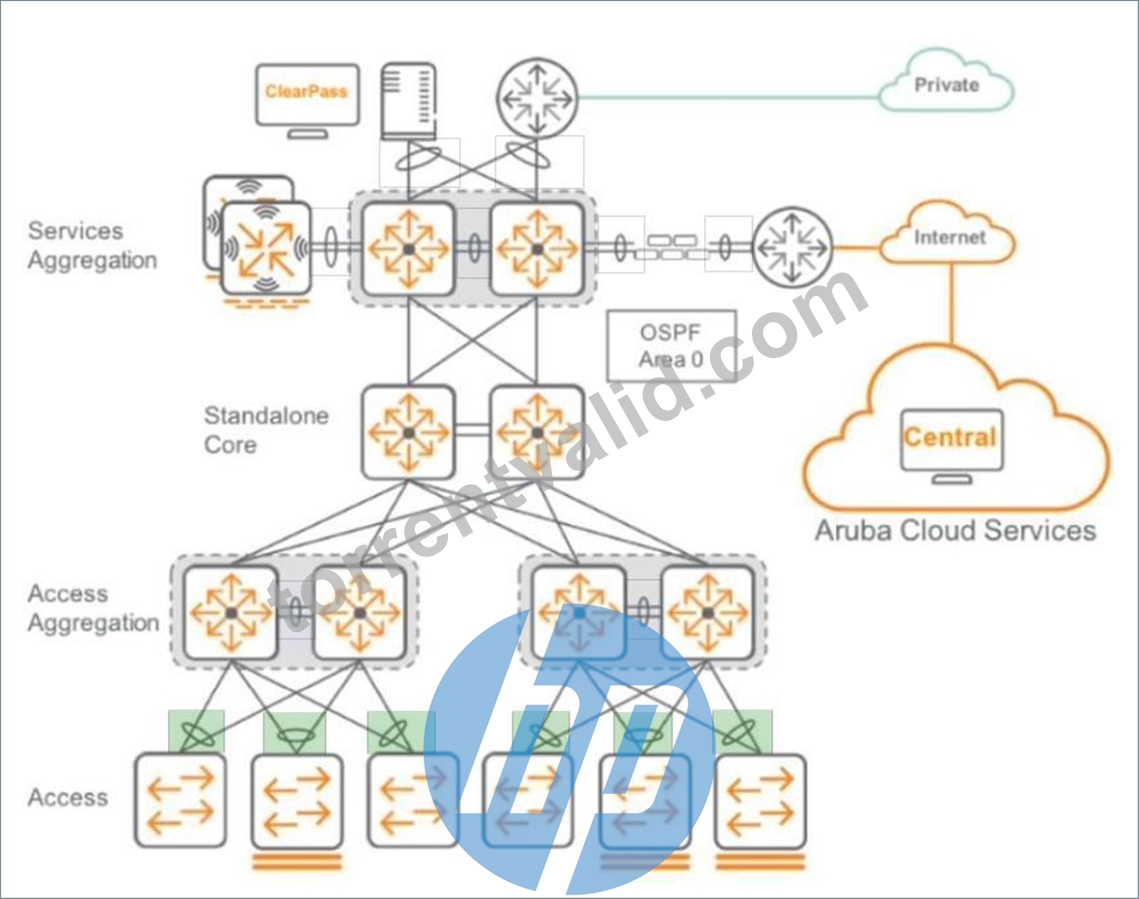
Explanation:
Access → Access Aggregation uplinks: Enable loop protection here to prevent loops caused by accidental cabling or misconfigurations.
Edge/user-facing ports (on the Access switches, where endpoints connect): Here you would enable BPDU Guard specifically to block rogue switches being connected.
NEW QUESTION # 74
Review the diagram and existing configuration of RouterA above. Which configuration changes are necessary to permit load balancing between RouterA and RouterB? (Selecttwo) Exhibit.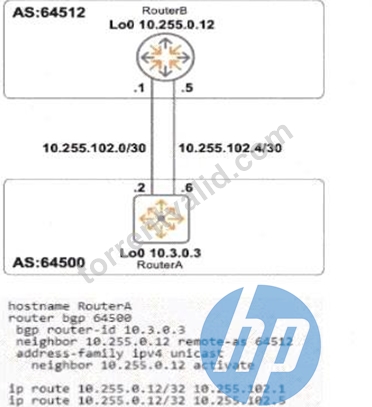
- A.

- B.

- C.

- D.

- E.

Answer: B,D
Explanation:
Analyze Topology and Existing Configuration:
* RouterA (AS 64500) peers with RouterB (AS 64512) using eBGP.
* Peering is configured between loopback interfaces (RouterA Lo0 10.3.0.3 to RouterB Lo0 10.255.0.12).
* Two parallel physical links connect the routers (10.255.102.0/30 and 10.255.102.4/30).
* RouterA has two static routes pointing to RouterB's loopback (10.255.0.12/32), one via each physical link's next hop (10.255.102.1 and 10.255.102.5). This provides reachability to the BGP peer address over both paths.
* RouterA's BGP config activates the neighbor 10.255.0.12 for IPv4 unicast but is missing key commands for stable loopback peering and load balancing.
Goal:Permit load balancing for traffic exchanged via BGP between RouterA and RouterB. This requires BGP ECMP (Equal Cost Multi-Path).
Requirements for eBGP ECMP over Loopbacks:
* Stable Peering:Peering must use loopback addresses. This requires:
* update-source loopback <id>: To source BGP TCP packets from the loopback IP.
* ebgp-multihop <ttl>: Because loopbacks are not directly connected (TTL > 1 needed).
* ECMP Enabled:BGP must be configured to allow multiple paths in the routing table. This requires:
* maximum-paths <n> (or maximum-paths ebgp <n>): To allow more than the default 1 path.
* Equal Paths:BGP must see multiple paths to thesameprefix learnedfrom RouterBthat are considered equal based on BGP path selection attributes (Weight, Local_Pref, AS_Path, Origin, MED, etc.). Since routes are learned from the same neighbor IP (RouterB's loopback), these attributes will likely be identical for routes learned via this peering. RouterA already has equal static routestothe BGP next hop (10.255.0.12).
NEW QUESTION # 75
A client is unable to connect to the network, In the HPE Aruba Networking ClearPass access tracker, wo can seean EAP timeout What is a possible cause of this message?
- A. The radius server can seethat theclient certificate is expired.
- B. The radius server doesnot trust the client certificate
- C. The client does not trust the radius server certificate.
- D. The client can see that theradiusserver certificateis expired.
Answer: C
Explanation:
The question involves an EAP timeout in HPE Aruba Networking ClearPass Access Tracker during an 802.1 X authentication attempt, with the task of identifying a possible cause.
* Analysis of Options:
* Option A:Incorrect. A client certificate trust issue would cause a different error, not an EAP timeout.
* Option B:Incorrect. An expired client certificate would result in an authentication failure, not a timeout.
* Option C:Incorrect. If the client sees an expired RADIUS server certificate, it would reject it, but this typically causes a trust error, not a timeout.
* Option D:Correct. If the client does not trust the RADIUS server's certificate (e.g., missing CA certificate or untrusted issuer), it may fail to proceed with the EAP handshake, leading to an EAP timeout.
* Why Option D is Correct:In 802.1X authentication with EAP (e.g., EAP-TLS or EAP-PEAP), the client must trust the RADIUS server's certificate to establish a secure TLS tunnel. If the client's trust store lacks the Certificate Authority (CA) certificate or the server's certificate is untrusted (e.g., self- signed without proper installation), the clientaborts the EAP handshake, resulting in an EAP timeout logged in ClearPass. This is a common issue in 802.1X deployments and can be resolved by ensuring the client has the correct CA certificate or by using a trusted server certificate, as per HPE Aruba Networking's security guidelines.
* Relevance to Certification Objectives:
* Authentication/Authorization (9%):Troubleshooting 802.1X and ClearPass authentication issues.
* Security (10%):Diagnosing wired 802.1X with EAP-TLS failures.
* Troubleshooting (10%):Resolving authentication timeouts in campus networks.
References:
HPE Aruba Networking ClearPass Policy Manager User Guide: 802.1X Authentication Troubleshooting.
HPE7-A06Study Guide: Covers EAP-based authentication and certificate issues.
HPE Aruba Networking Technical Documentation: 802.1X Certificate-Based Authentication Best Practices.
NEW QUESTION # 76
Match the AOS-CX switch BGP keepalive and holddown timersto the default.
Answer:
Explanation:
Explanation:
The question requires matching the default BGP keepalive and hold-down timers on AOS-CX switches to their respective values.
* Analysis of Options:
* Keepalive Timer:The keepalive timer determines how often BGP keepalive messages are sent to maintain a session. The default value on AOS-CX switches is 60 seconds.
* Hold-down Timer:The hold-down timer specifies the maximum time a BGP session can remain active without receiving a keepalive or updatemessage before it is considered down. The default value on AOS-CX switches is 180 seconds.
* Why This Mapping is Correct:Per BGP standards (RFC 4271) and HPE Aruba Networking AOS-CX documentation, the default BGP keepalive timer is 60 seconds, and the hold-down timer is 180 seconds (three times the keepalive interval). These timers ensure BGP sessions remain stable while allowing timely detection of peer failures. The AOS-CX implementation adheres to these defaults unless explicitly configured otherwise.
* Relevance to Certification Objectives:
* Routing (16%):Involves designing and troubleshooting BGP routing topologies, including timer configurations.
* Troubleshooting (10%):Includes diagnosing BGP session issues related to timers.
References:
HPE Aruba Networking AOS-CX Configuration Guide: BGP Configuration, detailing default timer values.
HPE7-A06Study Guide: Covers BGP session management and timers.
RFC 4271: A Border Gateway Protocol 4 (BGP-4), specifying default keepalive and hold-down timers.
NEW QUESTION # 77
An administrator is monitoring third-party WLAN transmitters in HPE Aruba Networking Central and some of them are classified as rogue and suspected rogue.
How are suspected rogues classified when using the default classification method for the rule
"Suspected AP On-Prem" in HPE Aruba Networking Central?
- A. signal level = "-50 dbM" AND WLAN classification = "On-Interfering"
- B. signal level = "-65 dbM" AND WLAN classification = "On-Prem"
- C. signal level = "-65 dbM" AND WLAN classification = "On-Interfering"
- D. signal level = "-50 dbM" AND WLAN classification = "On Wire"
Answer: B
Explanation:
In HPE Aruba Networking Central, the default classification rule "Suspected AP On-Prem" is triggered when an AP is detected with a signal strength of -65 dBm or stronger (indicating it is nearby/on-premises) and the WLAN classification is On-Prem. This allows administrators to flag potentially unauthorized APs within the organization's premises.
NEW QUESTION # 78
Drag and Drop Question
What is the correct sequence of events that occurs when a user device connects to a network using Dynamic Segmentation?
Answer:
Explanation:
Explanation:
In Dynamic Segmentation, the device first authenticates with ClearPass. Based on the authentication result, ClearPass assigns a role. The switch or AP then enforces the role by applying the appropriate VLAN or policy, and finally, the device is granted full access to the network.
NEW QUESTION # 79
......
HPE7-A06 Dumps Updated Practice Test and 128 unique questions: https://www.torrentvalid.com/HPE7-A06-valid-braindumps-torrent.html
Latest Aruba Certified Professional - Campus Access HPE7-A06 Actual Free Exam Questions: https://drive.google.com/open?id=1kE4CC0TFm93ekbiid7k9NdpDJye7XNLm