


Get instant access to JN0-650 Practice Tests 2026 Free Updated Today!
Welcome to download the newest PassLeader JN0-650 PDF dumps ( 72 Q&As)
Juniper JN0-650 Exam Syllabus Topics:
| Topic | Details |
|---|---|
| Topic 1 |
|
| Topic 2 |
|
| Topic 3 |
|
| Topic 4 |
|
NEW QUESTION # 17
You have PIM SM multicast configured and running in a network environment comprised of EX4300 devices. Your customers report increased delay when switching channels using IPTV. To help decrease the delay, you implement PIM join load balancing.
You add the set protocols pim join-load-balance command to the configuration. After committing, you notice that the flows are still using only one path.
In this scenario, which statement is correct?
- A. The interfaces must be specified to use for load balancing.
- B. The clear pim join-distribution command must be issued.
- C. IGMP snooping must also be configured.
- D. PIM join load-balancing only works for PIM-DM.
Answer: B
NEW QUESTION # 18
You have deployed sparse-mode multicast in your network using the IGP metrics shown in the exhibit.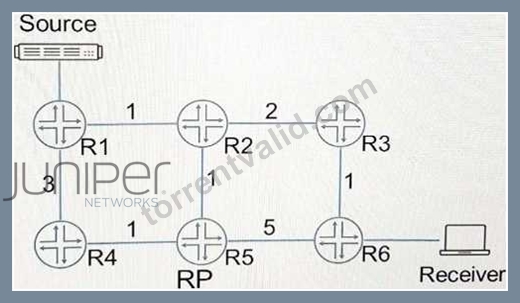
Which path will (*,G) traffic follow from the source to the receiver before the (S,G) state is registered?
- A. Source, R1, R2, R5, R6, Receiver
- B. Source, R1, R2, R5, R2, R3, R6, Receiver
- C. Source, R1, R4, R5, R6, Receiver
- D. Source, R1, R2, R3, R6, Receiver
Answer: B
NEW QUESTION # 19
You have an IPv4 multicast network configured as PIM-SM.
What must be done before replacing your static RP with auto-RP?
Enable sparse-dense mode on each of the routers in the network.
- A. Enable each router in the network to forward multicast packets.
- B. Configure each router in the network as a candidate BSR.
- C. Configure auto-RP domains on each router in the network.
Answer: C
NEW QUESTION # 20
You have an Ethernet subnet that can receive multicast traffic through the network. There are two devices that want to receive multicast streams. One device is interested in group 239.1.1.1; the other device is interested in group 239.1.1.2.
How does each device determine which multicast stream is the one it is interested in?
- A. The DR for the LAN segment filters the streams to each device based on the IGMP membership.
- B. The devices listen to both multicast streams and the application that requested the multicast stream filters the unwanted stream.
- C. The destination MAC address of multicast packets is determined by the multicast Group address; hosts listen for the interesting MAC address.
- D. The devices listen to both multicast streams and discard the unwanted stream based on the destination group address.
Answer: C
NEW QUESTION # 21
In the context of IP multicast, which statement about SSM is correct?
- A. It is less scalable than ASM.
- B. It only forwards traffic from registered sources to interested receivers.
- C. It requires an RP for multicast group communication.
- D. It uses (*, G) state exclusively.
Answer: B
NEW QUESTION # 22
Your enterprise network uses routing instances to support multitenancy. Your Junos devices use BGP to peer to multiple BGP devices. You must ensure that load balancing is achieved within the routing instance.
Which two statements would accomplish this task? (Choose two.)
- A. Configure a load-balance per-packet policy and apply it at the [edit routing-options forwarding-table] hierarchy.
- B. Configure the multipath option at the [edit protocols bgp group] hierarchy.
- C. Configure the multipath option at the [edit routing-instances routing-options] hierarchy.
- D. Configure the multipath option at the [edit protocols bgp group neighbor] hierarchy.
Answer: B,C
NEW QUESTION # 23
You are deploying new Juniper EX Series switches in a network that currently is using Cisco's Per- VLAN spanning tree plus (PVST+) and you must provide compatibility with this environment.
Which spanning tree protocol do you deploy in this scenario?
- A. VSTP
- B. RSTP
- C. STP
- D. MSTP
Answer: A
NEW QUESTION # 24
Exhibit
As shown in the exhibit, you have implemented CoS classifiers using Differentiated Services Code Point (DSCP) In this scenario, which two statements are correct? (Choose two.)
- A. This custom DSCP classifier must be associated with logical interfaces.
- B. This custom DSCP classifier must be associated with physical interfaces.
- C. The configuration imports all default classification assignments that are not specified.
- D. The default classification assignment overwrites all specified classifications
Answer: A,C
Explanation:
The exhibit shows a customBehavior Aggregate (BA) classifiernamed my-classifier for the Differentiated Services Code Point (DSCP) protocol.
* Importing Defaults (Statement C):The configuration line import default; is crucial. In Junos OS, when you create a custom classifier, you can use this statement toimport the default mapping tablefor all code points that you have not explicitly defined in the current block. This ensures that only the specific traffic types you care about are customized while the rest follows industry-standard defaults.
* Logical Interface Association (Statement A):In the Junos class-of-service hierarchy, classifiers are typically applied tological interfaces(e.g., ge-0/0/0.0). While they can sometimes be applied at a higher level, the standard practice for enterprise routing and switching is to associate them with the logical unit to provide granular control over subinterfaces or VLAN-tagged traffic.
* Why others are incorrect:Statement B is less accurate because the primary binding point in Junos is the unit (logical interface). Statement D is incorrect because the specific classifications defined in the custom blockoverridethe defaults; they are not overwritten by them.
NEW QUESTION # 25
Referring to the exhibit, what is the significance of the * next to an interface?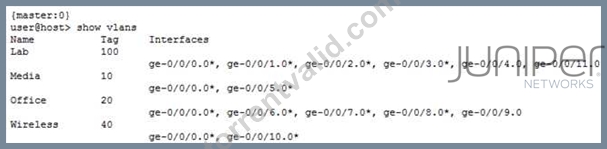
- A. The interface is currently active.
- B. The interface is an access port.
- C. The interface is currently down.
- D. The interface is a trunk port.
Answer: A
NEW QUESTION # 26
Referring to the exhibit which statement is true?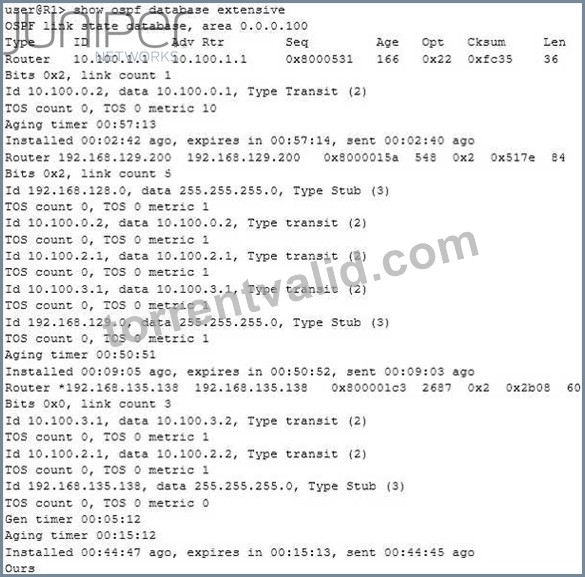
- A. R1 is a backbone router.
- B. R1 is an ABR
- C. R1 has the 8 bitt Set
- D. R1 is an ASBR
Answer: D
NEW QUESTION # 27
For what purpose is the 'override-metric' used in an OSPF configuration on a Junos device?
- A. To modify the default metric for a specific OSPF interface.
- B. To influence the OSPF route selection process.
- C. To change the metric of OSPF routes during redistribution.
- D. To set a fixed metric for all OSPF routes.
Answer: A
NEW QUESTION # 28
In Junos, which command is used to configure IGMP snooping on a VLAN?
- A. set igmp VLAN_NAME snooping
- B. set vlan VLAN_NAME multicast-snooping
- C. set vlans VLAN_NAME igmp-snooping
- D. set protocols igmp vlan VLAN_NAME
Answer: C
NEW QUESTION # 29
You have a multicast enabled network that uses PIM sparse mode.
Which two statements are true? (Choose two.)
- A. The RP sends a register stop message to the source DR when it receives the first packets of a multicast flow.
- B. The source DR sends a register stop message to the source DR when it begins forwarding traffic on the shortest path free.
- C. The source DR encapsulates multicast traffic of a new flow and unicasts it to the RP.
- D. The end receiver sends a register stop message to the source DR when it receives the first packets of a multicast flow.
Answer: A,C
NEW QUESTION # 30
While deploying class of service on an EX Series switch, what are two aspects of the scheduler? (Choose two.)
- A. It identifies the priority of the queue to which it is assigned.
- B. It defines interface rate-limiting.
- C. It defines a buffer size of the queue to which it is assigned.
- D. It provides DiffServ code translation.
Answer: A,C
Explanation:
In Junos OS Class of Service (CoS), schedulers are the fundamental components used to manage the resources of individual egress queues. They determine how the switch handles traffic for a specific forwarding class as it waits to exit an interface.
* Buffer Size (Option A): A scheduler defines the buffer size (memory allocation) for its assigned queue. This buffer holds packets during periods of congestion to prevent immediate packet loss. The size can be configured as a specific percentage of the total interface buffer, a temporal value in microseconds, or using the " remainder " of available space.
* Queue Priority (Option D): A scheduler identifies the priority of the queue. Junos supports multiple priority levels, such as low , medium-low , medium-high , and high . This setting dictates the order in which the transmission hardware services the queues; for example, high-priority queues are typically emptied before low-priority ones.
* Why other options are incorrect: Interface rate-limiting (Option B) is typically managed at the interface level or through policers , not the scheduler itself, which focuses on queue-specific transmission rates. DiffServ code translation (Option C) is the responsibility of rewrite rules , which modify the packet header markings as they leave the switch.
NEW QUESTION # 31
In Junos, which command can be used to troubleshoot IS-IS protocol issues?
- A. show isis statistics
- B. show isis database detail
- C. show isis adjacency
- D. show isis interface
Answer: B
NEW QUESTION # 32
......
Mar-2026 Latest TorrentValid JN0-650 Exam Dumps with PDF and Exam Engine: https://www.torrentvalid.com/JN0-650-valid-braindumps-torrent.html
Premium Quality Juniper JN0-650 Online dumps: https://drive.google.com/open?id=1h32-v9OqAonV2k0ghdUCUK8azJ_b0X7k