


Prepare BAPv5 Exam Questions [2024] Recently Updated Questions
Give push to your success with BAPv5 exam questions
NEW QUESTION # 17
A business analyst working for a manufacturing company has been asked to support a new initiative to review and redesign the company's Process, enabling it is increase its production and expand into overseas markets. He is working in a team of business analytics and has been asked to do the following:
a) Assist in the evaluation of the benefits defined in the benefits plan b) Lead requirements elicitation and clarification activities c) Deliver coaching, training and ongoing support for any changes to existing processes.
Once the business analyst has completed these activities, which parts of the Business Change lifecycle will he have supported-?
- A. Design. Alignment and Implementation
- B. Realisation. Design and Implementation
- C. Design and Realisation
- D. Implementation. Definition and Alignment
Answer: B
Explanation:
Explanation
The parts of the Business Change lifecycle that the business analyst will have supported are Realisation, Design and Implementation. Realisation is the phase where the benefits defined in the benefits plan are evaluated and measured. The business analyst will support this phase by assisting in the evaluation of the benefits (a). Design is the phase where the elements that will support the change are defined and developed.
The business analyst will support this phase by leading requirements elicitation and clarification activities (b).
Implementation is the phase where the change is embedded into the organisation and its processes. The business analyst will support this phase by delivering coaching, training and ongoing support for any changes to existing processes .
References:
Business Change Lifecycle - YouTube
The Change Management Life Cycle; Involve Your People to Ensure Success ...
NEW QUESTION # 18
EuroCoach is a holiday coach company that Is reviewing its internal business processes. The following requirement for improvement has been logged as a business rule:
'EuroCoach Is now legally responsible for ensuring that passengers taking cross-border journeys have valid passports and visas (If applicable) tor the countries to which, and through which, they will travel' Which type of business rule is this?
- A. External requirement.
- B. Internal processed
- C. External constraint.
- D. Internal policy.
Answer: A
Explanation:
Explanation
An external requirement is a business rule that is imposed by an external source, such as a law, regulation, or standard. The business rule in this question is a legal obligation that EuroCoach has to comply with, so it is an external requirement. Option C is the correct answer.
NEW QUESTION # 19
Efua is planning to use Design Thinking to improve the m-store customer experience She has asked you to suggest good techniques to help with the different stages.
Looking at the list of techniques and stages below which THREE combinations SHOULD be of benefit to Efua?
- A. Create Personas
- B. Define Current user needs or problems.
- C. Prototype: Scenario Analysis
- D. Empathise Customer Journey Map
- E. Evaluate Mind Mapping
Answer: A,B,D
Explanation:
Explanation
Design Thinking is an approach for solving complex problems by focusing on human needs and desires. It involves five stages: empathise, define, ideate, prototype and test. Therefore, options B, D and E are correct answers, as they suggest good techniques to help with the different stages of Design Thinking. Empathise is the stage where the problem is explored from the perspective of the users and their emotions, motivations and pain points are understood. A good technique to help with this stage is Customer Journey Map, which is a visual representation of the steps and emotions that a user goes through when interacting with a product or service. It helps to identify the pain points and opportunities for improvement in the user experience. Create is the stage where the users are represented by creating personas, which are fictional characters that embody the characteristics, goals and needs of a typical user group. Personas help to empathise with the users and design solutions that suit their preferences and expectations. Define is the stage where the problem is clearly defined and articulated based on the insights gained from the empathise stage. A good technique to help with this stage is Current user needs or problems, which is a statement that summarises what the users need or want to achieve and what prevents them from doing so. It helps to focus on the core problem and set the direction for ideation. Option A is not a correct answer, as Prototype is not a stage of Design Thinking, but a technique that can be used in the Prototype stage. Prototype is the stage where the ideas are turned into tangible and testable prototypes that can be used to demonstrate and evaluate the solutions. A good technique to help with this stage is Scenario Analysis, which is a technique that explores how different scenarios or situations could affect the outcomes of the solutions. It helps to test the feasibility and desirability of the prototypes. Option C is not a correct answer, as Evaluate is not a stage of Design Thinking, but a technique that can be used in the Test stage. Test is the stage where the prototypes are tested with real users and feedback is collected and analysed to refine and improve the solutions. A good technique to help with this stage is Mind Mapping, which is a technique that organises and visualises information in a hierarchical and associative way. It helps to capture and structure feedback and identify patterns and insights.
References: BCS Practitioner Certificate in BAP Specimen, page 28.
NEW QUESTION # 20
Marketing is primarily concerned with the 4Ps: product, promotion, price and price. The institute of Analysis (IoA) offers qualification in system analysis. A number of interviews have been held with senior stakeholders, including the marketing Manager. Here are two five of the activities that have been identified by stakeholders:
a) Agree new qualifications.
b) Upgrade the website.
c) Recruit new examiners.
d) Register candidates.
e) Analyze website activity.
Which of these activities would reflect the business perspective of the Marketing Manager of the loA?
- A. a. b and e
- B. b. d and e.
- C. a, c and d
- D. b, c and e
Answer: A
Explanation:
Explanation
Marketing is primarily concerned with the 4Ps: product, promotion, price and place. These are the elements of the marketing mix that an organisation can control or adjust to influence customer demand and satisfaction.
Therefore, option B is the correct answer, as it identifies which of these activities would reflect the business perspective of the Marketing Manager of the IoA. Option A identifies 'b' (upgrade the website), 'd' (register candidates) and 'e' (analyse website activity) as activities that would reflect the business perspective of the Marketing Manager of the IoA. These are incorrect examples of activities that would reflect the business perspective of the Marketing Manager of the IoA, as they are not related to any of the 4Ps. Option B identifies
'a' (agree new qualifications), 'b' (upgrade the website) and 'e' (analyse website activity) as activities that would reflect the business perspective of the Marketing Manager of the IoA. These are correct examples of activities that would reflect the business perspective of the Marketing Manager of the IoA, as they are related to some of the 4Ps. 'A' (agree new qualifications) is related to product, as it involves developing and offering new qualifications that meet customer needs and expectations. 'B' (upgrade the website) is related to promotion, as it involves improving and communicating the features and benefits of qualifications to potential customers. 'E' (analyse website activity) is related to place, as it involves monitoring and evaluating how customers access and purchase qualifications through online channels. Option C identifies 'a' (agree new qualifications), 'c' (recruit new examiners) and 'd' (register candidates) as activities that would reflect the business perspective of the Marketing Manager of the IoA. These are incorrect examples of activities that would reflect the business perspective of the Marketing Manager of the IoA, as 'c' (recruit new examiners) is not related to any of the 4Ps. Option D identifies 'b' (upgrade the website), 'c' (recruit new examiners) and 'e' (analyse website activity) as activities that would reflect the business perspective of the Marketing Manager of the IoA. These are incorrect examples of activities that would reflect the business perspective of the Marketing Manager of the IoA, as 'c' (recruit new examiners) is not related to any of the 4Ps.
References: BCS Practitioner Certificate in BAP Specimen, page 39.
NEW QUESTION # 21
A group of stakeholders at FlyMe travel operators are in a meeting to discus the Business Activity Model (BAM) for a new subsidiary business. They are planning to launch a new offering, which will offer flight bundle' packages for organization that regularly need to send their staff overseas. The following activities have been identified so far:
a) Monitor flight bundle' sates
b) Sell "night bundles*
c) Determine demand amongst existing customers
d) Identify potential airline earners
e) Determine 'flight bundle' locations,
f) Define bundle pricing.
Although the Operations Director for FlyMe is supportive of the new business proposition, she is not entirely convinced there is a gap in the market, nor is she confident that the idea will be profitable.
With these concerns in mind, which planning activities will she be keen to ensure are discussed before the meeting ends?
- A. a. c and f
- B. c and f
- C. b, d and e
- D. a, b. d and e.
Answer: B
Explanation:
Explanation
The Operations Director for FlyMe is concerned about the market demand and profitability of the new business proposition. Therefore, she will be keen to ensure that the planning activities that address these concerns are discussed before the meeting ends. These activities are c and f, as they involve determining the demand amongst existing customers and defining the bundle pricing. These activities will help to assess the feasibility and viability of the new offering. Option A is the correct answer.
NEW QUESTION # 22
A Business Analyst and a project Manager are producing a business case for an initiative, which aims to improve the cyber defense of a large financial services provider.
They met recently to review progress, and made the following notes for the next draft:
The benefits of cyber will be describes in quantitative terms, so we will need to describe these Qualitatively.
We need to make it clear that we have fully explored the solution market, and we have considered a range of approaches to meeting the objectives of this project.
The threat posed to the organization from cyber attack, and therefore the justification for the project, needs to be clearly articulated.
Which of the following sets of elements of a business case will cover ALL of these points?
- A. Description of the current situation, impact assessment, risk assessment
- B. Recommendations, risk assessment, options considered
- C. Impact assessment, analysis of costs and benefits, recommendations
- D. Description of the current situation. analysis of costs and benefits, options considered
Answer: D
Explanation:
Explanation
A business case is a formal written proposal that details the costs and benefits of a proposed business change or solution. It helps to justify and secure the approval and funding for a proposed business change or solution.
A business case typically consists of several elements, such as description of the current situation, analysis of costs and benefits, options considered, recommendations, impact assessment, risk assessment etc. Therefore, option A is the correct answer, as it identifies which set of elements of a business case will cover all of these points respectively. Description of the current situation is an element that describes the problem or opportunity that exists in the current state and the need or rationale for a change or solution. It helps to explain what is wrong or missing in the current state and what are the objectives and outcomes of a change or solution. This element will cover the point that the threat posed to the organisation from cyber attack, and therefore the justification for the project, needs to be clearly articulated. Analysis of costs and benefits is an element that evaluates the financial and non-financial impacts of a proposed change or solution. It helps to compare and contrast the costs and benefits of different options or solutions and determine their feasibility and desirability.
This element will cover the point that the benefits of cyber will be described in quantitative terms, so we will need to describe these qualitatively. Options considered is an element that identifies and describes the alternative ways of addressing a problem or opportunity. It helps to explore and analyse the pros and cons of different options or solutions and select the best one based on criteria and evidence. This element will cover the point that we need to make it clear that we have fully explored the solution market, and we have considered a range of approaches to meeting the objectives of this project. Option B is not a correct answer, as it does not identify which set of elements of a business case will cover all of these points respectively. Impact assessment is an element that assesses the effects or consequences of a proposed change or solution on people, processes, organisation and technology. It helps to identify who or what will be affected by a proposed change or solution and how they will be affected. This element will not cover any of these points. Recommendations is an element that proposes and justifies the preferred option or solution for addressing a problem or opportunity. It helps to persuade and convince decision makers or influencers to approve and fund a proposed change or solution. This element will not cover any of these points. Option C is not a correct answer, as it does not identify which set of elements of a business case will cover all of these points respectively.
Recommendations is an element that proposes and justifies the preferred option or solution for addressing a problem or opportunity. It helps to persuade and convince decision makers or influencers to approve and fund a proposed change or solution. This element will not cover any of these points. Risk assessment is an element that identifies and evaluates the uncertainties or threats that may affect a proposed change or solution. It helps to estimate the likelihood and impact of risks and plan how to avoid or mitigate them. This element will not cover any of these points. Option D is not a correct answer, as it does not identify which set of elements of a business case will cover all of these points respectively. Description of the current situation is an element that describes the problem or opportunity that exists in the current state and the need or rationale for a change or solution. It helps to explain what is wrong or missing in the current state and what are the objectives and outcomes of a change or solution. This element will cover the point that the threat posed to the organisation from cyber attack, and therefore the justification for the project, needs to be clearly articulated. Impact assessment is an element that assesses the effects or consequences of a proposed change or solution on people, processes, organisation and technology. It helps to identify who or what will be affected by a proposed change or solution and how they will be affected. This element will not cover any of these points. Risk assessment is an element that identifies and evaluates the uncertainties or threats that may affect a proposed change or solution. It helps to estimate the likelihood and impact of risks and plan how to avoid or mitigate them. This element will not cover any of these points.
References: BCS Practitioner Certificate in BAP Specimen, page 42.
NEW QUESTION # 23
Adiyan has been considering the feasibility of introducing a new payments method into his company His draft report reads
'The new payment method has not yet been widely adopted although it has the backing of all the big phone brands. Our current payments system will be upgraded next month to take payment as part of a scheduled release This method of payment will be supported under our current license deal Trials have shown that the technology will scale to our customer base and cyber security testing is encouraging' Which of the following is the BEST description of the areas of Technical feasibility mentioned in the report?
- A. Timely, Compatible. Secure, Scalable
- B. Reliable. Compatible, Secure. Architectural Alignment
- C. Proven. Compatible, Secure. Scalable
- D. Timely, Reliable, Proven, Architectural Alignment
Answer: C
Explanation:
Explanation
Technical feasibility is the extent to which a proposed business change or solution is possible and realistic from a technical perspective. It helps to assess whether a proposed business change or solution can be developed, implemented and maintained using the available or required technology. Therefore, option A is the correct answer, as it describes the areas of technical feasibility mentioned in the report. Proven is an area of technical feasibility that relates to whether the technology used for the proposed business change or solution has been tested and verified by previous or existing users or applications. It helps to ensure reliability and quality of the technology. An example of proven in the report is the new payment method has not yet been widely adopted although it has the backing of all the big phone brands. Compatible is an area of technical feasibility that relates to whether the technology used for the proposed business change or solution can work or integrate with other existing or required technologies. It helps to ensure interoperability and functionality of the technology. An example of compatible in the report is our current payments system will be upgraded next month to take payment as part of a scheduled release. Secure is an area of technical feasibility that relates to whether the technology used for the proposed business change or solution can protect or prevent unauthorised access, use, modification or disclosure of data or information. It helps to ensure confidentiality, integrity and availability of the technology. An example of secure in the report is cyber security testing is encouraging.
Scalable is an area of technical feasibility that relates to whether the technology used for the proposed business change or solution can handle or adapt to changes in demand, volume or performance. It helps to ensure efficiency and flexibility of the technology. An example of scalable in the report is trials have shown that the technology will scale to our customer base. Option B is not a correct answer, as it does not describe all the areas of technical feasibility mentioned in the report. Timely is an area of technical feasibility that relates to whether the technology used for the proposed business change or solution can be developed, implemented and maintained within the available or required time frame. It helps to ensure punctuality and speed of the technology. There is no example of timely in the report. Option C is not a correct answer, as it does not describe all the areas of technical feasibility mentioned in the report. Reliable is an area of technical feasibility that relates to whether the technology used for the proposed business change or solution can perform consistently and accurately without errors or failures. It helps to ensure dependability and accuracy of the technology. There is no example of reliable in the report. Architectural alignment is an area of technical feasibility that relates to whether the technology used for the proposed business change or solution can fit or align with other existing or required architectures, such as business, data or application architectures. It helps to ensure consistency and coherence of the technology. There is no example of architectural alignment in the report. Option D is not a correct answer, as it does not describe any of the areas of technical feasibility mentioned in the report.
References: BCS Practitioner Certificate in BAP Specimen, page 48.
NEW QUESTION # 24
On joining a new company. Sara spent time reviewing the company's organisation chart She was particularly interested in the sponsor of the project she is joining What is Sara LIKELY to have learnt about the sponsor from this? Select the TWO that apply
- A. The culture within their team
- B. Their preferred management style
- C. Their position in the company hierarchy
- D. The scope of their responsibilities
- E. Their span of control
Answer: C,E
Explanation:
Explanation
An organisation chart is a diagram that shows the structure and relationships of an organisation. It helps to identify who are the members, roles, levels and units of an organisation and how they are connected or related.
Therefore, options A and B are correct answers, as they are the information that Sara is likely to have learnt about the sponsor from the organisation chart. Option A is a correct answer, as their position in the company hierarchy is the information that Sara is likely to have learnt about the sponsor from the organisation chart.
Their position in the company hierarchy is the level or rank of the sponsor within the organisation's structure.
It helps to indicate their authority, status and influence within the organisation. Option B is a correct answer, as their span of control is the information that Sara is likely to have learnt about the sponsor from the organisation chart. Their span of control is the number of people or units that report directly to the sponsor within the organisation's structure. It helps to indicate their responsibility, workload and management style within the organisation. Option C is not a correct answer, as their culture within their team is not the information that Sara is likely to have learnt about the sponsor from the organisation chart. Their culture within their team is the shared values, beliefs, norms and behaviours of the sponsor and their team members within the organisation. It helps to indicate their motivation, satisfaction and performance within the organisation. Option D is not a correct answer, as their scope of responsibilities is not the information that Sara is likely to have learnt about the sponsor from the organisation chart. Their scope of responsibilities is the range or extent of tasks or activities that the sponsor has to perform or oversee within the organisation. It helps to indicate their objectives, outcomes and deliverables within the organisation. Option E is not a correct answer, as their preferred management style is not the information that Sara is likely to have learnt about the sponsor from the organisation chart. Their preferred management style is the way or approach that the sponsor uses to lead or direct their team members within the organisation. It helps to indicate their communication, delegation and feedback skills within the organisation.
References: BCS Practitioner Certificate in BAP Specimen, page 31.
NEW QUESTION # 25
Bessant Co.manufactures and sells clothing. The company is every profitable and the IT director would like to invest some of these profits into improving the technical infrastructure of the company, which would help the organic growth of the company. However, the finance director would like to use the profits to acquire one of its competitors.
Shelly is the business analyst on this project and she recognises that the IT and finance director do not agree on the future direction of the business. Once prefers organic growth and the other, growth by acquisition.
What technique COULD Shelly use to improve her understating ot these two different perspectives?
- A. The power/ interest grid
- B. POPIT model.
- C. SWOT analysis
- D. CATWOE.
Answer: D
Explanation:
Explanation
CATWOE is a technique that helps to understand different perspectives of a situation by analyzing six elements: Customers, Actors, Transformation process, Worldview, Owner, and Environmental constraints.
Shelly could use CATWOE to improve her understanding of the IT and finance director's views on the future direction of the business, by identifying who are the customers, actors, owners, and so on for each option (organic growth or acquisition), and how they differ. Option A is the correct answer.
References:
What Is The CATWOE Analysis And Why It Matters In Business - FourWeekMBA CATWOE Analysis: A Holistic Approach to Problem Solving - SlideModel
NEW QUESTION # 26
You have been asked to explain divergent and convergent thinking to a colleague How would you describe the purpose of both divergent and convergent thinking to them Select the BEST TWO answers
- A. Convergent thinking define the solution in detail
- B. Divergent thinking creatively considering multiple solutions to the problem
- C. Convergent thinking define the action to be taken, broadly
- D. Convergent thinking review ideas for way forward
- E. Divergent thinking generate ideas.
Answer: D,E
Explanation:
Explanation
Divergent thinking and convergent thinking are two types of thinking processes that can be used to solve problems creatively and effectively. Therefore, options A and B are correct answers, as they describe the purpose of both divergent and convergent thinking respectively. Option A describes the purpose of divergent thinking, which is to generate ideas. Divergent thinking involves exploring multiple possible solutions to a problem without judging or evaluating them. It helps to stimulate creativity and innovation by expanding the range and diversity of ideas. Option B describes the purpose of convergent thinking, which is to review ideas for way forward. Convergent thinking involves analysing and evaluating multiple possible solutions to a problem and selecting the best one for further development and implementation. It helps to ensure feasibility and suitability by narrowing down the range and diversity of ideas. Option C describes an aspect of divergent thinking, which is creatively considering multiple solutions to the problem, but not its purpose. The purpose of divergent thinking is to generate ideas, not just consider them creatively. Option D describes an aspect of convergent thinking, which is defining the solution in detail, but not its purpose. The purpose of convergent thinking is to review ideas for way forward, not just define them in detail. Option E describes an aspect of convergent thinking, which is defining the action to be taken, broadly, but not its purpose. The purpose of convergent thinking is to review ideas for way forward, not just define the action to be taken, broadly.
References: BCS Practitioner Certificate in BAP Specimen, page 47.
NEW QUESTION # 27
The management of a chain of hotels has decided that one of its critical success factors (CSF) is to 'provide excellent customer service' The below measures have been suggested.
Which THREE of these are appropriate key performance indicators (KPIs) for the CSF 'provide excellent customer service"?
- A. The number of customers who make use of their in-room mini bar
- B. The number of customers who complain.
- C. The percentage of customers who return
- D. The percentage of customers who use the leisure facilities
- E. The percentage of customers who join the hotel loyalty scheme
Answer: B,C,E
Explanation:
Explanation
A key performance indicator (KPI) is a measurable value that demonstrates how effectively an organisation is achieving a key business objective or critical success factor (CSF). A KPI should be relevant, specific, measurable, achievable, realistic and time-bound (SMART). Therefore, options C, D and E are appropriate KPIs for the CSF 'provide excellent customer service', as they measure aspects of customer satisfaction and loyalty that are directly related to the quality of service provided by the hotel chain. Option A is not an appropriate KPI, as it does not measure customer service, but rather customer consumption. Option B is not an appropriate KPI, as it does not measure customer service, but rather customer preference.
References: BCS Practitioner Certificate in BAP Specimen, page 15.
NEW QUESTION # 28
A business analyst has been assigned to help develop a plan for expanding a business that produces software for mobile phones and has interview he managing director to understand his perspective regarding the expansion. The managing director's worldview is as follows:
''The purpose of our business is to develop and sell software for mobile phones. The expansion will enable us to increase the amount of software we procedure, so we can keep pace with the growing demand of the market for software that is easy to use.'' Which of the following is a 'transformation' for this worldview?
- A. Keep pace with the growing demands of the market.
- B. Increase the amount of software we produce.
- C. Ensure that software is easy to use
- D. Develop and sell software for mobile phones.
Answer: D
Explanation:
Explanation
Transformation is the element of CATWOE that describes what changes or processes take place in a business situation or problem or its solution. It helps to identify what inputs are converted into outputs in a business situation or problem or its solution. Therefore, option A is the correct answer, as it is the transformation for this worldview. Develop and sell software for mobile phones is the transformation for this worldview, as it describes what changes or processes take place in the business situation or problem or its solution. It identifies what inputs (software development resources) are converted into outputs (software products) in the business situation or problem or its solution. Option B is not a correct answer, as it is not the transformation for this worldview, but an aspect of the output quality. Ensure that software is easy to use is not the transformation for this worldview, but an aspect of the output quality. It describes how the output (software products) should meet the customer needs and expectations, not what changes or processes take place in the business situation or problem or its solution. Option C is not a correct answer, as it is not the transformation for this worldview, but an aspect of the environment. Keep pace with the growing demands of the market is not the transformation for this worldview, but an aspect of the environment. It describes an external factor or constraint that affects the stakeholder's perspective or limits their options, not what changes or processes take place in the business situation or problem or its solution. Option D is not a correct answer, as it is not the transformation for this worldview, but an aspect of the desired outcome. Increase the amount of software we produce is not the transformation for this worldview, but an aspect of the desired outcome. It describes what the stakeholder wants to achieve from the business situation or problem or its solution, not what changes or processes take place in the business situation or problem or its solution.
References: BCS Practitioner Certificate in BAP Specimen, page 38.
NEW QUESTION # 29
Jayon has been asked to explain the gap analysis process to a new colleague. Which THREE of the following SHOULD Jayon cover?
- A. Compare the desired situation and existing situation
- B. Consider possible actions to address the gaps
- C. Deliver the solution to close the gaps
- D. Understand the existing situation
- E. Define the solutions to close the gaps
Answer: A,B,D
Explanation:
Explanation
Gap analysis is a process of identifying and assessing the differences between the current state and desired state of an organisation or project. It helps to determine what needs to be done to achieve business objectives or solve business problems. Gap analysis typically involves three main steps: understand the existing situation, compare the desired situation and existing situation, and consider possible actions to address the gaps.
Therefore, options A, B and C are correct answers, as they cover these steps in gap analysis. Option D is not a correct answer, as defining solutions to close gaps is not part of gap analysis itself, but rather a subsequent step that follows gap analysis. Gap analysis helps to identify what needs to be done, but not how it should be done.
Option E is not a correct answer, as delivering solutions to close gaps is not part of gap analysis itself, but rather a final step that follows defining solutions. Gap analysis helps to identify what needs to be done, but not how it should be done or implemented.
References: BCS Practitioner Certificate in BAP Specimen, page 25.
NEW QUESTION # 30
How would a business analyst use a Target Operating Model (TOM) in gap analysis?
- A. To identify how the organisation should structure itself to support the desired situation.
- B. To assess how far the organisation's current activities support the desired situation.
- C. To determine which activities in the desired situation are not financially feasible
- D. To establish which stakeholder views will not be reflected in the desired situation
Answer: B
Explanation:
Explanation
A Target Operating Model (TOM) is a high-level description of how an organisation wants to operate in order to achieve its vision and strategy. It defines what an organisation does, how it does it, who does it, where it does it and why it does it. A TOM can be used in gap analysis to compare the desired situation with the existing situation and identify what needs to change to achieve the desired situation. Therefore, option A is the correct answer, as using a TOM in gap analysis would help to assess how far the organisation's current activities support the desired situation. By comparing the current activities with those defined in the TOM, a gap analysis would help to identify what activities are missing, redundant or inefficient in achieving the desired situation. Option B is not a correct answer, as using a TOM in gap analysis would not help to identify how the organisation should structure itself to support the desired situation. The structure of an organisation is one aspect of a TOM, but not its main purpose. A TOM defines what an organisation does more than how it organises itself. Option C is not a correct answer, as using a TOM in gap analysis would not help to determine which activities in the desired situation are not financially feasible. The financial feasibility of an activity is not determined by comparing it with a TOM, but by conducting a cost-benefit analysis or a business case.
Option D is not a correct answer, as using a TOM in gap analysis would not help to establish which stakeholder views will not be reflected in the desired situation. The stakeholder views are not determined by comparing them with a TOM, but by conducting a stakeholder analysis or a CATWOE analysis.
References: BCS Practitioner Certificate in BAP Specimen, page 27.
NEW QUESTION # 31
The below statements have been made about the consensus Business Activity Model (BAM) Which THREE of the statements are TRUE?
- A. Shows who undertakes the business activities
- B. Forms the basis of subsequent gap analysis
- C. Shows the logical sequence of process steps
- D. A conceptual model
- E. Describes a stakeholder's perspective on what the business does
Answer: B,C,D
Explanation:
Explanation
A consensus Business Activity Model (BAM) is a diagram that shows the high level activities that an organisation performs or delivers and the flow or sequence of the activities. It helps to understand what an organisation does, how it does it, who does it, where it does it and why it does it from a common or shared perspective of all relevant stakeholder groups. Therefore, options A, C and D are true statements about a consensus BAM. Option A is a true statement, as a consensus BAM is a conceptual model that represents a business situation or problem at a high level of abstraction. It helps to simplify and clarify the complexity and ambiguity of the business situation or problem. Option C is a true statement, as a consensus BAM shows the logical sequence of process steps that the organisation follows or performs to achieve its objectives and outcomes. It helps to identify the order and dependencies of the activities and how they are connected or related. Option D is a true statement, as a consensus BAM forms the basis of subsequent gap analysis that compares the current and desired situations or problems and identifies the differences or gaps between them. It helps to determine what changes or improvements are needed to bridge the gaps and achieve the desired situation or problem. Option B is not a true statement, as a consensus BAM does not show who undertakes the business activities, but what the business activities are. The actors or performers of the business activities are shown in another technique, such as RACI chart. Option E is not a true statement, as a consensus BAM does not describe a stakeholder's perspective on what the business does, but a common or shared perspective of all stakeholder groups on what the business does. A stakeholder's perspective on what the business does is described in another technique, such as CATWOE.
References: BCS Practitioner Certificate in BAP Specimen, page 45.
NEW QUESTION # 32
A business analyst and a project manager are producing a business case for an initiative, which aims to improve the cyber defences of a large financial services provider They met recently to review progress and made the following notes for the next draft
1. The benefits of cyber security will be hard to describe in quantitative terms, so we will need to describe these qualitatively.
2 We need to make it clear that we have fully explored the solution market, and we have considered a range of approaches to meeting the objectives of this project.
3. The threat posed to the organisation from cyber attack, and therefore the justification for this project, needs to be clearly articulated Which THREE sections of a business case will cover these points'?
- A. Risk assessment
- B. Options considered
- C. Recommendations
- D. Analysis of costs and benefits
- E. Description of the current situation
Answer: B,D,E
Explanation:
Explanation
A business case is a document that provides the rationale and justification for a proposed business change or solution. It helps to evaluate the benefits, costs, risks and impacts of different options and recommend the best one for further development and implementation. A business case typically consists of several sections, such as executive summary, description of the current situation, description of the desired situation, options considered, analysis of costs and benefits, risk assessment and recommendations. Therefore, options A, B and C are correct answers, as they cover the sections of a business case that will address the points noted by the business analyst and the project manager. Options considered is the section where different approaches or solutions to meet the objectives of the project are identified and described. It helps to show that a range of alternatives have been explored and evaluated. Analysis of costs and benefits is the section where the financial implications of each option are estimated and compared. It helps to show the expected value and return on investment of each option. Description of the current situation is the section where the problem or opportunity that motivates the project is clearly defined and articulated. It helps to show the justification and urgency for the project. Option D is not a correct answer, as recommendations is not a section of a business case that will address any of the points noted by the business analyst and the project manager. Recommendations is the section where the preferred option is selected and proposed based on the analysis and evaluation of other sections. Option E is not a correct answer, as risk assessment is not a section of a business case that will address any of the points noted by the business analyst and the project manager. Risk assessment is the section where the uncertainties and potential negative consequences of each option are identified and analysed. It helps to show how risks can be avoided, reduced or managed.
References: BCS Practitioner Certificate in BAP Specimen, page 30.
NEW QUESTION # 33
A large mortgage provider has been running a project to develop an equity release product The project has run into difficulty due to a disagreement between two key stakeholders about whether the product should be developed in house or outsourced to a specialist company.
The business analyst on the project. George, has been discussing his role in resolving this problem with his manager.
Which of the following descriptions is George's manager LEAST LIKELY to use in describing his role'?
- A. To record the meeting and the resulting decision
- B. To negotiate with the stakeholders to reach a resolution
- C. To facilitate the discussion to allow the stakeholders to find a way forward
- D. To understand and challenge the stakeholders
Answer: B
Explanation:
Explanation
The role of a business analyst (BA) is to analyse business situations and problems, identify and evaluate potential solutions, and facilitate change within an organisation or project. A BA works with stakeholders at different levels and with different interests and perspectives to understand their needs and expectations and ensure they are met by suitable solutions. Therefore, option C is not likely to be used by George's manager in describing his role as a BA in resolving this problem. To negotiate with stakeholders to reach resolution implies that George has to persuade or compromise with stakeholders to agree on one solution or approach.
This is not part of the BA's role, as the BA does not have the authority or responsibility to make decisions or impose solutions on stakeholders. The BA's role is to analyse and evaluate different solutions or approaches objectively and present the findings and recommendations to stakeholders for their consideration and approval.
Option A is likely to be used by George's manager in describing his role as a BA in resolving this problem. To understand and challenge the stakeholders means that George has to elicit and validate the stakeholders' views and needs and question their assumptions and rationale. This is part of the BA's role, as the BA has to ensure that the stakeholders' views and needs are clear, consistent, realistic and aligned with the organisation's strategy and objectives. Option B is likely to be used by George's manager in describing his role as a BA in resolving this problem. To facilitate the discussion to allow the stakeholders to find a way forward means that George has to organise and conduct meetings or workshops with stakeholders to explore and evaluate different solutions or approaches and help them reach a consensus or agreement. This is part of the BA's role, as the BA has to enable effective communication and collaboration among stakeholders and help them resolve conflicts or issues. Option D is likely to be used by George's manager in describing his role as a BA in resolving this problem. To record the meeting and the resulting decision means that George has to document and communicate the outcomes and actions of the meeting or workshop with stakeholders and ensure they are understood and accepted by all parties. This is part of the BA's role, as the BA has to ensure that there is a clear and accurate record of what has been discussed and decided by stakeholders and that there is a shared understanding and commitment among them.
References: BCS Practitioner Certificate in BAP Specimen, page 36.
NEW QUESTION # 34
Halliday Holdings is embarking on a programme to improve its customer experience On joining the programme. Natasha wants to gain an understanding of how its current brand is perceived Which would be the BEST source of information for Natasha?
- A. The company website
- B. The company's complaints procedures
- C. Independent industry websites
- D. The company's organisational structure
Answer: C
Explanation:
Explanation
A brand is a name, term, design, symbol or any other feature that identifies one seller's good or service as distinct from those of other sellers. A brand perception is how customers and potential customers view a brand based on their experiences, associations and impressions. Therefore, option A is the best choice, as independent industry websites are likely to provide unbiased and reliable information on how customers perceive different brands in the market. They may also include customer reviews, ratings and feedback that can help measure customer satisfaction and loyalty. Option B is not a good choice, as the company website is likely to provide biased and selective information on its own brand that may not reflect how customers actually perceive it. It may also omit negative aspects or criticisms that could affect its image or reputation.
Option C is not a good choice, as the company's organisational structure is not relevant to its brand perception.
It may show how the company is organised internally, but it does not indicate how customers view its products or services externally. Option D is not a good choice, as the company's complaints procedures are not sufficient to measure its brand perception. They may show how the company handles customer issues or problems, but they do not capture how customers feel about its overall quality or value.
References: BCS Practitioner Certificate in BAP Specimen, page 22.
NEW QUESTION # 35
The customer journey map below was created for Eyes 4'U. a chain of high street opticians This shows the journey of a person who is 67 years old and retired with a limited pension and active social life What are the MOST LIKELY statements to be in Box F and Box 6?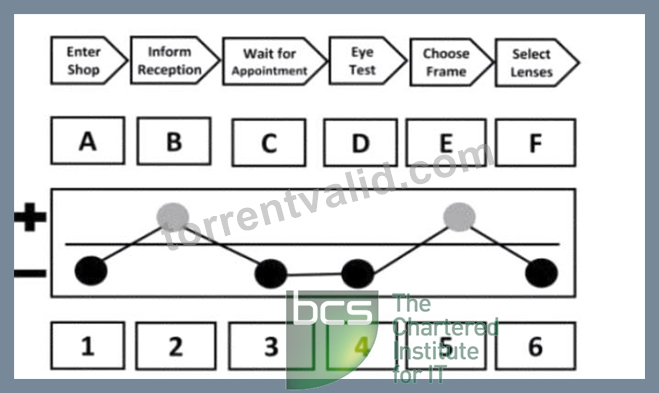
- A. F provide clearer information on options and pricing 6 concern at cost
- B. F pleased appointment ending 6 provide clearer information on options and pricing
- C. F concern at cost 6 provide clearer information on options and pricing
- D. F: worry about choosing the wrong frame 6: introduce virtual frame selection technology
Answer: C
Explanation:
Explanation
A customer journey map is a visual representation of the steps and emotions that a customer goes through when interacting with a product or service. It helps to identify the pain points and opportunities for improvement in the customer experience. A customer journey map typically consists of the following elements: stages, actions, thoughts, feelings, touchpoints and opportunities. Therefore, option A is the correct answer, as it matches the elements of the customer journey map for Box F and Box 6. Box F represents the feeling of the customer at the stage of choosing a frame. The feeling is concern at cost, as the customer is worried about the price of the frames and lenses. Box 6 represents the opportunity for improvement at the stage of selecting lenses. The opportunity is to provide clearer information on options and pricing, as this would help the customer to make an informed decision and reduce their anxiety. Option B is not a correct answer, as it does not match the elements of the customer journey map for Box F and Box 6. Box F represents the feeling of the customer, not an opportunity for improvement. Box 6 represents an opportunity for improvement, not a feeling of the customer. Option C is not a correct answer, as it does not match the elements of the customer journey map for Box F and Box 6. Box F represents the feeling of the customer, not an opportunity for improvement. Box 6 represents an opportunity for improvement, not a feeling of the customer.
Option D is not a correct answer, as it does not match the elements of the customer journey map for Box F and Box 6. Box F represents the feeling of the customer, not an opportunity for improvement. Box 6 represents an opportunity for improvement, not a feeling of the customer.
References: BCS Practitioner Certificate in BAP Specimen, page 23.
NEW QUESTION # 36
The directors of Swift Despatch believe they might be able to improve their service and reduce costs by opening a distribution centre in Coventry A team has been created to investigate this further, including representatives of logistics, property and marketing Yasmin has been asked to advise on how the Business Case should be progressed at this point.
What SHOULD she advise?
- A. Confirm with the directors the costs and benefits
- B. Create a high level Business Case
- C. It is too early to work on the Business Case
- D. Create a detailed Business Case
Answer: B
Explanation:
Explanation
A high level Business Case is a document that provides a preliminary rationale and justification for a proposed business change or solution. It helps to establish the feasibility and desirability of the project and secure initial approval and funding for further investigation and development. Therefore, option A is the correct answer, as creating a high level Business Case would be the best activity to undertake at this point for introducing a new procurement system. A high level Business Case would help to define the problem or opportunity that motivates the project, identify and compare different procurement solutions based on their expected benefits, costs, risks and impacts, and recommend the preferred option for further analysis and evaluation. A high level Business Case would provide a solid foundation for proceeding with the project and preparing a detailed Business Case later on. Option B is not a correct answer, as creating a detailed Business Case would not be an appropriate activity to undertake at this point for introducing a new procurement system. A detailed Business Case is a document that provides a comprehensive rationale and justification for a proposed business change or solution. It helps to confirm the viability and worthiness of the project and secure final approval and funding for implementation and delivery. A detailed Business Case would require conducting extensive research and analysis on the preferred procurement solution and presenting its definitive benefits, costs, risks and impacts. A detailed Business Case would be premature and unnecessary at this point, as it would depend on the outcome of the high level Business Case first. Option C is not a correct answer, as it is too early to work on the Business Case would not be an appropriate activity to undertake at this point for introducing a new procurement system. Working on the Business Case is an essential activity for any project that involves significant business change or investment. It helps to provide evidence and support for the project and ensure its alignment with the organisation's strategy and objectives. Working on the Business Case would not be too early at this point, as it would help to establish the feasibility and desirability of the project and secure initial approval and funding for further investigation and development. Option D is not a correct answer, as confirming with the directors the costs and benefits would not be an appropriate activity to undertake at this point for introducing a new procurement system. Confirming with the directors the costs and benefits would require preparing a high level Business Case first to estimate and compare the financial implications of different options and recommend the best one for further development and implementation. Confirming with the directors the costs and benefits without preparing a high level Business Case first would risk providing inaccurate or incomplete information that may not reflect the value or feasibility of the project.
References: BCS Practitioner Certificate in BAP Specimen, page 33.
NEW QUESTION # 37
Bluesky Travel is an independent travel agency specialising in luxury bespoke holidays, which is introducing a new booking process. So far, the following key changes have been made:
1) The new Commercial Off The Shelf (COTS) software package for making bookings has been installed and is working
2) Data is being migrated from the old computer system to the COTS software package
3) The IT department has documented the configuration of the COTS system
4) The legal department has confirmed that the new COTS system is compliant with company policies.
In taking a holistic approach, which of the following areas of the POPII Model have NOT yet been addressed by the changes identified?
- A. People and technology
- B. Organisation and process.
- C. Organisation and information.
- D. Process and people
Answer: B
Explanation:
Explanation
The elements of the POPII model that have not yet been addressed by the changes identified are organisation and process. This is because there is no mention of how the new booking process will affect the organisational structure, roles, responsibilities, and culture of the company, or how the new COTS software package will integrate with the existing business processes and workflows. These elements are important to consider when introducing a new system or technology, as they may require changes or adaptations to ensure alignment and compatibility. Option A is the correct answer.
References:
POPIT Model Business Analysis Technique - Knowledge Train
POPIT Model - GSU
NEW QUESTION # 38
......
BCS BAPv5 Exam Syllabus Topics:
| Topic | Details |
|---|---|
| Topic 1 |
|
| Topic 2 |
|
| Topic 3 |
|
| Topic 4 |
|
| Topic 5 |
|
| Topic 6 |
|
| Topic 7 |
|
Get BAPv5 Actual Free Exam Q&As to Prepare Certification: https://www.torrentvalid.com/BAPv5-valid-braindumps-torrent.html
BAPv5 100% Guarantee Download BAPv5 Exam PDF Q&A: https://drive.google.com/open?id=1HY93qfjUjiJtCtf_GwX3XeSJH1QRhpQm