


Pass Palo Alto Networks NetSec-Analyst Exam with Guarantee Updated 120 Questions
Latest NetSec-Analyst Pass Guaranteed Exam Dumps Certification Sample Questions
Palo Alto Networks NetSec-Analyst Exam Syllabus Topics:
| Topic | Details |
|---|---|
| Topic 1 |
|
| Topic 2 |
|
| Topic 3 |
|
| Topic 4 |
|
NEW QUESTION # 51
Which Security profile should be applied in order to protect against illegal code execution?
- A. Antivirus profile on denied traffic
- B. Antivirus profile on allowed traffic
- C. Vulnerability Protection profile on denied traffic
- D. Vulnerability Protection profile on allowed traffic
Answer: D
Explanation:
The Security profile that should be applied in order to protect against illegal code execution is the Vulnerability Protection profile on allowed traffic. The Vulnerability Protection profile defines the actions that the firewall takes to protect against exploits and vulnerabilities in applications and protocols. The firewall can block or alert on traffic that matches a specific threat signature or a group of threats. The Vulnerability Protection profile can prevent illegal code execution by detecting and blocking attempts to exploit buffer overflows, format string vulnerabilities, or other code injection techniques1. To apply the Vulnerability Protection profile on allowed traffic, you need to:
Create or modify a Vulnerability Protection profile on the firewall or Panorama and configure the rules and exceptions for the threats that you want to protect against2.
Attach the Vulnerability Protection profile to a Security policy rule that allows traffic that you want to scan for vulnerabilities3.
Commit the changes to the firewall or Panorama and the managed firewalls.
NEW QUESTION # 52
An analyst is troubleshooting a policy that is not matching traffic as expected. After reviewing the logs, the analyst sees that the traffic is matching a rule with a lower priority. Which feature allows the analyst to compare two rules side-by-side to identify the conflict?
- A. Policy Optimizer
- B. Config Audit
- C. ACC (Application Command Center)
- D. Rule Comparison
Answer: D
Explanation:
Comprehensive and Detailed 150 to 250 words of Explanation From Palo Alto Networks Network Security Analyst Knowledge:
The Rule Comparison tool (often found in Panorama or SCM) allows an analyst to select two specific security policies and see a highlighted, side-by-side view of their differences. This is an essential troubleshooting objective when dealing with large, complex rulebases where "shadowing" might occur.
By comparing the rules, the analyst can quickly see if one rule has a more broad source address or a different service object that is capturing traffic before it reaches the intended, more granular rule. Palo Alto Networks firewalls evaluate rules from the top down; therefore, understanding exactly where two rules diverge helps the analyst reorganize the policy set to ensure the most specific rules are at the top. This ensures the "Positive Enforcement Model" is maintained and that traffic is subjected to the intended security profiles and logging requirements.
NEW QUESTION # 53
In a Zero Trust environment, why is it recommended to use "User-ID" instead of just IP addresses in Security policy rules?
- A. IP addresses are dynamic and do not provide persistent identity in modern networks.
- B. Using User-ID reduces the CPU load on the Management Plane.
- C. To allow the firewall to perform hardware-level decryption.
- D. User-ID is required to enable the "application-default" service setting.
Answer: A
Explanation:
The transition from IP-based rules to identity-based rules is a cornerstone of the Network Security Analyst role. In modern environments--especially those with Wi-Fi, DHCP, and remote workers-- an IP address is a temporary identifier that can change multiple times a day. Relying solely on IPs makes it difficult to maintain accurate security audits and granular control.
By implementing User-ID, the analyst maps IP addresses to specific users and groups retrieved from an identity provider like Active Directory or Okta. This allows the analyst to write rules like
"Allow HR-Group to access HR-SaaS-App," which remains effective regardless of which IP address the HR employee is currently using. This provides persistent visibility and control, ensuring that security policies follow the user rather than the device. This is a critical objective for achieving a Zero Trust architecture, where identity is verified at every step of the communication process.
NEW QUESTION # 54
Selecting the option to revert firewall changes will replace what settings?
- A. the candidate configuration with settings from the running configuration
- B. the device state with settings from another configuration
- C. dynamic update scheduler settings
- D. the running configuration with settings from the candidate configuration
Answer: A
NEW QUESTION # 55
A large enterprise is implementing a new BYOD policy and needs to perform SSL Forward Proxy decryption on all user traffic for threat inspection. Due to the diverse nature of BYOD devices (Windows, macOS, Android, iOS), the IT team is concerned about certificate trust issues on user endpoints after deploying the firewall's Forward Trust certificate. Which of the following strategies best addresses the challenge of distributing and trusting the firewall's Forward Trust Certificate across this diverse BYOD landscape?
- A. Configuring the firewall to use a publicly trusted CA certificate for SSL Forward Proxy, eliminating the need for endpoint trust.
- B. Manually installing the Forward Trust Certificate on each BYOD device, which is scalable and ensures trust.
- C. Leveraging a Mobile Device Management (MDM) solution to push the Forward Trust Certificate as a trusted root CA to managed BYOD devices, combined with clear user instructions for unmanaged devices.
- D. Implementing Captive Portal authentication for BYOD users, where the certificate is automatically installed upon successful login.
- E. Excluding all BYOD traffic from SSL decryption to avoid certificate issues, relying solely on network-level protection.
Answer: C
Explanation:
For BYOD devices, manual certificate installation (A) is not scalable. Using a publicly trusted CA (B) for SSL Forward Proxy is not feasible as it implies the firewall's certificate itself would need to be signed by a public CA, which is not how Forward Proxy works. Captive Portal (D) typically handles authentication, not certificate distribution and trust. Excluding BYOD traffic (E) defeats the purpose of the security requirement. The most effective and scalable solution for diverse BYOD devices is to use an MDM solution (C) to centrally deploy the Forward Trust Certificate to managed devices. For unmanaged devices, providing clear, step-by-step instructions for manual installation is necessary, often coupled with policy disclaimers for using personal devices on the corporate network.
NEW QUESTION # 56
When using Strata Cloud Manager (SCM), which tool allows an analyst to automatically migrate local firewall configurations to a centralized management folder?
- A. Template Variable
- B. Policy Optimizer
- C. Strata Cloud Manager Transition
- D. Config Audit
Answer: C
Explanation:
The Strata Cloud Manager Transition tool is specifically designed to facilitate the migration of local, standalone firewall configurations into the SCM centralized management framework. This is a critical workflow for analysts moving toward a "unified management" model.
The tool analyzes the existing local configuration--including objects, policies, and network settings--and maps them to the appropriate Folders and Snippets within SCM. This ensures that the local "Source of Truth" is successfully shifted to the cloud management plane without losing granular security settings. During this process, the analyst can identify and resolve naming conflicts or redundant objects, cleaning up the configuration as it is centralized. Transitioning firewalls into SCM is a key objective as it unlocks AI-powered monitoring, centralized auditing, and simplified lifecycle management across the entire global estate.
NEW QUESTION # 57
According to a customer's CIO, who is upgrading PAN-OS versions, "Finding issues and then engaging with your support people requires expertise that our operations team can better utilize elsewhere on more valuable tasks for the business." The upgrade project was initiated in a rush because the company did not have the appropriate tools to indicate that their current NGFWs were reaching capacity.
Which two actions by the Palo Alto Networks team offer a long-term solution for the customer? (Choose two.)
- A. Propose AIOps Premium within Strata Cloud Manager (SCM) to address the company's issues from within the existing technology.
- B. Inform the CIO that the new enhanced security features they will gain from the PAN-OS upgrades will fix any future problems with upgrading and capacity.
- C. Suggest the inclusion of training into the proposal so that the operations team is informed and confident in working on their firewalls.
- D. Recommend that the operations team use the free machine learning-powered AIOps for NGFW tool.
Answer: A,C
Explanation:
The customer's CIO highlights two key pain points: (1) the operations team lacks expertise to efficiently manage PAN-OS upgrades and support interactions, diverting focus from valuable tasks, and (2) the company lacked tools to monitor NGFW capacity, leading to a rushed upgrade. The goal is to recommend long-term solutions leveraging Palo Alto Networks' offerings for Strata Hardware Firewalls. Options B and D-training and AIOps Premium within Strata Cloud Manager (SCM)- address these issues by enhancing team capability and providing proactive management tools. Below is a detailed explanation, verified against official documentation.
Step 1: Analyzing the Customer's Challenges
* Expertise Gap: The CIO notes that identifying issues and engaging support requires expertise the operations team doesn't fully have or can't prioritize. Upgrading PAN-OS on Strata NGFWs involves tasks like version compatibility checks, pre-upgrade validation, and troubleshooting, which demand familiarity with PAN-OS tools and processes.
* Capacity Visibility: The rushed upgrade stemmed from not knowing the NGFWs were nearing capacity (e.g., CPU, memory, session limits), indicating a lack of monitoring or predictive analytics.
Long-term solutions must address both operational efficiency and proactive capacity management, aligning with Palo Alto Networks' ecosystem for Strata firewalls.
Reference: PAN-OS Administrator's Guide (11.1) - Upgrade Overview
"Successful upgrades require planning, validation, and monitoring to avoid disruptions and ensure capacity is sufficient." Step 2: Evaluating the Recommended Actions Option A: Recommend that the operations team use the free machine learning-powered AIOps for NGFW tool.
Analysis: AIOps for NGFW (free version) is a cloud-based tool that uses machine learning to monitor firewall health, detect anomalies, and provide upgrade recommendations. It offers basic telemetry (e.g., CPU usage, session counts) and alerts, which could have flagged capacity issues earlier. However, it lacks advanced features like automated remediation, detailed capacity planning, or integration with Strata Cloud Manager, limiting its long-term impact. Additionally, it doesn't address the expertise gap, as the team still needs knowledge to interpret and act on insights.
Conclusion: Helpful but not a comprehensive long-term solution.
Reference: AIOps for NGFW Documentation
"The free version provides basic health monitoring and ML-driven insights but lacks premium features for proactive management." Option B: Suggest the inclusion of training into the proposal so that the operations team is informed and confident in working on their firewalls.
Analysis: Palo Alto Networks offers training through the Palo Alto Networks Authorized Training Partners and Cybersecurity Academy, covering PAN-OS administration, upgrades, and troubleshooting. For Strata NGFWs, courses like "Firewall Essentials: Configuration and Management (EDU-210)" teach upgrade best practices, capacity monitoring (e.g., via Device > High Availability > Resources), and support engagement.
How It Solves the Issue:
Reduces reliance on external expertise by upskilling the team.
Enables efficient upgrade planning (e.g., using Best Practice Assessment (BPA) tool).
Frees the team for higher-value tasks by minimizing support escalations.
Long-Term Benefit: A trained team can proactively manage upgrades and capacity, addressing the CIO's concern about expertise allocation.
Conclusion: A strong long-term solution.
Reference: Palo Alto Networks Training Catalog
"Training empowers operations teams to confidently manage NGFWs, including upgrades and capacity planning." Option C: Inform the CIO that the new enhanced security features they will gain from the PAN-OS upgrades will fix any future problems with upgrading and capacity.
Analysis: New PAN-OS versions (e.g., 11.1) bring features like enhanced App-ID, decryption, or ML- based threat detection, improving security. However, these don't inherently solve upgrade complexity or capacity visibility. Capacity issues depend on hardware limits (e.g., PA-5200 Series max sessions), not software features, and upgrades still require expertise. This response oversells benefits without addressing root causes.
Conclusion: Not a valid long-term solution.
Reference: PAN-OS 11.1 Release Notes
"New features enhance security but do not automate upgrade processes or capacity monitoring." Option D: Propose AIOps Premium within Strata Cloud Manager (SCM) to address the company's issues from within the existing technology.
Analysis: AIOps Premium, integrated with Strata Cloud Manager (SCM), is a subscription-based service for managing Strata NGFWs. It provides:
Predictive Analytics: Forecasts capacity needs (e.g., CPU, memory, sessions) using ML.
Upgrade Planning: Recommends optimal upgrade paths and validates configurations.
Proactive Alerts: Identifies issues before they escalate, reducing support calls.
Centralized Management: Monitors all firewalls from SCM, integrating with existing PAN-OS deployments.
How It Solves the Issue:
Prevents rushed upgrades by predicting capacity limits (e.g., via Capacity Saturation Reports).
Simplifies upgrade preparation with automated insights, reducing expertise demands.
Aligns with existing Strata technology, enhancing ROI.
Long-Term Benefit: Offers a scalable, proactive toolset to manage NGFWs, addressing both capacity and operational efficiency.
Conclusion: A robust long-term solution.
Reference: Strata Cloud Manager AIOps Premium Documentation
"AIOps Premium provides advanced capacity planning and upgrade readiness, minimizing operational burden." Step 3: Why B and D Are the Best Choices B (Training): Directly tackles the expertise gap, empowering the team to handle upgrades and capacity monitoring independently. It's a foundational fix, ensuring long-term self-sufficiency.
D (AIOps Premium in SCM): Provides a technological solution to preempt capacity issues and streamline upgrades, reducing the need for deep expertise and support escalations. It complements training by automating complex tasks.
Synergy: Together, they address both human (expertise) and systemic (tools) challenges, aligning with the CIO's goals of operational efficiency and business value.
Step 4: How These Actions Integrate with Strata NGFWs
Training: Teaches use of PAN-OS tools like System Resources (CLI: show system resources) and Dynamic Updates for capacity and upgrade prep.
AIOps Premium: Enhances Strata NGFW management via SCM, pulling telemetry (e.g., from Device > Setup > Telemetry) to predict and resolve issues.
Reference: PAN-OS Administrator's Guide (11.1) - Monitoring
"Combine training and tools like AIOps to optimize NGFW performance and upgrades."
NEW QUESTION # 58
What is the minimum timeframe that can be set on the firewall to check for new WildFire signatures?
- A. once every 24 hours
- B. every 30 minutes
- C. every 1 minute
- D. every 5 minutes
Answer: C
Explanation:
Because new WildFire signatures are now available every five minutes, it is a best practice to use this setting to ensure the firewall retrieves these signatures within a minute of availability.
NEW QUESTION # 59
An analyst needs to prevent users from downloading executable files from "High-Risk" URL categories while allowing them from "Business-and-Economy." Which profile should be configured to achieve this specific file-type restriction?
- A. Data Filtering Profile
- B. File Blocking Profile
- C. URL Filtering Profile
- D. Vulnerability Protection Profile
Answer: B
Explanation:
Comprehensive and Detailed 150 to 250 words of Explanation From Palo Alto Networks Network Security Analyst Knowledge:
The File Blocking Profile is the primary tool used by Palo Alto Networks firewalls to control the movement of specific file types across the network. While a URL Filtering Profile (Option A) can block access to a website based on its category, it does not have the granular ability to distinguish between a PDF download and an EXE download on that site.
To meet the requirement, the analyst creates a File Blocking Profile with rules that target the .exe file extension. The profile allows the analyst to set actions like alert, block, or continue based on the direction of the traffic (upload or download) and the application being used. By attaching this profile to a Security policy rule, the firewall uses Content-ID to look deep into the payload-beyond just the file extension-to identify the true file type. This prevents users from bypassing security by simply renaming a malicious .exe file to .txt.
This is a core objective for ensuring that sanctioned web browsing does not become a vector for malware delivery.
NEW QUESTION # 60
DNS rewrite can only be configured on a NAT rule with which type of destination address translation?
- A. Dynamic IP and Port (DIPP)
- B. Dynamic IP
- C. Dynamic IP (with session distribution)
- D. Static IP
Answer: D
Explanation:
Comprehensive and Detailed 150 to 250 words of Explanation From Palo Alto Networks Network Security Analyst Knowledge:
In Palo Alto Networks PAN-OS, the DNS rewrite feature (often referred to as DNS Doctoring) is specifically designed to solve the issue of split-horizon DNS in environments where internal users must access an internal server using its public IP address. This occurs when the DNS server returns the public IP address of a server to an internal client, but the client and server are on the same or related internal networks.
The firewall can only perform a DNS rewrite when a Static IP destination NAT rule is in place. When this option is enabled, the firewall monitors DNS responses passing through it. If a DNS response contains an IP address that matches the "Original Destination" IP in a static NAT rule, the firewall rewrites the DNS payload to the "Translated Destination" IP (the private IP of the server).
This functionality is restricted to Static IP translation because it requires a 1-to-1, predictable mapping between the public and private addresses. Dynamic translation types (A, B, and D) involve pools of addresses or port-overloading, which makes it impossible for the firewall to determine which specific internal IP address should be written into the DNS response at any given time. By ensuring a static mapping, the Network Security Analyst guarantees that internal clients receive the correct internal IP address to reach their destination without hair-pinning traffic unnecessarily through the public interface.
NEW QUESTION # 61
With Strata Cloud Manager (SCM) or Panorama, customers can monitor and manage which three solutions?
(Choose three.)
- A. Prisma SD-WAN
- B. Prisma Cloud
- C. Prisma Access
- D. Cortex XSIAM
- E. NGFW
Answer: A,C,E
Explanation:
* Prisma Access (Answer A):
* Strata Cloud Manager (SCM) and Panorama provide centralized visibility and management for Prisma Access, Palo Alto Networks' cloud-delivered security platform for remote users and branch offices.
* NGFW (Answer D):
* Both SCM and Panorama are used to manage and monitor Palo Alto Networks Next- Generation Firewalls (NGFWs) deployed in on-premise, hybrid, or multi-cloud environments.
* Prisma SD-WAN (Answer E):
* SCM and Panorama integrate with Prisma SD-WAN to manage branch connectivity and security, ensuring seamless operation in an SD-WAN environment.
* Why Not B:
* Prisma Cloud is a distinct platform designed for cloud-native security and is not directly managed through Strata Cloud Manager or Panorama.
* Why Not C:
* Cortex XSIAM (Extended Security Intelligence and Automation Management) is part of the Cortex platform and is not managed by SCM or Panorama.
References from Palo Alto Networks Documentation:
* Strata Cloud Manager Overview
* Panorama Features and Benefits
NEW QUESTION # 62
Actions can be set for which two items in a URL filtering security profile? (Choose two.)
- A. PAN-DB URL Categories
- B. Custom URL Categories
- C. Allow List
- D. Block List
Answer: C,D
Explanation:
https://docs.paloaltonetworks.com/pan-os/8-1/pan-os-admin/url-filtering/url-filtering-concepts/url-filtering-profile-actions
NEW QUESTION # 63
Selecting the option to revert firewall changes will replace what settings?
- A. Dynamic update scheduler settings
- B. The candidate configuration with settings from the running configuration
- C. The device state with settings from another configuration
- D. The running configuration with settings from the candidate configuration
Answer: D
NEW QUESTION # 64
In a Zero Trust environment, why is it recommended to use "User-ID" instead of just IP addresses in Security policy rules?
- A. IP addresses are dynamic and do not provide persistent identity in modern networks.
- B. Using User-ID reduces the CPU load on the Management Plane.
- C. To allow the firewall to perform hardware-level decryption.
- D. User-ID is required to enable the "application-default" service setting.
Answer: A
Explanation:
Comprehensive and Detailed 150 to 250 words of Explanation From Palo Alto Networks Network Security Analyst Knowledge:
The transition from IP-based rules to identity-based rules is a cornerstone of the Network Security Analyst role. In modern environments-especially those with Wi-Fi, DHCP, and remote workers-an IP address is a temporary identifier that can change multiple times a day. Relying solely on IPs makes it difficult to maintain accurate security audits and granular control.
By implementing User-ID, the analyst maps IP addresses to specific users and groups retrieved from an identity provider like Active Directory or Okta. This allows the analyst to write rules like "Allow HR-Group to access HR-SaaS-App," which remains effective regardless of which IP address the HR employee is currently using. This provides persistent visibility and control, ensuring that security policies follow the user rather than the device. This is a critical objective for achieving a Zero Trust architecture, where identity is verified at every step of the communication process.
NEW QUESTION # 65
Given the screenshot, what are two correct statements about the logged traffic? (Choose two.)
- A. The traffic was denied by URL filtering.
- B. The web session was decrypted.
- C. The web session was unsuccessfully decrypted.
- D. The traffic was denied by security profile.
Answer: B
NEW QUESTION # 66
What are two differences between an implicit dependency and an explicit dependency in App-ID? (Choose two.)
- A. An implicit dependency requires the dependent application to be added in the security policy
- B. An explicit dependency does not require the dependent application to be added in the security policy
- C. An explicit dependency requires the dependent application to be added in the security policy
- D. An implicit dependency does not require the dependent application to be added in the security policy
Answer: C,D
NEW QUESTION # 67
A security analyst observes unusual outbound DNS queries for newly registered domains (NRDs) originating from several internal workstations, followed by attempts to establish C2 communication on non-standard ports. This behavior is indicative of a sophisticated malware infection. Which combination of Palo Alto Networks profiles and configurations, applied to outbound security policies, would be most effective in detecting and preventing this type of multi-stage attack?
- A. DNS Security Profile (Sinkhole & Block NRD category), Anti-Spyware Profile (DNS Signatures), and WildFire Analysis Profile for all unknown executables.
- B. Custom Application Signature for non-standard C2 ports, User-ID for affected users, and a Port-Based Security Policy blocking all non-standard ports.
- C. URL Filtering Profile (Block 'newly-registered-domain' category), Antivirus Profile (Heuristics), and a custom 'File Blocking' profile for all executables.
- D. Vulnerability Protection Profile (Critical severity, Block), Data Filtering Profile (Predefined PII), and QOS profile for suspicious traffic.
- E. DNS Security Profile (Sinkhole unknown domains, enable DNS signatures), Anti-Spyware Profile (Enable DNS Sinkhole, signatures for C2), WildFire Analysis (all file types), and a Security Policy with application 'ping' and 'web-browsing' explicitly denied on outbound.
Answer: A
Explanation:
Option A directly addresses the described attack stages. 'DNS Security Profile' with 'Sinkhole' and 'Block NRD category' will detect and prevent resolution of newly registered malicious domains. The 'Anti-Spyware Profile' is crucial for detecting C2 traffic based on signatures, including DNS-based C2. 'WildFire Analysis Profile' is essential for identifying and blocking unknown malicious executables that might initiate this behavior. This combination offers a multi-layered defense against both the initial DNS stage and subsequent C2 attempts.
NEW QUESTION # 68
Which rule type is appropriate for matching traffic occurring within a specified zone?
- A. Universal
- B. Intrazone
- C. Interzone
- D. Shadowed
Answer: B
NEW QUESTION # 69
An organization is migrating its on-premise Panorama to a cloud-based architecture and wants to ensure seamless log collection and analysis for its global network of Palo Alto Networks firewalls. They are considering Strata Logging Service. What are the key benefits of using Strata Logging Service over solely relying on Panorama's built-in log collectors for this scenario, specifically concerning scalability and data retention?
- A. Strata Logging Service provides dynamic log scaling based on ingest rate and offers flexible data retention policies, offloading storage and compute from Panorama.
- B. Strata Logging Service only stores traffic logs, while Panorama stores all log types, making Panorama superior for comprehensive analysis.
- C. There is no significant difference; both provide similar capabilities for log collection and retention in a cloud environment.
- D. Panorama's built-in log collectors are always more cost-effective and scalable for cloud deployments.
- E. Strata Logging Service offers unlimited log retention and requires less administrative overhead than managing Panorama log collectors.
Answer: A
Explanation:
Strata Logging Service is a cloud-native logging solution designed for massive scalability and elastic storage. It dynamically adjusts to varying log volumes and provides configurable data retention policies, significantly reducing the administrative burden and infrastructure costs associated with managing on-premise or cloud-hosted Panorama log collectors, which have fixed capacities and require manual scaling. Strata Logging Service collects all log types from Palo Alto Networks devices, not just traffic logs.
NEW QUESTION # 70
The firewall sends employees an application block page when they try to access Youtube.
Which Security policy rule is blocking the youtube application?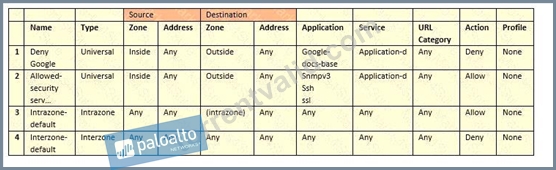
- A. allowed-security services
- B. intrazone-default
- C. Deny Google
- D. interzone-default
Answer: D
NEW QUESTION # 71
......
New NetSec-Analyst Test Materials & Valid NetSec-Analyst Test Engine: https://www.torrentvalid.com/NetSec-Analyst-valid-braindumps-torrent.html
NetSec-Analyst Updated Exam Dumps [2026] Practice Valid Exam Dumps Question: https://drive.google.com/open?id=1LQSpYaZc3RixLkT9Q2jRz8l2jImTam1p