


Latest C_SEC_2405 Pass Guaranteed Exam Dumps Certification Sample Questions
New C_SEC_2405 Test Materials & Valid C_SEC_2405 Test Engine
NEW QUESTION # 48
When performing a comparison from the imparting role, what happens to the organizational level field values in the derived role? Note: There are 2 correct answers to this question.
- A. Data for organizational levels that have already been maintained in the derived role is NOT overwritten.
- B. Data for organizational levels is transferred only when authorization data for the derived role is first modified.
- C. Data for organizational levels is always transferred when authorization data for the derived role is modified.
- D. Data for organizational levels that have already been maintained in the derived role is overwritten.
Answer: A,B
NEW QUESTION # 49
To connect to data sources that are NOT all based on OData, which of the following options does SAP recommend you use?
- A. SAP Integration Suite
- B. SAP Process Integration
- C. OData Provisioning service
- D. Cloud connector
Answer: A
Explanation:
For connecting to data sources that are not exclusively based on OData, SAP recommends using the SAP Integration Suite. This comprehensive platform supports a wide range of integration scenarios, including OData, REST, SOAP, and other protocols, making it ideal for connecting diverse data sources, whether on- premise or cloud-based. The SAP Integration Suite provides tools for data mapping, transformation, and orchestration, ensuring seamless and secure data exchange across heterogeneous systems. In contrast, the OData Provisioning service is specifically designed for OData-based integrations, limiting its applicability to non-OData sources. The Cloud connector facilitates secure connectivity between SAP BTP and on-premise systems but is not a complete integration solution. SAP Process Integration, while used for integration in older SAP landscapes, lacks the flexibility and cloud-native capabilities of the SAP Integration Suite. By leveraging the SAP Integration Suite, organizations can achieve robust, scalable, and secure integrations, aligning with SAP's modern integration strategy for complex, multi-protocol environments.
NEW QUESTION # 50
In which order do you define the security-relevant objects in SAP BTP?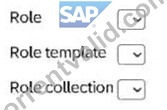
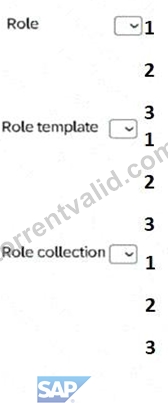
Answer:
Explanation: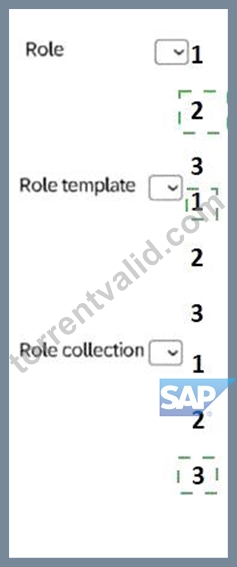
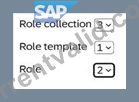
NEW QUESTION # 51
In SAP HANA Cloud, who has access to a database object?
- A. The user SYSTEM and the creator
- B. The user DBADMIN and the group owner
- C. The owner and the SAP-owned users
- D. The creator and the schema owner
Answer: D
NEW QUESTION # 52
To connect to data sources that are NOT all based on OData, which of the following options does SAP recommend you use?
- A. SAP Integration Suite
- B. SAP Process Integration
- C. OData Provisioning service
- D. Cloud connector
Answer: A
NEW QUESTION # 53
For which of the following can transformation variables be used?
- A. To save data permanently
- B. To save data temporarily
- C. To save data to the output JSON file
Answer: B
Explanation:
In SAP Cloud Identity Services, transformation variables are used to save data temporarily during data transformation processes. These variables act as placeholders to store intermediate values, such as user attributes or calculated fields, while processing data between source and target systems in identity provisioning. Temporary storage enables complex transformations, like mapping or reformatting data, without affecting the final output until the transformation is complete. Transformation variables are not used to save data to the output JSON file, as this is handled by the transformation rules' final output configuration.
Similarly, they do not save data permanently, as their scope is limited to the transformation process, and permanent storage would occur in the target system's repository. By using transformation variables for temporary data storage, SAP Cloud Identity Services ensures flexible and efficient data handling, supporting seamless integration and customization of identity data flows while maintaining security and accuracy in provisioning processes.
NEW QUESTION # 54
What is required to centrally administer a user's master record using Central User Administration? Note:
There are 3correct answers to this question.
- A. An existing master record in the target client for the user
- B. An RFC destination to the target system
- C. An ALE distribution model
- D. An entry in transaction BD54 for the child system
- E. An RFC destination to the target client
Answer: B,C,D
Explanation:
* Context:Central User Administration (CUA) centralizes user management across SAP systems.
* Solution Explanation:
* A:RFC destination to the target system is required for communication.
* D:ALE distribution model ensures correct data distribution.
* E:Transaction BD54 maintains logical system entries for child systems.
SAP Security References:
* SAP CUA Configuration Guide
* SAP Help Portal for RFC and ALE Integration
NEW QUESTION # 55
After you maintained authorization object S_TABU_DIS and ACTVT field value 02 as authorization defaults for transaction SM30 in your development system, what would be the correct option for transporting only these changes to your quality assurance system?
- A. Save tables USOBT_C and USOBX_C to a transport request and transport using the Transport Management System.
- B. Save your changes and use the transport interface in SU25 to transport the changes using the Transport Management System.
- C. Save your changes to a Workbench transport request and transport using the Transport Management System.
- D. Save your changes to a Customizing transport request and transport using the Transport Management System.
Answer: C
Explanation:
When you maintain authorization defaults (e.g., adding authorization object S_TABU_DIS with ACTVT value 02 for transaction SM30) and need to transport these changes:
* Changes are Cross-Client and Repository-Based:
* Authorization default changes in SU24 are considered cross-client because they affect all clients in the system.
* These changes are part of the SAP repository and are treated as Workbench requests.
* Save Changes to a Workbench Transport Request:
* Upon saving changes in SU24, the system prompts you to assign them to a transport request.
* Select or create aWorkbench transport requestto capture the changes.
* Use the Transport Management System (TMS):
* Use TMS to transport the Workbench request from the development system to the quality assurance system.
* This ensures that the authorization defaults are consistently applied across systems.
Why Other Options Are Incorrect:
* Option B:Customizing transport requests are client-specific and not suitable for cross-client repository changes.
* Option C:Manually transporting tables USOBT_C and USOBX_C is not recommended and can lead to inconsistencies.
* Option D:SU25 is used for post-upgrade authorization adjustments, not for transporting SU24 changes.
SAP Security References:
* SAP Help Portal:Transporting Authorization Data Changes
* SAP Documentation:Using Workbench Requests for Cross-Client Objects
* SAP Note:Best Practices for Transporting SU24 Authorization Defaults
NEW QUESTION # 56
Which levels of security protection are provided by Secure Network Communication (SNC)? Note: There are
3correct answers to this question.
- A. Privacy
- B. Authorization
- C. Availability
- D. Authentication
- E. Integrity
Answer: A,D,E
NEW QUESTION # 57
What authorization object can be used to authorize an administrator to create specific authorizations in roles?
- A. S_USER_AUT
- B. S_USER_VAL
- C. S_USER_AGR
- D. S_USER_TCD
Answer: A
Explanation:
TheS_USER_AUTauthorization object allows administrators to create or modify specific authorizations within roles. This ensures granular control over what authorizations an administrator can define, maintaining adherence to security policies.
Key Fields in S_USER_AUT:
* ACTVT (Activity):Determines if the administrator can create, change, or display authorizations.
* AUTH (Authorization):Specifies the exact authorizations that can be created or modified.
SAP Security References:
* SAP Help Portal: Authorization Object S_USER_AUT Overview
* SAP Note on Role and Authorization Management
NEW QUESTION # 58
Which tool can you use to modify the entities schema content across multiple repositories?
- A. SAP Cloud Identity Services Transformation Editor
- B. SAP BTP Account Explorer
- C. SAP Business Application Studio
- D. SAP Cloud Identity Services Schemas app
Answer: D
Explanation:
The SAP Cloud Identity Services Schemas app is the tool used to modify entities schema content across multiple repositories in SAP's identity management framework. This app provides a centralized interface for defining and managing schema attributes, such as user or group properties, ensuring consistency across different identity repositories. Administrators can use it to customize schemas to meet specific organizational needs, supporting integration with various SAP and non-SAP systems. The SAP BTP Account Explorer is used for managing accounts and subaccounts, not schema modifications. The SAP Cloud Identity Services Transformation Editor focuses on data transformations during provisioning, not schema management. SAP Business Application Studio is a development environment for building applications, not for managing identity schemas. The Schemas app's ability to handle schema content across repositories ensures unified identity data structures, enhancing interoperability and security in SAP Cloud Identity Services, making it the ideal tool for this purpose.
NEW QUESTION # 59
What can be assigned directly to a user when using the SAP Launchpad service in SAP BTP?
- A. Spaces
- B. Catalogs
- C. Role collections
- D. Launchpad roles
Answer: C
Explanation:
In the SAP Launchpad service within SAP Business Technology Platform (BTP), Role collections can be assigned directly to a user. Role collections are groups of roles that define access to specific applications, services, or functionalities within the Launchpad, allowing administrators to grant users the necessary permissions to access content, such as Fiori apps or custom applications. By assigning role collections directly to users in the SAP BTP subaccount, administrators ensure that users have the appropriate access rights tailored to their responsibilities. Spaces, which organize apps in the Launchpad, and Catalogs, which group apps and tiles, are assigned to roles or role collections, not directly to users. Launchpad roles are not a distinct entity in SAP BTP; roles are part of role collections. This direct assignment of role collections simplifies access management, ensuring secure and efficient user access to the SAP Launchpad service while aligning with SAP BTP's security and authorization framework.
NEW QUESTION # 60
In the administration console of the Cloud Identity Services, for which system type can you define both read and write transformations?
- A. Proxy systems
- B. Source systems
- C. Target systems
Answer: C
NEW QUESTION # 61
When you maintain authorizations for SAPUI5 Fiori apps, which of the following object types is the front-end authorization object type?
- A. TADIR IWSG - SAP Gateway: Service Groups Metadata
- B. TADIR G4BA-SAP Gateway Odata V4 Backend Service Group & Assignments
- C. TADIR INA1 InA Service
- D. TADIR IWSV - SAP Gateway Business Suite Enablement-Service
Answer: D
Explanation:
* Context:SAPUI5 Fiori apps require front-end authorizations managed via OData services.
* Solution Explanation:
* IWSV:Represents the service object type for SAP Gateway Business Suite Enablement.
SAP Security References:
* SAP Gateway Authorization Documentation
* SAP Fiori Authorization Maintenance Guide
NEW QUESTION # 62
In the administration console of the Cloud Identity Services, which authentication providers are available? Note: There are 2 correct answers to this question.
- A. Successfactors
- B. Concur
- C. FieldGlass
- D. Ariba
Answer: A,D
NEW QUESTION # 63
Which tool can you use to modify the entities schema content across multiple repositories?
- A. SAP Cloud Identity Services Transformation Editor
- B. SAP BTP Account Explorer
- C. SAP Business Application Studio
- D. SAP Cloud Identity Services Schemas app
Answer: D
Explanation:
* Context:Modifying entities schema content across multiple repositories is crucial for customizing identity services.
* Solution Description:
* TheSchemas appin SAP Cloud Identity Services is specifically designed for managing schema content.
SAP Security References:
* SAP Cloud Identity Services Documentation
* SAP Schemas App User Guide
NEW QUESTION # 64
Under which of the following conditions can you merge authorizations for the same object during role maintenance? Note: There are 2 correct answers to this question.
- A. The maintenance status of the changed authorizations must match the status of a manual authorization.
- B. The activation status of a manual authorization must match the status of the changed authorizations.
- C. The activation status and the maintenance status of the authorizations must NOT match.
- D. The activation status and the maintenance status of the authorizations must match.
Answer: B,D
Explanation:
During role maintenance in SAP systems, merging authorizations for the same object is possible under specific conditions to streamline role management. The activation status of a manual authorization must match the status of the changed authorizations, ensuring consistency in how authorizations are applied within the role. Additionally, both the activation status and the maintenance status of the authorizations must align, meaning that the authorizations being merged should be in the same state (e.g., active or inactive) and maintenance phase (e.g., standard or changed). These conditions prevent conflicts and ensure that merged authorizations function correctly within the role, maintaining security and compliance. Mismatches in status or non-alignment of maintenance states can lead to errors or unintended access restrictions.
NEW QUESTION # 65
Which authorization objects can be used to restrict access to SAP Enterprise Search models in the SAP Fiori launchpad? Note: There are 2 correct answers to this question.
- A. S_ESH_CONN
- B. SDDLVIEW
- C. S_ESH_ADM
- D. RSDDLTIP
Answer: A,C
NEW QUESTION # 66
......
SAP C_SEC_2405 Exam Syllabus Topics:
| Topic | Details |
|---|---|
| Topic 1 |
|
| Topic 2 |
|
| Topic 3 |
|
| Topic 4 |
|
| Topic 5 |
|
C_SEC_2405 Sample with Accurate & Updated Questions: https://www.torrentvalid.com/C_SEC_2405-valid-braindumps-torrent.html
C_SEC_2405 Updated Exam Dumps [2026] Practice Valid Exam Dumps Question: https://drive.google.com/open?id=1jMgfnVk1aW20lS_4uvbQDQf75EMWzSI4