


Free Aug-2023 UPDATED Adobe AD0-E718 Certification Exam Dumps is Online
Adobe Exam 2023 AD0-E718 Dumps Updated Questions
Adobe AD0-E718 exam is one of the most sought-after certification exams for professionals who want to enhance their skills in the field of Adobe Commerce. AD0-E718 exam is designed for individuals who have experience in Adobe Commerce and want to become a master in this field. AD0-E718 exam validates the knowledge and skills of candidates in designing and implementing Adobe Commerce solutions.
Adobe AD0-E718 certification exam is designed to test the knowledge and skills of professionals who work with Adobe Commerce. Adobe Commerce is an all-in-one platform that enables businesses to create, manage, and optimize their online stores. AD0-E718 exam is primarily aimed at architects who design and implement Adobe Commerce solutions for clients. AD0-E718 exam covers a wide range of topics, including architecture and design, deployment, customization, integration, and optimization.
NEW QUESTION # 22
An Adobe Commerce Architect is asked by a merchant using B2B features to help with a configuration issue.
The Architect creates a test Company Account and wants to create Approval Rules for orders. The Approval Rules tab does not appear in the Company section in the Customer Account Menu when the Architect logs in using the Company Administrator account.
Which two steps must be taken to fix this issue? (Choose two.)
- A. Set Enable Purchase Orders' on the Company Record to TRUE
- B. Make sure that the 'Purchase Order' payment method is active
- C. Set 'Enable B2B Quote" in the B2B Admin to TRUE
- D. Set 'Enable Purchase Orders' in the B2B Admin to TRUE
- E. Merchant needs to log out of frontend and then log back in to load new permissions
Answer: A,D
Explanation:
Enabling Purchase Orders at both the B2B Admin and the Company Record levels is necessary for Approval Rules to appear in the Company section of the Customer Account Menu. When 'Enable Purchase Orders' is set to TRUE, the system assumes that the company will be making purchases using purchase orders, and the Approval Rules tab becomes visible.
To create Approval Rules for orders, the Architect needs to enable Purchase Orders both in the B2B Admin and on the Company Record. This will allow the Company Administrator to access the Approval Rules tab in the Customer Account Menu and create rules based on various criteria. The Purchase Order payment method and the B2B Quote feature are not required for this functionality. Reference: https://docs.magento.com/user-guide/customers/account-dashboard-approval-rules.html
NEW QUESTION # 23
An Adobe Commerce Architect designs a data flow that contains a new product type with its own custom pricing logic to meet a merchant requirement.
Which three developments are valid when reviewing the implementation? (Choose three.)
- A. Custom type model extended from the abstract Product Type model
- B. Hydrator for attributes belonging to the new product type
- C. Content of the etc/product_types.xml file
- D. Data patch to register the new product type
- E. New price model extending \Magento\Catalog\Model\Product\Type\Price
- F. A new class with custom pricing logic, extending the abstract Product model class
Answer: A,C,E
Explanation:
Explanation
According to some tutorials45, creating a custom product type in Adobe Commerce involves several steps, such as:
* Creating a product_types.xml file in etc folder to declare the new product type
* Creating a custom type model that extends from an abstract product type model
* Creating a custom price model that extends from an abstract price model
* Creating a layout file for the new product type
* Creating a data patch to register the new product type
Based on these steps, I would say that three possible developments that are valid when reviewing the implementation are:
* A. Content of the etc/product_types.xml file
* C. Custom type model extended from the abstract Product Type model
* F. New price model extending \Magento\Catalog\Model\Product\Type\Price These developments would allow creating a new product type with its own custom pricing logic and attributes.
NEW QUESTION # 24
An Adobe Commerce Architect needs to scope a bespoke news section for a merchant's Adobe Commerce storefront. The merchant's SEO agency requests that the following URL structure:
news/{date}/{article_url_key}l where {date} is the publication date of the article, and {article_url_key} is the URL key of the article.
The Architect scopes that a news entity type will be created. The date and URL key data will be stored against each record and autogenerated on save. The values will be able to be manually overridden.
The Architect needs to manage routing this functionality and adhere to best practice.
Which two options should the Architect consider to meet these requirements? (Choose two.)
- A. Create a custom router that runs before the standard router and matches the news portion of the URL. then looks for and loads a news article by matching the date and URL key parts of the URL.
- B. Create a standard controller route and an Index/Index index controller class that loads the relevant news article by matching the URL date and URL key parts.
- C. Create a plugin that intercepts lu^jentoXFraBeworkUppXActien::executed, looks for the news portion of the URL and if it matches, loads the relevant news article by matching the URL date and URL key parts.
- D. Create a standard controller route and mapping the internal URLs (such as news/article/view/id/1) to rewrites that are generated on save and then stored in the URL rewrites table.
- E. Create an observer that listens to the controllers_front_send_response_before event, looks for the mm portion of the URL, and If it matches, loads the relevant news article by matching the URL date and URL key parts.
Answer: A,B
Explanation:
To manage routing this functionality and adhere to best practice, you need to consider the following options:
Create a standard controller route and an Index/Index index controller class that loads the relevant news article by matching the URL date and URL key parts. This option will create a simple and straightforward way to handle the news requests using the standard Magento routing mechanism. The Index/Index controller class will receive the date and URL key parameters from the request and use them to load the news article model from the database.
Create a custom router that runs before the standard router and matches the news portion of the URL, then looks for and loads a news article by matching the date and URL key parts of the URL. This option will create a more flexible and customizable way to handle the news requests using a custom router class that implements \Magento\Framework\App\RouterInterface. The custom router class will check if the request path starts with news, then extract the date and URL key parts from the path and use them to load the news article model from the database.
Reference:
https://belvg.com/blog/how-to-create-custom-router-in-magento-2.html
https://devdocs.magento.com/guides/v2.4/extension-dev-guide/routing.html
NEW QUESTION # 25
While reviewing a newly developed pull request that refactors multiple custom payment methods, the Architect notices multiple classes that depend on \Magento\Framework\Encryption\EncryptorInterf ace to decrypt credentials for sensitive dat a. The code that is commonly repeated is as follows: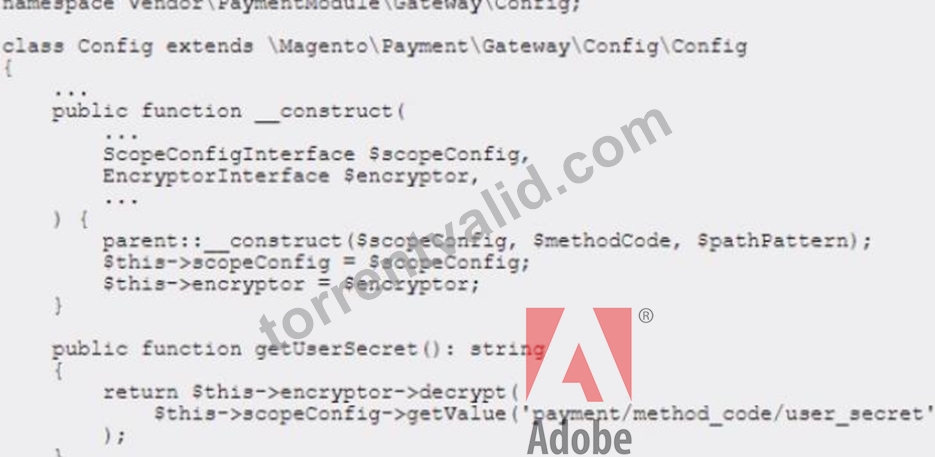
In each module, the user_secret config is declared as follows:
The Architect needs to recommend an optimal solution to avoid redundant dependency and duplicate code among the methods. Which solution should the Architect recommend?
- A. Add a plugin after the getvalue method of $sccpeConfig, remove the $encryptor from dependency and use it in the plugin to decrypt the value if the config name is 'user.secret?
- B. Replace all Vendor\PaymentModule\Gateway\Config\Config Classes With virtualTyp- Of Magento\Payxer.t\Gateway\Conflg\Config and Set <user_secret backend_Model="Magento\Config\Model\Config\Backend\Encrypted" /> under ccnfig.xml
- C. Create a common config service class vendor\Payment\Gateway\config\Config under Vendor.Payment and use it as a parent class for all of the Vender \EaymentModule\Gateway\Config\Config Classes and remove $sccpeConfig and $encryptor dependencies
Answer: B
Explanation:
To avoid redundant dependency and duplicate code among the methods, the Architect should recommend replacing all Vendor\PaymentModule\Gateway\Config\Config classes with virtualType of Magento\Payment\Gateway\Config\Config and setting <user_secret backend_model="Magento\Config\Model\Config\Backend\Encrypted" /> under config.xml. This will allow using the core config class that already has the scopeConfig dependency and the logic to get the value from the config. The backend_model attribute will ensure that the user_secret value is encrypted and decrypted automatically by the core EncryptorInterface class. Option B is incorrect because it will add unnecessary complexity and overhead to the scopeConfig object. Option C is incorrect because it will still require creating a custom config service class and injecting the encryptor dependency. Reference: https://devdocs.magento.com/guides/v2.4/payments-integrations/base-integration/integration-intro.html https://devdocs.magento.com/guides/v2.4/config-guide/prod/config-reference-encryptor.html
NEW QUESTION # 26
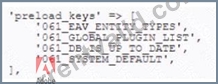
An Architect is configuring the preload.keys for Redis on an Adobe Commerce on-premise instance.
The Architect discovers that the following cache keys are loaded on each frontend request: eav_entity_types, GLOBAL_PLUGIN_LIST, DB_IS_UP_TO_DATE , SYSTEM_DEFAULT.
* The id_prefix of the frontend =>page_cache is set to 061_.
* The id_prefix of frontend => default: is not set.
* The Architect has enabled and configured Redis L2 caching.
How should the preload.keys be configured?
- A.
- B.
- C.
- D.
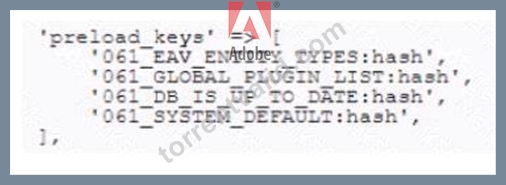
Answer: A
NEW QUESTION # 27
A representative of a small business needs an Adobe Commerce Architect to design a custom integration of a third-party payment solution. They want to reduce the list of controls identified in their Self-Assessment Questionnaire as much as possible to achieve PCI compliance for their existing Magento application.
Which approach meets the business needs?
- A. Utilize the payment provider Iframe system to isolate content of the embedded frame from the parent web page.
- B. Utilize the Advanced Encryption standard (AES-256) algorithm to encrypt all customer-sensitive data from the payment module.
- C. Utilize a trusted signed certificate issued by a Certification Authority (CA) to secure each connection made by the payment solution protocol via HTTPS.
Answer: C
Explanation:
Explanation
The best approach to meet the business needs is to utilize a trusted signed certificate issued by a Certification Authority (CA) to secure each connection made by the payment solution protocol via HTTPS. This will ensure that the data exchanged between the application, the payment provider, and the customer is all encrypted and secure. Additionally, this approach will help to reduce the list of controls identified in the Self-Assessment Questionnaire, as it is a secure and approved method of protecting customer data.
NEW QUESTION # 28
An Adobe Commerce Architect needs to create a new customer segment condition to enable admins to specify an 'Average sales amount' condition for certain segments.
The Architect develops the custom condition under
vendor\Module\Model\Segment\condition\AverageSalesAmount with all of its requirements: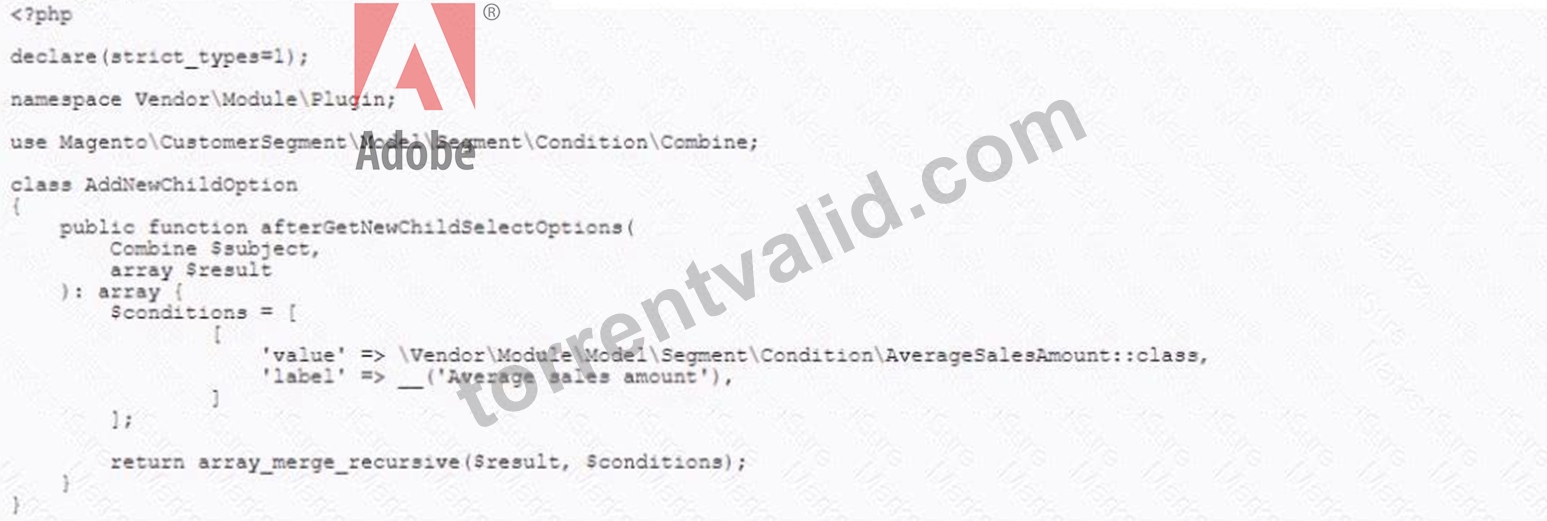
During testing, the following error appears:
Which two steps should the Architect complete to fix the problem? (Choose two.)
- A.

- B.

- C.

- D.

- E.

Answer: A,C
NEW QUESTION # 29
An Architect wants to create an Integration Test that does the following:
* Adds a product using a data fixture
* Executes $this->someLogic->execute($product) on the product
* Checks if the result is true.
Sthis->someLogic has the correct object assigned in the setup () method-Product creation and the tested logic must be executed in the context of two different store views with IDs of 3 and 4, which have been created and are available for the test.
How should the Architect meet these requirements?
- A. Create one test class with two test methods. Use the @magentoStoreContext 3 annotation in one method and @magentoStoreContext 4 in the other one.
- B. Create two test Classes With one test method each. Use the @magentoExecuteInStoreContext 3 and
@magentoExecuteInStoreContext 4 annotations on the class level. - C. Create one test class with one test method. Use the \Magento\testFramework\ store\Executionstorecontext class once in the fixture and another time in the test.
Answer: B
Explanation:
Explanation
The best approach for the Architect to meet the requirements is Option B. Create two test Classes With one test method each. Use the @magentoExecuteInStoreContext 3 and @magentoExecuteInStoreContext 4 annotations on the class level. This will ensure that the fixture is executed in the context of Store View 3, and the tested logic is executed in the context of Store View 4. This approach allows for more granular control of the store views and reduces the complexity of the test.
NEW QUESTION # 30
An Architect is working to implement Adobe Commerce into a pre-built ecosystem in a company.
Communication between different company domains uses event-driven design and is driven via AMQP protocol with using RabbitMQ.
The Architect needs to establish the data flow between the ERP system and Adobe Commerce.
The ERP system stores only customer data excluding customer addresses.
The role of Adobe Commerce is to provide Customer Address data to the enterprise ecosystem.
Primary Customer data should not be changed from Adobe Commerce side; it should only be updated by messages data from ERP.
Which three AMQP configurations should be considered to meet these requirements? (Choose three.)
- A. Create a queue_topology.xml configuration file for Customer Address messages
- B. Create a queue_topology.xml configuration file for Customer data messages
- C. Create a queue_publisher.xml configuration file for Customer data messages
- D. Create a queue_customer.xml and communication.xml configuration files for Customer Address messages
- E. Create a nueue_publisher.xml configuration file for Customer Address messages
- F. Create a queue_consumer.xml and communction.xml configuration files for Customer data messages
Answer: B,E,F
Explanation:
To establish the data flow between the ERP system and Adobe Commerce using AMQP protocol with RabbitMQ, you need to consider the following AMQP configurations:
Create a queue_consumer.xml and communication.xml configuration files for Customer data messages. These files will define the topics, handlers, and consumers that will receive and process the messages from the ERP system. The communication.xml file will also specify the schema for the Customer data messages.
Create a queue_publisher.xml configuration file for Customer Address messages. This file will define the exchange where the Customer Address messages will be published to. The exchange will route the messages to the appropriate queues based on the binding rules.
Create a queue_topology.xml configuration file for Customer Address messages. This file will define the message routing rules and declare the queues and exchanges for the Customer Address messages. The queue_topology.xml file will also specify the connection name and type for RabbitMQ.
Reference:
1: https://devdocs.magento.com/guides/v2.3/extension-dev-guide/message-queues/config-mq.html
NEW QUESTION # 31
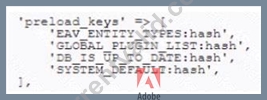
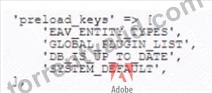
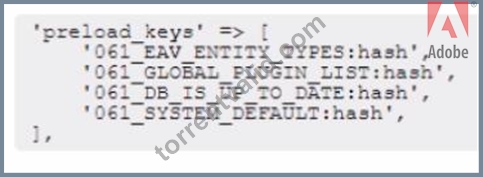
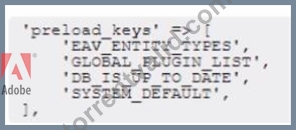
An Architect is configuring the preload.keys for Redis on an Adobe Commerce on-premise instance.
The Architect discovers that the following cache keys are loaded on each frontend request: eav_entity_types, GLOBAL_PLUGIN_LIST, DB_IS_UP_TO_DATE , SYSTEM_DEFAULT.
* The id_prefix of the frontend =>page_cache is set to 061_.
* The id_prefix of frontend => default: is not set.
* The Architect has enabled and configured Redis L2 caching.
How should the preload.keys be configured?
- A.
- B.
- C.
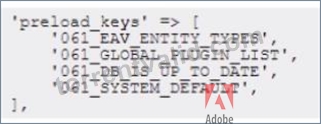
- D.
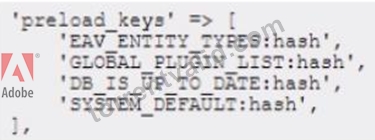
Answer: C
Explanation:
The preload.keys should be configured as shown in Option D. This is because the preload feature allows Redis to load data that is reused between pages, such as eav_entity_types, GLOBAL_PLUGIN_LIST, DB_IS_UP_TO_DATE , SYSTEM_DEFAULT. The preload keys should include the id_prefix of the cache backend and the suffix ':hash' to indicate the hashed data version. See Use Redis for default cache in the Adobe Commerce Developer Guide1. Reference: https://devdocs.magento.com/guides/v2.3/config-guide/redis/redis-pg-cache.html1
NEW QUESTION # 32
A merchant is using a unified website that supports native Adobe Commerce B2B and B2C with a single store view.
The merchant wants to show the B2B account features like negotiable quotes and credit limits in the header of the site on every page for the logged-in users who are part of a B2B company account.
Each B2B company has its own individual shared catalog and customer group, and many customer groups for non B2B customers change. The merchant requests that this should not be tied to customer groups.
Which two solutions should the Architect recommend considering public data and caching? (Choose two.)
- A. Create a plugin that switches the theme when a user is part of a B2B company so the output can be modified accordingly in the alternate theme.
- B. Create a new custom condition for customer segments that allow for choosing whether a user is part of a B2B company and then use this segment to modify the output accordingly.
- C. Check if the current user is part of a B2B company within a block class and modify the output accordingly.
- D. Set whether the current user is part of a B2B company in the customer session and use that data directly to modify the output accordingly.
- E. Create a new HTTP Context variable to allow for separate public content to be cached for users in B2B companies where the output can be modified accordingly.
Answer: B,E
Explanation:
C would involve creating a new custom condition for customer segments that allow for choosing if a user is part of a B2B company, and then use this segment to modify the output accordingly. E would involve creating a new HTTP Context variable to allow for separate public content to be cached for users in B2B companies, where the output can be modified accordingly.
To show the B2B account features in the header of the site on every page for the logged-in users who are part of a B2B company account, the Architect should recommend two solutions: C) Create a new custom condition for customer segments that allow for choosing whether a user is part of a B2B company and then use this segment to modify the output accordingly. This solution will allow the merchant to create a customer segment based on the custom condition and use it to display different content in the header for B2B users. E) Create a new HTTP Context variable to allow for separate public content to be cached for users in B2B companies where the output can be modified accordingly. This solution will ensure that the public content cache is varied based on the custom HTTP Context variable, which can be set based on whether the user is part of a B2B company or not. Option A is incorrect because switching the theme based on the user's B2B status is not a scalable or maintainable solution, and it will also affect the entire site's appearance, not just the header. Option B is incorrect because checking the user's B2B status within a block class will not work with public content cache, as it will not vary the cache based on that condition. Option D is incorrect because setting the user's B2B status in the customer session will not work with public content cache, as it will not vary the cache based on that data. Reference: https://devdocs.magento.com/guides/v2.4/extension-dev-guide/segmentation.html https://devdocs.magento.com/guides/v2.4/extension-dev-guide/cache/page-caching/public-content.html
NEW QUESTION # 33
A developer needs to uninstall two custom modules as well as the database data and schemas. The developer uses the following command:
bin/magento module:uninstall Vendor_SampleMinimal Vendor_SampleModifyContent When the command is run from CLI, the developer fails to remove the database schema and data defined in the module Uninstall class.
Which three requirements should the Architect recommend be checked to troubleshoot this issue? (Choose three.)
- A. bin/magento maintenance: enable command should be run in CLI before
- B. Invoke uninstallData() and uninstallSchema () are defined in the Uninstall class
- C. --remove-data option is specified as an argument for the CLI command
- D. invoked uninstall () method is implemented in the Uninstall class
- E. remove-schema and --remove-data options are specified as arguments for the CLI command
- F. composer.json file is present and defines the module as a composer package
Answer: B,D,E
Explanation:
Explanation
To troubleshoot the issue, the Architect should check that the remove-schema and --remove-data options are specified as arguments for the CLI command, that the Uninstall class defines the uninstallData() and uninstallSchema() methods, and that the invoked uninstall() method is implemented in the Uninstall class.
NEW QUESTION # 34
Due to a marketing campaign, a website is experiencing a very large number of simultaneously placed orders, which is affecting checkout performance. The website is in the production deploy mode.
Which two website settings can an Architect optimize to decrease the impact on checkout performance? (Choose two.)
- A. Multithreaded checkout processing admin panel setting (stores > s ettmgs > Configuration > Sales > Checkout > General Settings > Asynchronous) can be set to a higher value representing the number of PHP threads used exclusively for checkout
- B. Asynchronous indexing admin panel Setting (Stores > Settings > Ccr.f iguraticr. > Advanced > developer > Grid Settings > Asynchronous indexing) can be enabled by executing the following CLI command: tm/magento config:set dev/grid/async_ini*xmg 1
- C. A new database can be created and the Split Database feature can be automatically configured with the following command: bin/Magento setup:db-schema:split-sales-sales --host=''<checkout db host or ip>" -dbname="<name>" -username""<checkout db username>'' -password=" <password>"
- D. Asynchronous email notifications admin panel Setting (stores > Settings > Configuration > Sales > Sales Emails > General Settings > Asynchronous) can be enabled
- E. The website deploy mode can be set to si-g- by executing the following CLI command: bin/magento deploy:mode:set siege. Provided that it will be changed back to production as soon as the number of simultaneously placed orders decreases to acceptable levels
Answer: B,C
Explanation:
Asynchronous indexing allows Magento to process indexers in the background without affecting the storefront performance. Splitting the database allows Magento to use a separate database for checkout-related tables, which reduces the load on the main database and improves checkout performance. Reference: https://devdocs.magento.com/guides/v2.4/extension-dev-guide/indexing.html#asynchronous-indexing https://devdocs.magento.com/guides/v2.4/config-guide/multi-master/multi-master.html To decrease the impact on checkout performance, the Architect should do two things:
Enable asynchronous indexing admin panel setting. This will allow Magento to update indexes using cron jobs instead of doing it on the fly during checkout. This option can be found under Stores > Settings > Configuration > Advanced > Developer > Grid Settings > Asynchronous indexing. It can also be enabled by executing the following CLI command: bin/magento config:set dev/grid/async_indexing 1 Create a new database and use the Split Database feature. This will allow Magento to separate the sales data from the main database and reduce the load on the database server. This option can be configured with the following command: bin/magento setup:db-schema:split-sales --host='<checkout db host or ip>' --dbname='<name>' --username='<checkout db username>' --password='<password>' Reference:
https://devdocs.magento.com/guides/v2.4/extension-dev-guide/indexing.html#m2devgde-asynchronous-indexing
https://devdocs.magento.com/guides/v2.4/config-guide/multi-master/multi-master.html
NEW QUESTION # 35
An Architect needs to review a custom product feed export module that a developer created for a merchant.
During final testing before the solution is deployed, the product feed output is verified as correct. All unit and integration tests for code pass.
However, once the solution is deployed to production, the product price values in the feed are incorrect for several products. The products with incorrect data are all currently part of a content staging campaign where their prices have been reduced.
What did the developer do incorrectly that caused the feed output to be incorrect for products in the content staging campaign?
- A. The developer forgot to use the getContentStagingValue() method to retrieve the active campaign value of the product data
- B. The developer did not check for an active content staging campaign and emulates the campaign state when retrieving product data.
- C. The developer retrieved product data directly from the database using the entity_id column rather than a collection or repository.
Answer: A
Explanation:
Explanation
According to the Adobe Commerce documentation, when retrieving product data, developers must use the getContentStagingValue() method to ensure that the active campaign value for theproduct is retrieved. This method takes into account any content staging campaigns that might be active, and returns the appropriate value from the content staging campaign rather than the default value from the database. Failing to use this method can result in incorrect data being returned in the product feed.
NEW QUESTION # 36
An Adobe Commerce Architect is reviewing api-functional test code. Some tests send errors to indicate that the customer address does not exist.
The test codes show the following:
Which steps should the Architect take to fix the test errors?
A)
B)
C)
- A. Option B
- B. Option A
- C. Option C
Answer: A
Explanation:
The test errors are caused by using the wrong customer ID and address ID in the request. The correct customer ID and address ID should be obtained from the response of the previous request to create a customer and an address. The test code should use $this->customer->getId() and $this->address->getId() instead of hard-coded values. Reference: https://devdocs.magento.com/guides/v2.4/get-started/web-api-functional-testing.html
NEW QUESTION # 37
An Adobe Commerce Architect needs to set up two websites on a single Adobe Commerce instance with base URLs: example.com and website2.example.com.
How should the Architect configure this project so that both websites can use the same customer base?
- A. Set Cookie Domain for both websites to ".example.com"
- B. Change Session Cookie attribute to "SameSite=None"
- C. Disable Session Validation for "HTTP_X_FORWARDED_FOR" header
Answer: A
Explanation:
Explanation
By setting the same cookie domain for both websites, the customer base can be shared between both websites, as the customer will be authenticated by the same cookie across both sites. This will ensure that customers don't have to log in twice when switching between the two sites.
NEW QUESTION # 38
......
Adobe AD0-E718 certification exam is a computer-based test that consists of 60 multiple-choice questions. AD0-E718 exam duration is 120 minutes, and the passing score is 64%. AD0-E718 exam questions are designed to test the candidate's knowledge in Adobe Commerce Cloud architecture, including its features, functionality, and integration with other systems.
Adobe Certified AD0-E718 Dumps Questions Valid AD0-E718 Materials: https://www.torrentvalid.com/AD0-E718-valid-braindumps-torrent.html
Get The Most Updated AD0-E718 Dumps To Adobe Commerce Certification: https://drive.google.com/open?id=1w3oOBMSm5iVtTaS7uJat-VGoPKNJvkoS